
DW in text means “Don’t Worry.” It is a casual abbreviation used in texting and online messaging to reassure someone, reduce concern, or signal that everything is fine.
If you have ever received a message that simply says “dw”, you may have paused for a second wondering what it meant. Texting language moves quickly, and short abbreviations often replace full phrases. Among the most common reassurance acronyms is DW.
Because digital conversations are fast and informal, people frequently shorten everyday expressions. As a result, “don’t worry” becomes dw in just two letters. In this guide, you will learn exactly what DW means in text, how and when to use it, tone variations, comparisons with similar abbreviations, and common mistakes to avoid.
What Does DW Mean in Text?
In texting and online chats, DW stands for “Don’t Worry.”
It is typically used to:
- Reassure someone
- Calm concerns
- Downplay a situation
- Show that something is not a big deal
Although it is short, DW carries a clear emotional message. In most cases, it signals comfort and reassurance.
Where Did DW Come From?
Text abbreviations became popular in the early days of:
- SMS messaging
- Online chat rooms
- Instant messaging platforms
- Social media
Since texting originally had character limits, users began shortening common phrases. Over time, abbreviations like LOL, BRB, and DW became widely accepted in casual digital communication.
Today, DW appears frequently in:
- Text messages
- WhatsApp chats
- Instagram DMs
- Snapchat messages
- Online gaming chats
Because it is short and easy to type, it remains popular across generations.
How DW Is Used in Conversations
DW is typically placed at the beginning or end of a sentence. However, it can also stand alone.
1. As a Standalone Reply
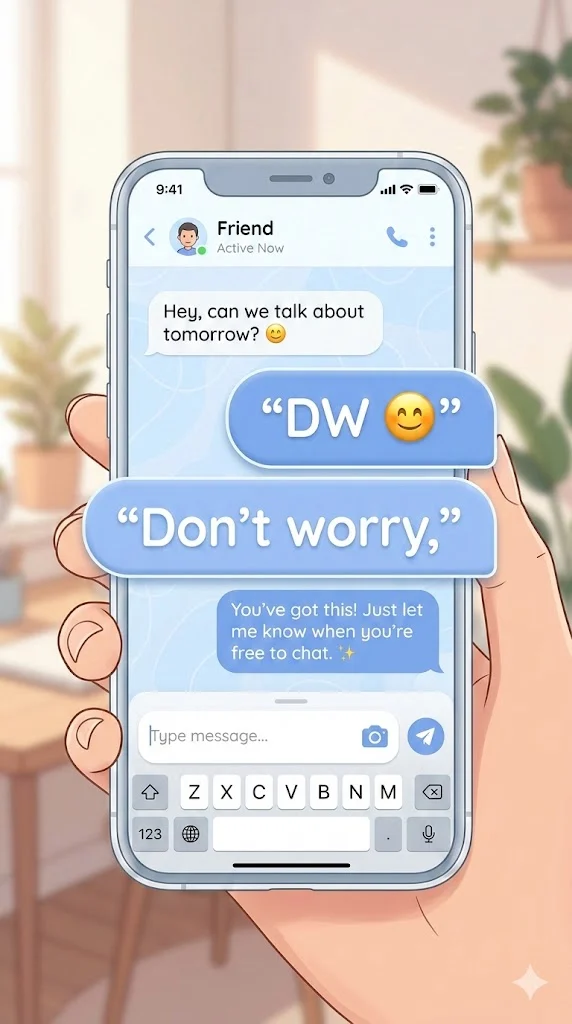
Friend: “Sorry I’m late.”
You: “DW 😊”
In this case, DW quickly communicates forgiveness or reassurance.
2. At the Beginning of a Sentence
“DW, I already handled it.”
“DW, everything is fine.”
Here, DW immediately sets a calming tone.
3. At the End of a Sentence
“It’s all sorted now, dw.”
“I’ll take care of it, dw.”
In this position, DW softens the message.
Tone and Emotional Meaning of DW
While DW usually sounds friendly, tone depends on context.
Friendly and Warm 😊
“DW, it happens to everyone.”
This feels supportive and kind.
Casual and Neutral
“DW about it.”
This is relaxed and informal.
Slightly Dismissive 😐
“DW.”
When used alone without context, it can sometimes sound abrupt.
Therefore, adding context or an emoji can make it feel warmer.
Example Table: DW in Different Contexts
| Situation | Message | Tone |
|---|---|---|
| Friend apologizes | “DW, no problem at all.” | Friendly |
| Work chat | “DW, I’ll fix the file.” | Neutral |
| Minor mistake | “It’s fine dw.” | Casual |
| Short reply only | “DW.” | Can feel brief or blunt |
Because tone is harder to read in text, small additions like “it’s okay” or a smile emoji often improve clarity.
DW vs Similar Text Abbreviations
Although DW means “Don’t Worry,” other abbreviations carry similar meanings. Understanding the differences helps you choose the right one.
Comparison Table
| Abbreviation | Meaning | Tone |
|---|---|---|
| DW | Don’t worry | Reassuring |
| NBD | No big deal | Casual |
| NP | No problem | Friendly |
| IDC | I don’t care | Often dismissive |
| It’s fine | Everything is okay | Neutral to reassuring |
For example:
- “DW” focuses on calming someone.
- “NBD” emphasizes that something is minor.
- “NP” responds to thanks or apologies politely.
While they overlap slightly, each carries a different emotional nuance.
When to Use DW
Using DW works best in informal conversations. For example, it fits naturally in chats with friends, siblings, or close colleagues.
Appropriate situations include:
- Responding to apologies
- Reassuring someone who feels guilty
- Downplaying a small issue
- Comforting someone briefly
However, DW may not be suitable in very formal communication.
When Not to Use DW
In professional emails or formal writing, spelling out the full phrase is usually better.
Instead of:
“DW about the report.”
Write:
“Please don’t worry about the report.”
Additionally, in serious emotional situations, a full sentence feels more supportive than just “dw.”
For example, if someone shares bad news, responding only with “dw” may seem insensitive. In those cases, a longer message shows empathy.
Common Variations of DW
Sometimes, people expand or modify DW slightly.
Examples include:
- Dw 😊
- Dw about it
- Dwwww in playful texting
- Don’t worry lol
Even so, the core meaning remains the same.
Alternate Meanings of DW
Although DW usually means “Don’t Worry” in texting, it can have other meanings in different contexts.
For example:
- DW may refer to “Dear Wife” in online forums.
- DW can stand for a brand or name in specific industries.
However, in everyday texting, it almost always means “Don’t Worry.”
Polite and Professional Alternatives to DW
If you want to sound more polished, consider these alternatives:
- Please don’t worry.
- There is no need to worry.
- It’s completely fine.
- I’ve taken care of it.
- No problem at all.
These options are especially useful in workplace communication.
Common Mistakes with DW
Although DW is simple, there are still small errors to avoid.
Using It in Serious Situations
If someone is genuinely upset, writing only “dw” can feel dismissive. Adding context improves tone.
Instead of:
“dw.”
Try:
“Don’t worry, we’ll figure it out together.”
Using It in Formal Settings
In job applications, academic writing, or official emails, avoid abbreviations like DW.
Professional communication generally requires full words.
Frequently Asked Questions
1. What does DW mean in text?
DW stands for “Don’t Worry.”
2. Is DW rude?
No, it is usually reassuring. However, it can sound abrupt if used alone.
3. Is DW formal or informal?
It is informal and best used in casual conversations.
4. Can DW be used at work?
It can be used in casual workplace chats, but not in formal emails.
5. What is the difference between DW and NBD?
DW reassures someone. NBD emphasizes that something is minor.
6. Can DW mean something else?
In other contexts, it may have different meanings, but in texting it almost always means “Don’t Worry.”
7. Should DW be capitalized?
It can be written as DW or dw. Both are common in texting.
8. Is DW still popular?
Yes. It remains widely used in texting and social media.
Conclusion
So, what does DW mean in text? In simple terms, it stands for “Don’t Worry.” It is a short, informal way to reassure someone and reduce concern in digital conversations.
To recap:
- DW is commonly used in texting and messaging apps
- It expresses reassurance and calm
- Tone depends on context
- It works best in casual communication
- In formal situations, full phrases are better
Understanding abbreviations like DW helps you communicate clearly and confidently in modern digital conversations.
Discover More Post
What Does Proximal Mean in Anatomy? Clear Definition and …
What Does Excluded Mean in PowerSchool – DefineHubs.com –