
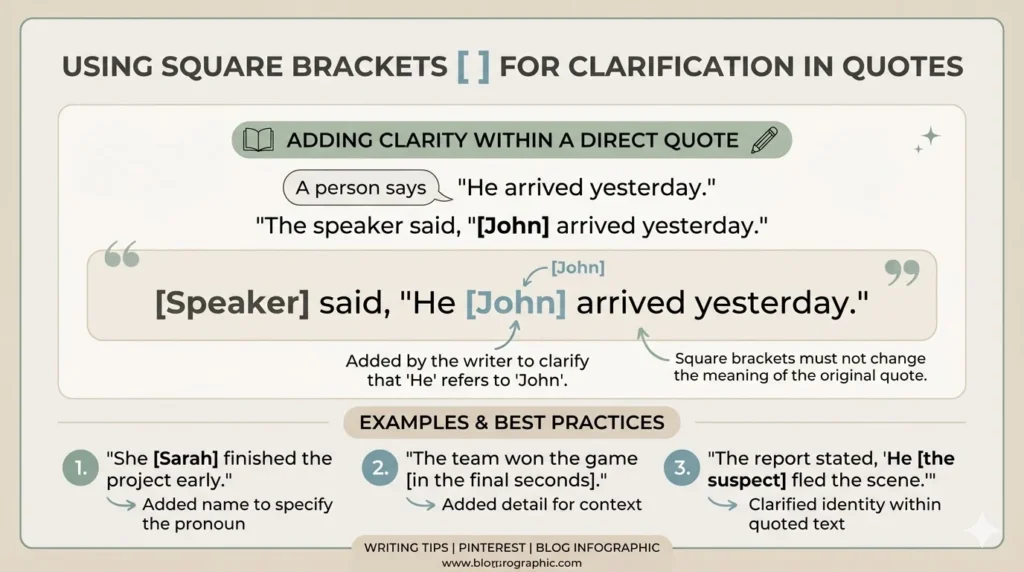

Brackets in a quote are used to add, clarify, or modify words within a quoted passage without changing the original meaning. They help provide context, correct grammar, or insert explanations while clearly showing that the added text is not part of the original quote.
When reading articles, essays, or even social media posts, you might notice square brackets appearing inside quoted text. At first, they can seem confusing or even out of place. However, brackets serve an important purpose in writing, especially when quoting someone accurately while still making the text clear and understandable.
Understanding what brackets mean in a quote can improve your reading comprehension and writing skills. In this guide, you will learn exactly how brackets work, why writers use them, and how to use them correctly in your own writing.
What Do Brackets Mean in a Quote?
In writing, brackets are square punctuation marks used inside a quote to show added or changed words.
Writers use brackets to:
- Add missing context
- Clarify meaning
- Adjust grammar or tense
- Insert explanations
Importantly, brackets signal to the reader that the content inside them was not part of the original quote.
Why Brackets Are Used in Quotes
Quoting someone word for word is important. However, sometimes the original wording does not fully make sense in a new sentence or context. This is where brackets become useful.
For example, a quote might include pronouns or references that are unclear on their own. In such cases, brackets help clarify meaning without misrepresenting the original speaker.
As a result, brackets allow writers to stay accurate while improving readability.
Common Uses of Brackets in Quotes
Brackets are used in several specific ways. Each serves a different purpose, but all help maintain clarity and accuracy.
1. Adding Clarification
One of the most common uses of brackets is to explain who or what is being referred to.
Example:
- Original quote: “He was late again.”
- Revised with brackets: “He [John] was late again.”
Here, the writer adds the name to make the sentence clearer for readers.
2. Changing Pronouns or Verb Forms
Sometimes a quote needs slight grammatical adjustment to fit smoothly into a sentence.
Example:
- Original: “I am happy with the results.”
- Integrated: She said that she “[was] happy with the results.”
In this case, the verb tense changes to match the surrounding sentence.
3. Adding Missing Words
Writers may insert small words to make a quote grammatically correct in its new context.
Example:
- Original: “Is going to the meeting.”
- With brackets: “She [is] going to the meeting.”
This ensures the sentence reads properly while keeping the meaning intact.
4. Indicating Changes in Capitalization
Brackets can also show when the first letter of a quote has been changed.
Example:
- Original: “the project was successful.”
- In a sentence: “[T]he project was successful.”
This helps the quote fit grammatically into the new sentence.
5. Adding Explanations or Notes
In academic or formal writing, brackets may include brief explanations.
Example:
- “The results were inconclusive [due to limited data].”
This gives readers extra context without altering the original message.
Examples of Brackets in Quotes
Below is a table showing different types of bracket usage.
Brackets in Quotes Examples Table
| Purpose | Original Quote | With Brackets |
|---|---|---|
| Clarification | “She won the award.” | “She [Maria] won the award.” |
| Grammar Change | “I am ready.” | He said he “[was] ready.” |
| Added Word | “Going to the store.” | “I [am] going to the store.” |
| Capitalization | “this is important.” | “[T]his is important.” |
| Explanation | “The event failed.” | “The event failed [due to weather].” |
Tone and Meaning When Using Brackets
Brackets usually maintain a neutral and informative tone. However, the way they are used can slightly influence how a quote feels.
Neutral Tone
- “He [the manager] approved the request.”
This simply adds clarity.
Helpful Tone
- “She was late [because of traffic].”
This provides useful context.
Slightly Interpretive Tone
- “They failed [unexpectedly].”
Here, the added word introduces interpretation, so it should be used carefully.
In general, writers should avoid adding opinions inside brackets unless clearly necessary.
Brackets vs Other Punctuation in Quotes
Brackets are often confused with other punctuation marks. Understanding the differences can help avoid mistakes.
Comparison Table
| Punctuation | Purpose |
|---|---|
| Brackets [ ] | Add or modify words in a quote |
| Parentheses ( ) | Add extra information outside quotes |
| Ellipsis … | Show omitted words |
| Quotation Marks “ ” | Indicate spoken or written words |
Example Comparison
- Brackets: “He [John] arrived late.”
- Parentheses: He arrived late (according to the report).
- Ellipsis: “He arrived … after the meeting started.”
Each has a distinct role, and mixing them up can confuse readers.
When Not to Use Brackets
Although brackets are useful, they should not be overused.
Avoid using brackets when:
- The original quote already makes sense
- The addition changes the original meaning
- You are inserting personal opinions unnecessarily
Instead, keep bracket use minimal and purposeful.
Alternate Meanings of Brackets
Outside of quoting, brackets can have different meanings depending on context.
For example:
- In mathematics, brackets group numbers or operations
- In programming, they define arrays or code structures
- In general writing, they may add side notes or clarifications
However, in quotes, their role is very specific and focused on clarity.
Polite and Professional Alternatives to Using Brackets
Sometimes, instead of modifying a quote with brackets, you can rephrase your sentence.
Examples:
Instead of:
- “He [the CEO] approved the plan.”
You could write:
- The CEO said, “He approved the plan.”
Or:
- According to the CEO, the plan was approved.
This approach can feel smoother in formal writing.
Tips for Using Brackets Correctly
To use brackets effectively, keep these tips in mind:
- Always ensure the original meaning remains unchanged
- Use brackets sparingly
- Keep additions short and clear
- Avoid inserting opinions
- Double check grammar after inserting brackets
By following these guidelines, your writing will stay accurate and professional.
Frequently Asked Questions
1. What do brackets mean in a quote?
Brackets show that words have been added or changed inside a quote for clarity or grammar.
2. Are brackets part of the original quote?
No. They indicate that the writer has added or modified the text.
3. Why do writers use brackets?
They use brackets to clarify meaning, fix grammar, or add context.
4. Can brackets change the meaning of a quote?
They should not. Brackets must preserve the original meaning.
5. What is the difference between brackets and parentheses?
Brackets modify quoted text, while parentheses add extra information outside quotes.
6. Can brackets be used in casual writing?
Yes, but they are more common in formal or academic writing.
7. What do brackets with ellipses mean?
They show that part of the quote has been removed and possibly clarified.
8. Is it okay to add explanations in brackets?
Yes, as long as the explanation is accurate and does not distort the meaning.
Conclusion
So, what do brackets mean in a quote? Simply put, they are tools that help writers add clarity, adjust grammar, and provide context without changing the original message.
To recap:
- Brackets show added or modified text
- They improve clarity and readability
- They must not alter the original meaning
- They are commonly used in academic and professional writing
- They should be used carefully and sparingly
Once you understand how brackets work, reading and writing quotes becomes much easier. More importantly, you will be able to present information clearly while staying true to the original source.
Discover More Post
What Does Churn Mean in Business? Definition, Types, and …
What Does Momo Mean in Japanese? Meaning, Usage and …
What Does FTM Mean in Text? Meaning, Examples, and …