
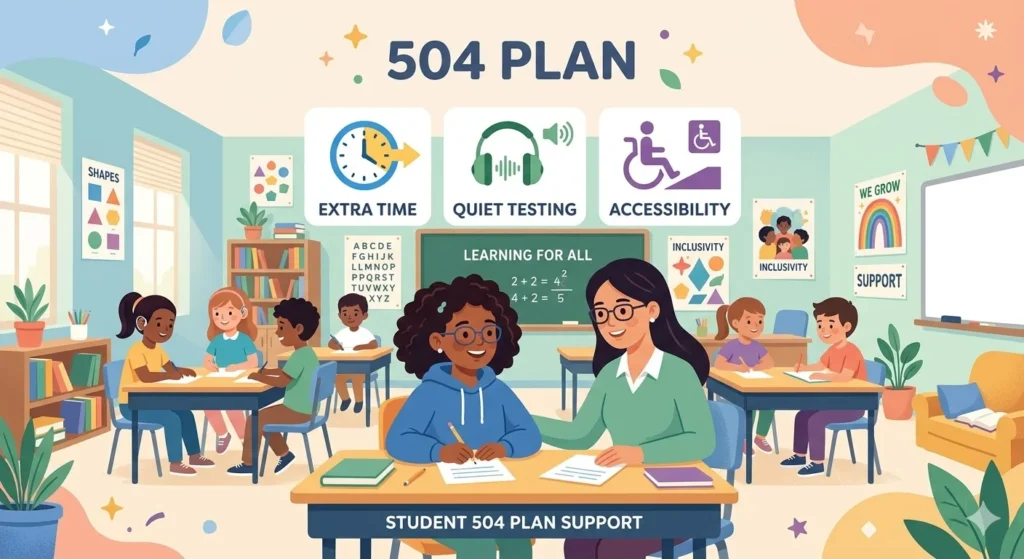

A 504 plan in school is a formal plan developed under Section 504 of the Rehabilitation Act that provides accommodations and support to students with disabilities so they can learn in a general education setting alongside their peers.
If you have ever heard a teacher, counselor, or parent mention a “504,” you might have wondered what it actually means. Although the term sounds technical, it plays a very important role in helping students succeed in school.
In simple terms, a 504 plan ensures that students with physical or mental challenges receive the support they need without changing the core curriculum. As a result, these students can participate fully in classroom activities, tests, and school life.
This guide explains what a 504 means in school, how it works, who qualifies, and how it compares to other support systems like IEPs. By the end, you will have a clear understanding of how 504 plans help students thrive.
What Does 504 Mean in School?
In education, 504 refers to Section 504 of the Rehabilitation Act of 1973, a civil rights law in the United States.
This law protects students with disabilities from discrimination and requires schools to provide equal access to education.
Therefore, a 504 plan is created to:
- Remove barriers to learning
- Provide classroom accommodations
- Ensure equal participation in school activities
Unlike some special education programs, a 504 plan focuses on access and fairness, not changing what a student is expected to learn.
What Is a 504 Plan?
A 504 plan is a written document that outlines specific accommodations a student needs in school.
These accommodations help level the playing field so the student can succeed in a regular classroom environment.
Key Features of a 504 Plan
- Designed for students with disabilities
- Applies in general education settings
- Focuses on access, not curriculum changes
- Created by a school team, often including parents
- Reviewed and updated as needed
Because every student is different, each 504 plan is personalized.
Who Qualifies for a 504 Plan?
To qualify for a 504 plan, a student must have a disability that substantially limits one or more major life activities.
These activities can include:
- Learning
- Reading
- Writing
- Concentrating
- Walking
- Seeing
- Hearing
Common Conditions That May Qualify
Students with many different conditions can receive a 504 plan. For example:
- ADHD
- Anxiety or depression
- Diabetes
- Asthma
- Autism (in some cases)
- Physical injuries
- Learning difficulties that do not require special education
However, eligibility depends on how much the condition affects the student’s ability to function in school.
Common Accommodations in a 504 Plan
A 504 plan does not change what a student learns. Instead, it changes how they access learning.
Examples of 504 Accommodations
- Extra time on tests and assignments
- Preferential seating
- Breaks during class or exams
- Use of assistive technology
- Modified homework load
- Access to notes or recorded lessons
- Permission to leave class for medical needs
These supports are designed to reduce barriers while keeping expectations consistent.
Example 504 Plan Accommodations Table
| Student Need | Accommodation | Purpose |
|---|---|---|
| Difficulty focusing | Preferential seating | Reduces distractions |
| Slow test performance | Extended time | Allows fair completion |
| Anxiety during exams | Quiet testing room | Improves concentration |
| Physical condition | Frequent breaks | Supports health needs |
| Note-taking challenges | Teacher-provided notes | Ensures access to content |
How a 504 Plan Is Created
The process of getting a 504 plan involves several steps.
Step by Step Overview
First, a concern is raised by a teacher, parent, or doctor.
Next, the school evaluates the student’s needs.
Then, a team meeting is held to discuss eligibility.
After that, accommodations are agreed upon.
Finally, the plan is written and implemented.
Throughout this process, parents usually play an active role.
How 504 Plans Are Used in Real School Settings
In everyday school life, 504 plans are used quietly but effectively.
For instance, a student with ADHD may sit near the teacher to stay focused. Meanwhile, another student with anxiety might take tests in a separate room. In addition, a student with diabetes may be allowed to eat snacks during class.
Because of these adjustments, students can participate more comfortably and confidently.
Tone and Interpretation of “504” in Conversations
The term “504” is usually neutral and professional.
Neutral Tone
- “He has a 504 plan for extra time.”
- “We are reviewing her 504 accommodations.”
Supportive Tone
- “The 504 really helps him stay on track.”
- “She is doing much better with her 504 plan.”
Concerned Tone
- “We might need to update the 504.”
- “His current 504 is not meeting his needs.”
In most cases, the term is used respectfully and focuses on support rather than limitation.
504 Plan vs IEP: What Is the Difference?
Many people confuse 504 plans with IEPs, but they are not the same.
Comparison Table
| Feature | 504 Plan | IEP |
|---|---|---|
| Law | Section 504 | IDEA |
| Purpose | Equal access | Specialized instruction |
| Curriculum changes | No | Yes |
| Eligibility | Broader | More specific |
| Classroom setting | General education | May include special education |
Key Difference
A 504 plan provides accommodations, while an IEP provides specialized instruction and services.
What a 504 Plan Does Not Mean
It is important to clear up common misunderstandings.
A 504 plan does not mean:
- The student is less capable
- The student receives easier work
- The student is in special education
- The student will always need accommodations
Instead, it simply ensures equal opportunity.
Alternate Meanings of 504
Although “504” in school usually refers to Section 504, it can have other meanings in different contexts.
For example:
- An HTTP 504 error means a server timeout
- Area code 504 is used in Louisiana in the United States
However, in an educational setting, it almost always refers to a 504 plan.
Polite and Professional Alternatives
Instead of just saying “504,” people sometimes use clearer language.
Examples include:
- “504 plan accommodations”
- “student support plan”
- “accessibility plan”
- “learning accommodations plan”
These alternatives can sound more descriptive, especially in formal communication.
Frequently Asked Questions
1. What does a 504 mean in school?
It refers to a 504 plan that provides accommodations for students with disabilities under federal law.
2. Is a 504 plan special education?
No. It provides support in general education without changing the curriculum.
3. Who qualifies for a 504 plan?
Students with disabilities that significantly impact major life activities.
4. Can a student have both a 504 plan and an IEP?
Typically, no. Students usually have one or the other based on their needs.
5. Do 504 plans follow students to new schools?
Yes, but the new school may review and adjust the plan.
6. Are 504 plans legally required?
Yes. Schools must follow them under federal law.
7. Can parents request a 504 plan?
Yes. Parents can initiate the process at any time.
8. How often is a 504 plan reviewed?
Usually once a year, though it can be updated anytime if needed.
Conclusion
So, what does 504 mean in school? It refers to a 504 plan, a legal support system that helps students with disabilities access education on equal terms.
To summarize:
- A 504 plan is based on a civil rights law
- It provides accommodations, not curriculum changes
- It supports students in general education classrooms
- It is flexible and tailored to individual needs
- It helps create a fair and inclusive learning environment
Understanding 504 plans is important for parents, students, and educators alike. With the right support in place, students can overcome barriers and reach their full potential.
Discover More Post
What Does IMO Mean in Slang? Definition, Examples, and …
What Does st Mean in Weight? Stone Explained Simply for 2026
What Does LFG Mean in Texting? Full Meaning and Examples …