
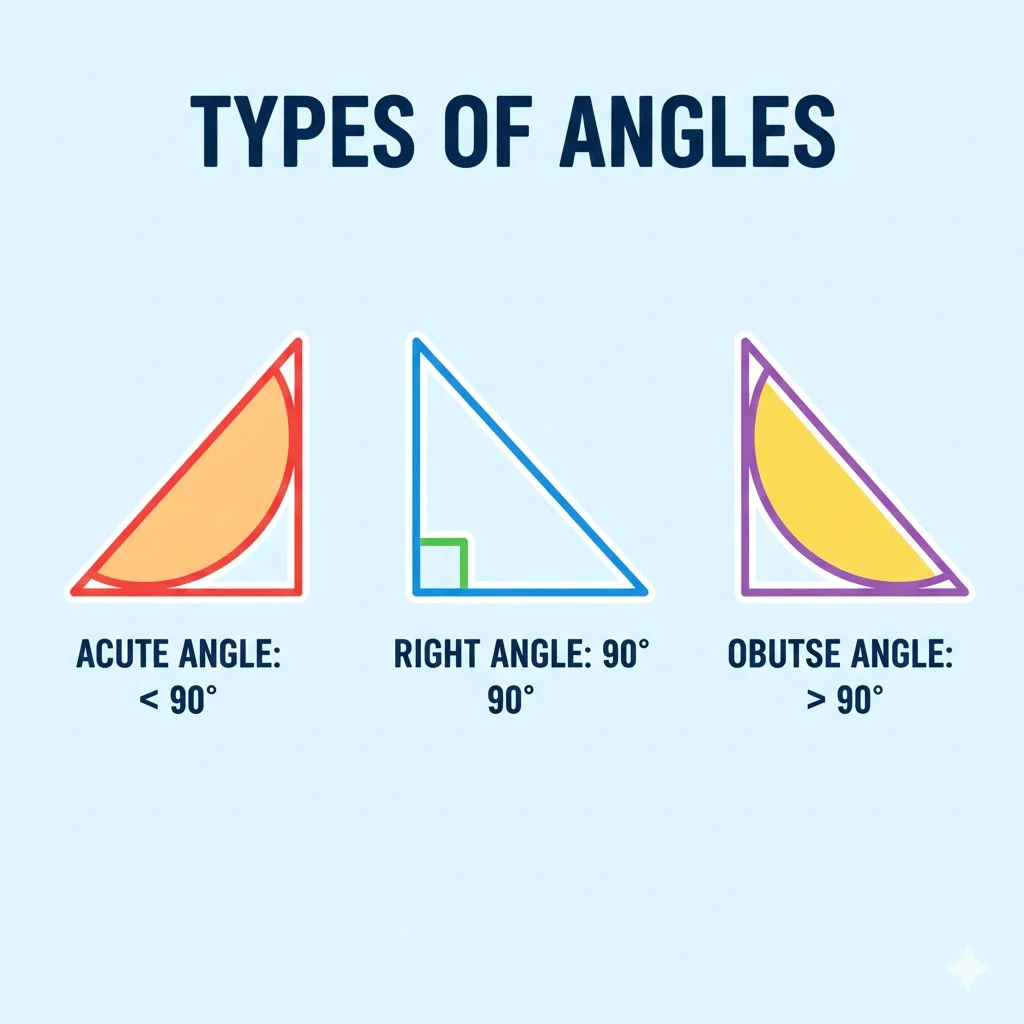

Acute in math describes an angle that measures greater than 0 degrees but less than 90 degrees. An acute angle is smaller than a right angle and appears sharp or narrow in shape.
Math uses many everyday words in very specific ways, and acute is a great example. You may have heard the word used outside of math to describe something intense or sharp, like “acute pain.” In mathematics, however, acute has a precise and easy to understand meaning once you see it in context.
Whether you are studying geometry for the first time, helping a student with homework, or simply refreshing your knowledge, understanding what acute means in math is essential. This article explains the definition, origin, visual meaning, examples, comparisons, and common mistakes in a clear and friendly way.
What Does Acute Mean in Math?
In mathematics, acute refers to a type of angle.
An acute angle is an angle that measures:
- More than 0 degrees
- Less than 90 degrees
In other words, it is a small angle that opens less than a right angle.
Because of its narrow opening, an acute angle often looks sharp or pointed.
Understanding Angles Before Acute Makes Sense
Before going deeper, it helps to briefly understand what an angle is.
An angle is formed when two lines or rays meet at a point called the vertex. The amount of opening between the lines is measured in degrees.
Angles are classified based on their size, and acute is one of the most common classifications.
Origin of the Word Acute
The word acute comes from the Latin word acutus, which means “sharp” or “pointed.”
This meaning carried naturally into mathematics because acute angles appear sharp compared to wider angles.
As geometry developed in ancient Greek and Roman mathematics, terms like acute became standard ways to describe angle types.
How Acute Is Used in Geometry
In geometry, acute is mainly used to describe angles and shapes that contain those angles.
You will most often see it in:
- Angle classification
- Triangle classification
- Geometry proofs and diagrams
Understanding this term helps you quickly recognize shapes and solve problems more efficiently.
Acute Angles Explained Simply
An acute angle always measures less than 90 degrees.
Here are some common examples:
- 15 degrees
- 30 degrees
- 45 degrees
- 60 degrees
- 89 degrees
Once an angle reaches 90 degrees, it is no longer acute.
Visualizing an Acute Angle
If you imagine a right angle like the corner of a book, any angle smaller than that corner is acute.
Another way to picture it is by thinking of clock hands:
- At 1 o’clock, the angle between the hands is acute
- At 2 o’clock, it is still acute
- At 3 o’clock, it becomes a right angle
This mental image helps many students remember the concept easily.
Acute Angles in Triangles
Angles become even more important when working with triangles.
Triangles are classified by their angles, and acute plays a key role here.
Acute Triangle Definition
An acute triangle is a triangle where all three angles are acute.
That means:
- Every angle is greater than 0 degrees
- Every angle is less than 90 degrees
Since the angles of a triangle always add up to 180 degrees, an acute triangle spreads those degrees evenly across smaller angles.
Example of an Acute Triangle
Consider a triangle with angles:
- 50 degrees
- 60 degrees
- 70 degrees
All three angles are less than 90 degrees, so this is an acute triangle.
Angle Types Compared
Understanding acute is easier when you compare it with other angle types.
Angle Comparison Table
| Angle Type | Degree Measure | Description |
|---|---|---|
| Acute | Less than 90 degrees | Small and sharp |
| Right | Exactly 90 degrees | Perfect corner |
| Obtuse | More than 90 degrees | Wide opening |
| Straight | Exactly 180 degrees | Flat line |
This comparison shows where acute fits within the broader angle system.
Acute vs Right vs Obtuse
These three terms often appear together in math lessons.
Key Differences
Acute angles are smaller than right angles
Right angles measure exactly 90 degrees
Obtuse angles are larger than 90 degrees but less than 180 degrees
Because of this, acute angles are always the smallest of the three.
Real World Examples of Acute Angles
Math becomes easier when you connect it to real life.
Examples of acute angles include:
- Slightly open scissors
- The tip of a slice of pizza
- The angle between clock hands at 1 o’clock
- A narrow roof peak
Once you notice them, acute angles appear everywhere.
How Teachers and Textbooks Use Acute
In classrooms, the word acute is usually introduced early in geometry.
You may see it used in sentences like:
- Identify all acute angles in the figure
- Classify the triangle as acute, right, or obtuse
- Measure the angle and determine if it is acute
In each case, the word gives quick information about size and shape.
Common Mistakes Students Make with Acute
Even though the idea is simple, mistakes still happen.
Confusing Acute with Obtuse
This is one of the most common errors.
Acute angles are small
Obtuse angles are wide
If the angle looks bigger than a corner, it is not acute.
Thinking Acute Means Extremely Small
Another misconception is that acute angles must be tiny.
In reality, an 89 degree angle is still acute, even though it looks close to a right angle.
Forgetting Units
Angles are measured in degrees, not centimeters or inches.
When identifying an acute angle, always think in terms of degree measurement.
Alternate Meanings of Acute Outside Math
Outside of mathematics, acute can have different meanings.
For example:
- Acute pain refers to severe or sudden pain
- Acute awareness means sharp perception
However, in math, acute always refers to angle size, not intensity or seriousness.
Polite and Professional Use of Acute in Math Writing
In academic or professional settings, acute is used in a precise and neutral way.
Examples:
- The diagram contains two acute angles
- This triangle is classified as acute
- The angle formed is acute and measures 35 degrees
Using the term correctly shows clarity and mathematical accuracy.
Frequently Asked Questions
1. What does acute mean in math?
In math, acute means an angle that measures less than 90 degrees.
2. Is 90 degrees an acute angle?
No. An angle measuring 90 degrees is a right angle, not acute.
3. Can a triangle have one acute angle?
Yes. Many triangles have one or two acute angles.
4. What is an acute triangle?
An acute triangle is a triangle where all three angles are acute.
5. Is 45 degrees considered acute?
Yes. Any angle less than 90 degrees is acute.
6. How can I quickly tell if an angle is acute?
If it is smaller than a right angle, it is acute.
7. Are acute angles common in geometry?
Yes. They appear frequently in shapes, diagrams, and real world examples.
8. Does acute mean the same thing in all math topics?
Yes. Whenever acute is used in math, it refers to angle size.
Conclusion
So, what does acute mean in math? It describes an angle that is greater than 0 degrees and less than 90 degrees. These angles appear sharp, narrow, and smaller than a right angle.
To recap:
- Acute angles measure less than 90 degrees
- They are common in geometry and triangles
- An acute triangle has three acute angles
- The word comes from Latin meaning sharp
- The meaning stays consistent across math topics
Once you understand acute, reading diagrams and solving geometry problems becomes much easier.
Discover More Post
What Does Glory Mean in the Bible? Biblical Meaning …
What Does a Spread Mean in Betting? Simple Explanation …
What Does Up and Down Mean in Golf? Explained with …