
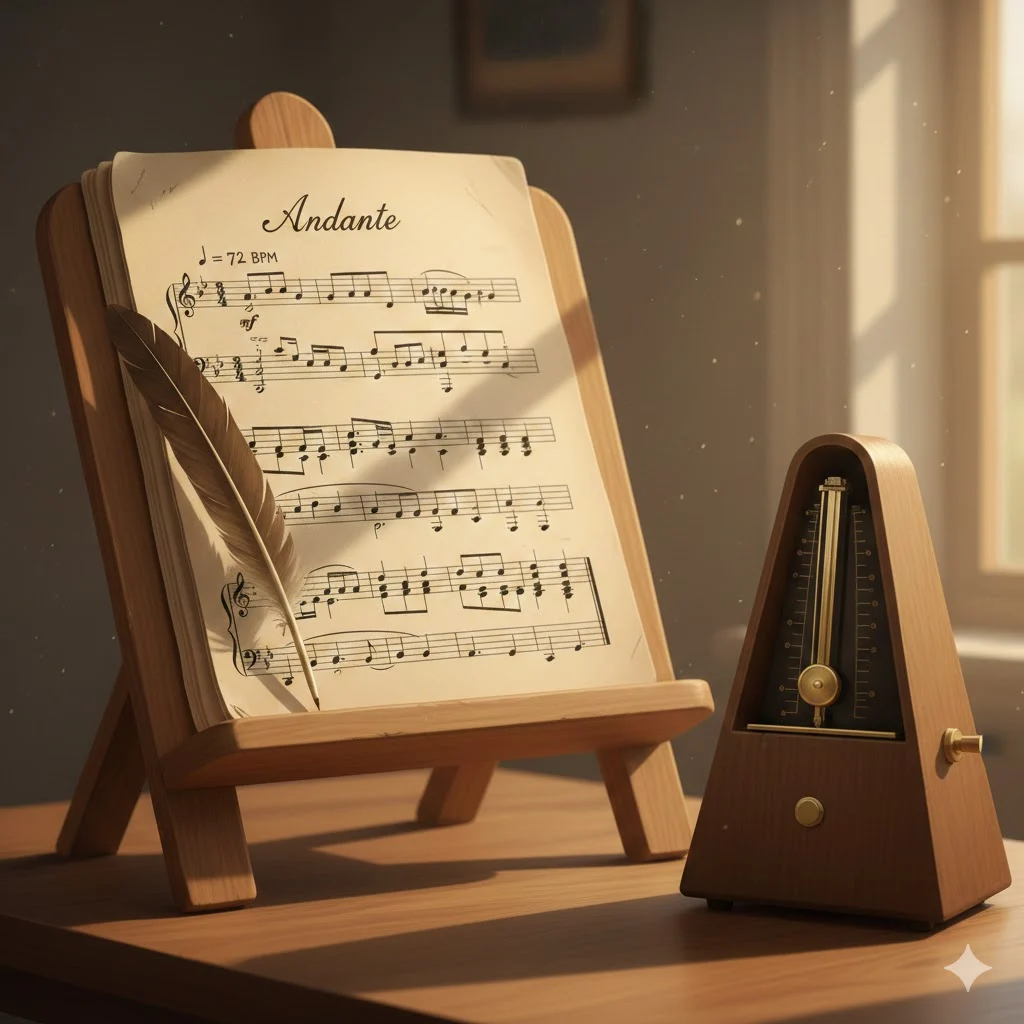

Have you ever looked at sheet music and felt confused by words like andante, allegro, or adagio? You’re not alone. These musical terms can feel intimidating at first, especially if you’re new to music. One of the most common tempo markings you’ll see is andante, and many beginners ask the same question: what does andante mean in music?
Simply put, andante tells musicians how fast or slow to play a piece. But its meaning goes deeper than just speed. It also sets a mood, a feeling, and a natural flow to the music.
In this guide, we’ll explain what does andante mean in music in plain English. You’ll learn its origin, tempo range, real examples, how musicians interpret it, and how it compares to other musical terms. No jargon. No confusion. Just music made simple.
What Does Andante Mean in Music? (Definition & Meaning)
Andante is a musical tempo marking that means “at a walking pace.”
The word comes from Italian, where andare means “to walk.” When a composer writes andante in sheet music, they want the performer to play at a comfortable, steady, natural speed, similar to how a person walks.
Key Meaning of Andante
- Tempo: Moderate
- Speed: Not fast, not slow
- Feel: Calm, flowing, relaxed
- Mood: Gentle, thoughtful, expressive
In modern terms, andante usually falls between 76–108 beats per minute (BPM), though interpretations can vary.
Simple Explanation
Think of andante as music that moves forward smoothly without rushing or dragging.
🎵 Not slow like a lullaby.
🎵 Not fast like a dance.
🎵 Just steady and natural.
Origin and History of Andante in Music
The use of andante dates back to the Baroque period (1600–1750), when composers began using Italian words to describe tempo and expression.
Why Italian?
Italian became the standard language for music because:
- Many early composers were Italian
- Italy was the center of musical innovation
- Musical notation spread from Italian publishers
How Andante Evolved
Originally, andante literally meant “walking.”
But over time:
- It became slightly slower in interpretation
- Composers used it more for expressive movement
- It began to imply mood, not just speed
By the Classical and Romantic eras, andante was no longer just about tempo. It also suggested grace, balance, and emotional control.
How Fast Is Andante? (Tempo Explained Clearly)
Tempo can be confusing, so let’s simplify it.
Andante Tempo Range
| Tempo Marking | BPM Range | Speed Description |
|---|---|---|
| Largo | 40–60 | Very slow |
| Adagio | 66–76 | Slow |
| Andante | 76–108 | Walking pace |
| Moderato | 108–120 | Medium |
| Allegro | 120–168 | Fast |
Important Note
There is no single exact speed for andante. The tempo depends on:
- The composer
- The musical style
- The emotion of the piece
- The performer’s interpretation
That’s why two performances of the same andante piece may sound slightly different.
How Andante Is Used in Different Types of Music
Classical Music
In classical music, andante often appears in:
- Slow movements of symphonies
- Piano sonatas
- String quartets
Example:
- Mozart – Andante movements are often lyrical and emotional.
Romantic Music
Romantic composers used andante to:
- Express emotion
- Create storytelling through music
- Slow down the listener’s experience
Example:
- Beethoven used andante to create contrast between intense movements.
Modern and Film Music
Even today, composers use andante-style tempos in:
- Film scores
- Background music
- Emotional scenes
It helps create:
- Reflection
- Calm tension
- Emotional depth
Andante vs Similar Tempo Terms
Many people confuse andante with other tempo markings. Let’s clear that up.
Comparison Table
| Term | Meaning | Speed | Feel |
|---|---|---|---|
| Adagio | Slow | Slower than andante | Calm, emotional |
| Andante | Walking pace | Medium | Flowing, relaxed |
| Andantino | Slightly faster/slower than andante | Varies | Light |
| Moderato | Moderate | Faster than andante | Balanced |
| Allegretto | Lightly fast | Faster | Cheerful |
Key Difference
Andante focuses on movement, not slowness.
It moves forward gently.
What Does Andante Feel Like to Play or Listen To?
When you play music marked andante:
- Your hands feel relaxed
- Notes breathe naturally
- Phrasing feels smooth
When you listen to andante music:
- It feels calm but not sleepy
- You sense motion
- The melody feels thoughtful
It’s perfect for:
- Emotional storytelling
- Background listening
- Learning musical expression
How Musicians Interpret Andante
Musicians don’t treat andante like a strict rule. Instead, they consider:
- Context of the piece
- Composer’s style
- Era of music
- Emotion intended
Example
An andante in a sad piece may be:
- Slightly slower
- More expressive
An andante in a joyful piece may be:
- Lighter
- A bit faster
That flexibility is what makes music human.
Andante in Sheet Music (What to Look For)
When reading sheet music:
- Andante appears above the staff
- Sometimes followed by:
- Andante cantabile (walking pace, singing style)
- Andante sostenuto (walking pace, sustained)
These extra words add emotion and character to the tempo.
Common Misunderstandings About Andante
Many beginners think:
- Andante means slow ❌
- Andante is fixed speed ❌
Truth
- Andante is moderate
- It allows interpretation
- It describes movement, not exact tempo
Understanding this helps musicians play more naturally.
Why Andante Is Important in Music Learning
Learning what does andante mean in music helps you:
- Read sheet music confidently
- Understand tempo markings
- Play with correct emotion
- Improve musical expression
It’s one of the first tempo terms every musician should master.
FAQs
1. What does andante mean in music?
Andante means at a walking pace, a moderate and natural tempo.
2. Is andante slow or fast?
Neither. It is moderate—between slow and fast.
3. What BPM is andante?
Usually between 76 and 108 BPM, depending on interpretation.
4. Is andante faster than adagio?
Yes. Andante is faster than adagio.
5. Why do composers use andante?
To create flow, balance, and expressive movement in music.
6. Can andante change within a piece?
Yes. Some pieces gradually speed up or slow down around an andante base.
Conclusion
Now you know exactly what does andante mean in music. It represents a walking pace, a natural and flowing tempo that keeps music moving without rushing. More than just speed, andante shapes emotion, mood, and expression. From classical symphonies to modern film scores, it remains one of the most important tempo markings in music. Understanding andante helps you read sheet music better, play with confidence, and truly feel the music. Once you recognize it, you’ll hear andante everywhere—quietly guiding the rhythm of beautiful melodies.