
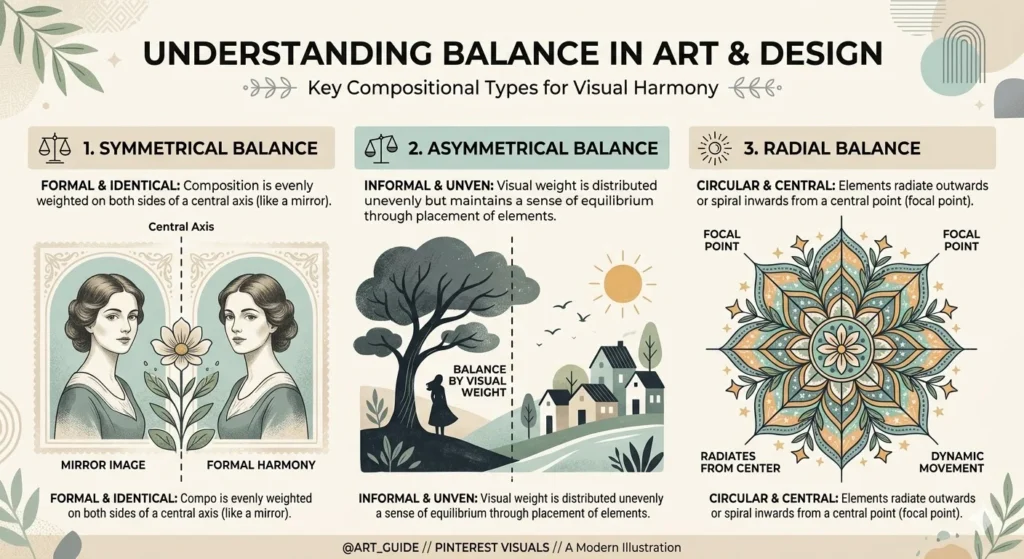

Balance in art refers to the visual distribution of elements within a composition so that no single part feels heavier or dominates the whole. It creates a sense of stability, harmony, and structure in an artwork.
Have you ever looked at a painting and felt that everything just “works” together, even if you cannot explain why? That feeling often comes from balance. It is one of the most important principles of art, yet it is also one of the easiest to overlook.
Whether you are viewing a famous painting, designing a poster, or creating your own artwork, understanding balance in art helps you see why some compositions feel calm and pleasing, while others feel chaotic or unsettling.
In this guide, you will learn exactly what balance means in art, the different types of balance, how artists use it, and how you can apply it in your own creative work.
What Does Balance Mean in Art?
In art, balance means arranging visual elements so that they feel evenly distributed across a composition.
These elements can include:
- Color
- Shape
- Texture
- Line
- Space
- Form
When balance is achieved, the artwork feels stable and complete. On the other hand, when balance is missing, the composition may feel awkward or uncomfortable.
Importantly, balance does not always mean everything looks identical. Instead, it is about visual weight, which is how much attention different elements attract.
Why Balance Is Important in Art
Balance plays a major role in how viewers experience art.
First, it helps create a sense of stability and order. As a result, the viewer can focus on the message or subject without distraction.
In addition, balance guides the viewer’s eye across the artwork. This makes the composition easier to understand and more engaging.
Moreover, artists can use balance intentionally to create certain emotions. For example, a balanced composition can feel calm and peaceful, while an unbalanced one can feel tense or dramatic.
Types of Balance in Art
There are several types of balance that artists use. Each type creates a different visual effect and mood.
1. Symmetrical Balance
Symmetrical balance occurs when both sides of an artwork are identical or very similar.
This type of balance is often associated with:
- Formality
- Stability
- Calmness
Examples include portraits, architecture, and reflections.
Example description:
A face where both sides mirror each other creates perfect symmetry.
Because of its structure, symmetrical balance feels predictable and orderly.
2. Asymmetrical Balance
Asymmetrical balance happens when elements are different but still visually balanced.
For instance, a large object on one side may be balanced by several smaller objects on the other.
This type of balance feels:
- More dynamic
- More interesting
- Less rigid
As a result, many modern artworks use asymmetrical balance to create movement and energy.
3. Radial Balance
Radial balance occurs when elements radiate from a central point.
Common examples include:
- Mandalas
- Flowers
- Circular patterns
In this type, all elements are arranged around a center, creating a strong focal point.
Consequently, radial balance often feels harmonious and unified.
4. Crystallographic Balance
Crystallographic balance, also called all over balance, distributes elements evenly across the entire surface.
There is no single focal point. Instead, the viewer’s eye moves freely across the artwork.
This type is common in:
- Abstract art
- Pattern based designs
Because everything is evenly spread, the composition feels consistent and continuous.
Examples of Balance in Art
Understanding balance becomes easier when you see it in context.
Balanced Composition Example
A landscape painting where:
- The sun is on one side
- Trees and mountains balance the other side
Even though the elements differ, the composition still feels stable.
Unbalanced Composition Example
Imagine a painting with:
- A large dark shape on one side
- Empty space on the other
This creates tension and may feel uncomfortable or incomplete.
However, artists sometimes use imbalance intentionally for dramatic effect.
Balance in Art Table
| Type of Balance | Description | Visual Effect |
|---|---|---|
| Symmetrical | Mirror like equality | Calm and stable |
| Asymmetrical | Different but balanced elements | Dynamic and interesting |
| Radial | Elements around a center | Unified and focused |
| Crystallographic | Even distribution everywhere | Continuous and pattern like |
How Artists Create Balance
Artists use several techniques to achieve balance in their work.
1. Visual Weight
Different elements carry different visual weight.
For example:
- Dark colors feel heavier than light ones
- Large shapes attract more attention than small ones
- Bright colors stand out more than dull ones
Balancing these elements helps create harmony.
2. Color Distribution
Color plays a major role in balance.
For instance, a bright red area on one side can be balanced by multiple softer colors on the other.
3. Placement and Position
Where elements are placed affects balance.
Objects near the center feel more stable. In contrast, objects near the edges feel more dynamic.
4. Contrast and Detail
Highly detailed areas draw attention. Therefore, they carry more visual weight.
Balancing detail across the composition prevents one side from overpowering the other.
Emotional Effects of Balance
Balance is not just technical. It also affects how art feels.
Balanced Art Feels
- Calm
- Peaceful
- Stable
- Organized
Unbalanced Art Feels
- Tense
- Dramatic
- Energetic
- Unpredictable
Because of this, artists choose balance types based on the mood they want to create.
Balance vs Other Principles of Art
Balance is one of several principles of art.
Here is how it compares to others.
| Principle | Focus |
|---|---|
| Balance | Distribution of visual weight |
| Contrast | Differences between elements |
| Emphasis | Creating a focal point |
| Unity | Overall harmony |
| Movement | Guiding the viewer’s eye |
Although each principle is different, they often work together in a composition.
Common Mistakes When Using Balance
Beginners often misunderstand balance in art.
Making Everything Symmetrical
While symmetry is useful, overusing it can make artwork feel boring.
Ignoring Visual Weight
Not all elements are equal. Ignoring this can lead to imbalance.
Overcrowding One Side
Placing too many elements in one area makes the composition feel heavy.
Alternate Meanings of Balance
Outside of art, the word balance has several meanings.
For example:
- In finance, it refers to the amount of money in an account
- In fitness, it refers to physical stability
- In life, it refers to managing different priorities
However, in art, balance always relates to visual distribution.
Polite and Professional Alternatives
Instead of simply saying “balance,” you can use more descriptive terms in art discussions.
Examples include:
- Visual harmony
- Even composition
- Stable arrangement
- Proportional layout
These alternatives are especially useful in academic or professional writing.
Frequently Asked Questions
1. What does balance mean in art?
Balance in art means distributing visual elements so the composition feels stable and harmonious.
2. What are the main types of balance in art?
The main types are symmetrical, asymmetrical, radial, and crystallographic.
3. Why is balance important in art?
It helps create stability, guides the viewer’s eye, and improves overall composition.
4. Can art be intentionally unbalanced?
Yes. Artists sometimes use imbalance to create tension or drama.
5. What is asymmetrical balance in art?
It is when different elements are arranged in a way that still feels visually balanced.
6. Is symmetry always better?
No. Symmetry can feel too predictable, while asymmetry often feels more dynamic.
7. How do artists create balance?
They use visual weight, color, placement, and contrast.
8. Does balance affect emotions in art?
Yes. Balanced art feels calm, while unbalanced art can feel tense or energetic.
Conclusion
So, what does balance mean in art? It is the careful arrangement of visual elements to create stability, harmony, and a pleasing composition.
To recap:
- Balance is about visual weight, not just symmetry
- There are different types, including symmetrical and asymmetrical
- It shapes how viewers experience and feel about art
- Artists use it intentionally to guide attention and emotion
By understanding balance, you can not only appreciate art more deeply but also improve your own creative work.
Discover More Post
What Does PF Mean in Fantasy Football? Complete Guide …
What Does Volume Mean in Science? Definition, Formula …
What Does PCT Mean in Football? Simple … – DefineHubs.com –