
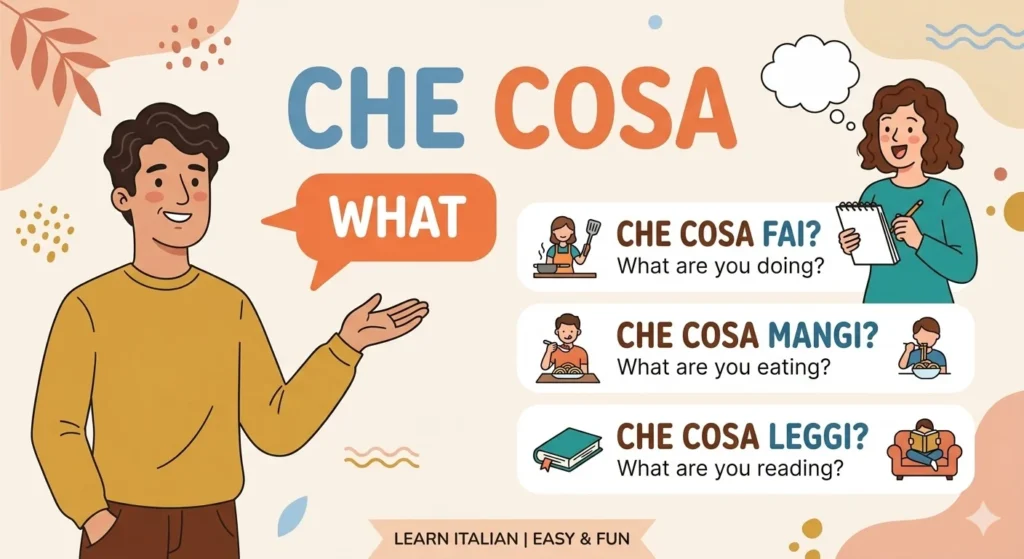

Che cosa is an Italian phrase that means “what” or “what thing” in English. It is commonly used to ask questions and request information, especially in a clear or slightly formal way.
If you have ever listened to Italian conversations, watched Italian movies, or started learning the language, you have probably heard the phrase che cosa. At first, it may seem like just another way to say “what,” but in reality, it carries its own tone, structure, and usage rules.
Because Italian offers more than one way to say “what,” understanding che cosa will help you sound more natural and confident. In this guide, you will learn what che cosa means, how to use it correctly, how it compares to similar expressions, and how native speakers use it in real life.
What Does Che Cosa Mean in Italian?
In Italian, che cosa literally translates to “what thing.” However, in everyday usage, it simply means “what.”
More importantly, it is used to ask questions about things, actions, or situations.
For example:
- Che cosa vuoi
What do you want - Che cosa stai facendo
What are you doing
Although the literal translation includes “thing,” native speakers do not think of it that way. Instead, they use it naturally as a question word.
Breaking Down Che Cosa
To fully understand the phrase, it helps to look at each word separately.
- Che means “what” or “which”
- Cosa means “thing”
When combined, che cosa emphasizes the idea of asking about something specific.
As a result, it can sometimes feel slightly more precise or expressive than just saying che alone.
Origin and Popularity of Che Cosa
Italian, like many Romance languages, evolved from Latin. Over time, different ways of asking “what” developed, including che, che cosa, and cosa.
Today, che cosa remains widely used across Italy. In fact, it is especially common in:
- Spoken Italian
- Everyday conversations
- Questions where clarity is important
At the same time, shorter forms like che and cosa are also very popular, particularly in casual speech.
When to Use Che Cosa
There are several situations where che cosa is appropriate. Below are the most common ones.
1. Asking General Questions
First, che cosa is often used to ask open ended questions.
Examples:
- Che cosa vuoi mangiare
What do you want to eat - Che cosa pensi
What do you think
Because it sounds complete and clear, it works well in many situations.
2. Asking About Actions
In addition, che cosa is frequently used with verbs to ask what someone is doing.
Examples:
- Che cosa fai
What are you doing - Che cosa stai guardando
What are you watching
This usage is very common in everyday conversations.
3. Adding Clarity or Emphasis
Sometimes, speakers choose che cosa instead of che to make the question feel more explicit.
Example:
- Che cosa significa
What does it mean
In this case, che cosa can sound slightly more deliberate or thoughtful.
4. Semi Formal Situations
While not strictly formal, che cosa can feel a bit more complete than shorter alternatives.
For example, in polite conversation:
- Che cosa desidera
What would you like
This makes it suitable for respectful or neutral interactions.
Examples of Che Cosa in Real Conversations
Here are some examples showing different tones and contexts.
Friendly Tone 😊
- Che cosa fai stasera
What are you doing tonight - Che cosa vuoi vedere
What do you want to watch
Neutral Tone
- Che cosa significa questa parola
What does this word mean - Che cosa succede
What is happening
Confused or Frustrated Tone 😐
- Che cosa stai dicendo
What are you saying - Che cosa vuoi da me
What do you want from me
In each example, the tone depends more on context than on the phrase itself.
Che Cosa vs Che vs Cosa
Italian offers multiple ways to say “what,” which can be confusing at first.
Comparison Table
| Expression | Meaning | Tone | Usage |
|---|---|---|---|
| Che cosa | What | Neutral to slightly formal | Clear and complete questions |
| Che | What Which | Casual | Very common in speech |
| Cosa | What | Neutral | Often used alone or in questions |
Example Comparison
- Che cosa fai
- Che fai
- Cosa fai
All three mean “What are you doing,” but:
- Che cosa fai sounds more complete
- Che fai sounds more casual
- Cosa fai is neutral and very common
Common Phrases with Che Cosa
Here are some frequently used expressions.
- Che cosa vuoi
What do you want - Che cosa succede
What is happening - Che cosa significa
What does it mean - Che cosa cerchi
What are you looking for - Che cosa hai detto
What did you say
Learning these phrases will help you understand spoken Italian more easily.
Common Mistakes with Che Cosa
Although che cosa is straightforward, learners sometimes make mistakes.
Overusing Che Cosa
Using che cosa in every sentence can sound repetitive.
Instead, try mixing it with che or cosa depending on context.
Word Order Issues
Italian questions often keep the same structure as statements.
Incorrect:
- Che cosa tu vuoi
Correct:
- Che cosa vuoi
Alternate Meanings of Che Cosa
In standard Italian, che cosa consistently means “what.”
However, depending on tone, it can express:
- Curiosity
- Surprise
- Confusion
For example:
- Che cosa
What
The meaning stays the same, but the emotion changes based on how it is said.
Polite and Professional Alternatives
If you want to sound more formal or polite, you can use variations like:
- Che cosa desidera
What would you like - Che cosa preferisce
What do you prefer - Che cosa intende
What do you mean
These forms are useful in professional or respectful situations.
Frequently Asked Questions
1. What does che cosa literally mean?
It literally means “what thing,” but it is simply used as “what.”
2. Is che cosa formal or informal?
It is neutral and can be used in both casual and semi formal situations.
3. Can I just say che instead of che cosa?
Yes. Che is shorter and very common in everyday speech.
4. Is cosa the same as che cosa?
Yes. Cosa also means “what,” though the structure may differ slightly.
5. Which is more common in Italy?
All forms are used, but che and cosa are often more common in casual conversation.
6. Can che cosa be used in all questions?
It can be used in most questions, but varying your expressions sounds more natural.
7. Does che cosa change meaning based on tone?
The core meaning stays the same, but tone can express emotion.
8. Is che cosa used in formal writing?
Yes, it is acceptable and often preferred for clarity.
Conclusion
So, what does che cosa mean in Italian? It means “what” and is used to ask questions about things, actions, or situations.
To recap:
- Che cosa literally means “what thing”
- It is commonly used in questions
- It sounds clear and slightly more complete than shorter forms
- It can be replaced by che or cosa in many cases
- It works in both casual and semi formal contexts
By understanding che cosa, you gain more flexibility in Italian and can communicate more naturally in different situations.
Discover More Post
WTM Meaning in Text What Does WTM Stand For? in 2026
What Does Por Qué Mean in Spanish? Explanation for 2026
What Does Jagiya Mean in Korean? Meaning, Usage, and …