
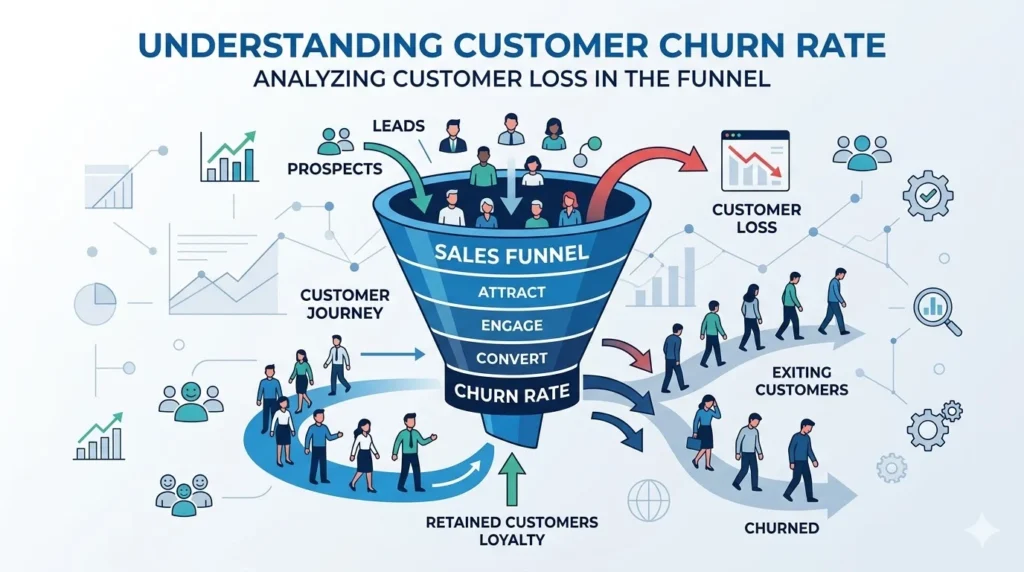

Churn in business refers to the percentage of customers who stop using a company’s product or service during a specific period of time. It is a key metric that measures customer loss and helps businesses understand retention, satisfaction, and long term growth.
If you run a business, manage a product, or work in marketing, you have probably heard the term churn. At first, it may sound technical or even confusing. However, once you understand it, churn becomes one of the most important indicators of how healthy a business really is.
In today’s competitive market, gaining new customers is only part of the equation. Keeping them is what truly drives sustainable growth. That is exactly where churn comes in.
In this guide, you will learn what churn means in business, why it matters, how to calculate it, the different types of churn, and how companies reduce it effectively.
What Does Churn Mean in Business?
In simple terms, churn means losing customers.
More specifically, it refers to the rate at which customers stop doing business with a company over a certain time period.
For example, if a company starts the month with 100 customers and loses 10 by the end, its churn rate is 10 percent.
Because churn directly impacts revenue, it is one of the most closely tracked metrics in industries like:
- Subscription services
- SaaS companies
- Telecom providers
- Streaming platforms
- Financial services
Why Churn Matters in Business
Understanding churn is essential for long term success.
First, high churn means customers are leaving faster than expected. As a result, growth becomes difficult even if new customers are being added.
In addition, acquiring new customers is often more expensive than retaining existing ones. Therefore, reducing churn can significantly improve profitability.
Moreover, churn provides insight into customer satisfaction. If people are leaving, something may be wrong with the product, pricing, or overall experience.
Key reasons churn matters:
- It directly affects revenue
- It signals customer dissatisfaction
- It impacts brand reputation
- It influences long term growth
Types of Churn in Business
Churn is not just one single concept. Instead, it can be divided into different types depending on what is being measured.
1. Customer Churn
Customer churn refers to the number or percentage of customers who leave.
Example:
A company loses 20 out of 200 customers in a month.
Customer churn rate:
10 percent
This is the most common way businesses measure churn.
2. Revenue Churn
Revenue churn focuses on lost income rather than the number of customers.
Example:
A business loses high paying clients, even if total customer count stays stable.
In this case, revenue churn may be high even when customer churn is low.
3. Voluntary Churn
Voluntary churn happens when customers choose to leave.
Common reasons include:
- Poor customer experience
- High pricing
- Better competitors
- Lack of value
4. Involuntary Churn
In contrast, involuntary churn occurs without the customer’s direct decision.
Examples include:
- Payment failures
- Expired credit cards
- Technical issues
Although unintentional, it still affects revenue and must be managed.
How to Calculate Churn Rate
Calculating churn is straightforward.
Basic Churn Rate Formula
Churn Rate equals:
Number of customers lost during a period divided by total customers at the start of that period multiplied by 100
Example Calculation
If you start with 500 customers and lose 50:
Churn rate:
50 divided by 500 multiplied by 100 equals 10 percent
Churn Calculation Table
| Starting Customers | Customers Lost | Churn Rate |
|---|---|---|
| 100 | 5 | 5 percent |
| 250 | 25 | 10 percent |
| 500 | 50 | 10 percent |
| 1000 | 200 | 20 percent |
This table shows how churn increases as more customers leave.
Real World Examples of Churn
To better understand churn, let’s look at real business scenarios.
Example 1: Subscription Service
A streaming platform loses users every month when subscriptions expire.
This is customer churn.
Example 2: SaaS Company
A software company loses a few large enterprise clients.
Even if user numbers remain stable, revenue drops significantly.
This is revenue churn.
Example 3: Telecom Provider
Customers switch to a competitor offering better pricing.
This is voluntary churn.
Example 4: Online Service
A customer’s payment fails due to an expired card.
This is involuntary churn.
Common Causes of High Churn
Businesses often experience churn due to multiple factors.
First, poor onboarding can drive customers away quickly. If users do not understand how to use a product, they are more likely to leave.
Second, lack of value is a major issue. Customers will not stay if they do not see clear benefits.
In addition, pricing plays a big role. If a product feels too expensive, users may switch to competitors.
Furthermore, weak customer support can frustrate users and increase churn.
Other causes include:
- Better alternatives in the market
- Technical issues or bugs
- Lack of engagement
- Misaligned expectations
How to Reduce Churn
Reducing churn is a top priority for most businesses.
Fortunately, there are proven strategies that can help.
1. Improve Customer Onboarding
A smooth onboarding process helps customers understand value quickly.
As a result, they are more likely to stay.
2. Deliver Consistent Value
Customers stay when they feel they are getting real benefits.
Therefore, focus on solving problems and meeting expectations.
3. Enhance Customer Support
Fast and helpful support builds trust.
In turn, satisfied customers are less likely to leave.
4. Use Feedback to Improve
Listening to customers helps identify problems early.
Consequently, businesses can fix issues before users churn.
5. Offer Flexible Pricing
Flexible plans can reduce churn caused by cost concerns.
For example, offering monthly and yearly options can help retain different types of customers.
Churn vs Retention: Key Differences
Churn and retention are closely related but opposite concepts.
Comparison Table
| Churn | Retention |
|---|---|
| Measures customer loss | Measures customer loyalty |
| Negative metric | Positive metric |
| Focuses on exits | Focuses on staying customers |
| Higher is bad | Higher is good |
In simple terms, reducing churn improves retention.
Common Misconceptions About Churn
Many people misunderstand churn.
One common belief is that churn only matters for subscription businesses. In reality, any business with repeat customers can track churn.
Another misconception is that churn is always bad. While high churn is harmful, a small amount can be normal depending on the industry.
Some also assume churn is only about customers. However, revenue churn can sometimes be even more important.
Polite and Professional Alternatives to “Churn”
In some business settings, you may prefer less negative language.
Here are alternatives that sound more neutral or professional:
- Customer attrition
- Customer turnover
- Client loss rate
- Retention decline
- Subscription drop off
These terms are often used in reports and presentations.
Frequently Asked Questions
1. What does churn mean in business?
Churn means the rate at which customers stop using a product or service over time.
2. Why is churn important?
It affects revenue, growth, and customer satisfaction.
3. What is a good churn rate?
A good churn rate depends on the industry, but lower is always better.
4. How do you calculate churn?
Divide customers lost by total customers at the start, then multiply by 100.
5. What is the difference between churn and retention?
Churn measures losses, while retention measures how many customers stay.
6. Can churn be reduced?
Yes. Improving customer experience, pricing, and support can reduce churn.
7. What causes high churn?
Common causes include poor service, high prices, and strong competition.
8. Is churn only for subscription businesses?
No. Any business with repeat customers can measure churn.
Conclusion
So, what does churn mean in business? Simply put, it refers to the rate at which customers stop doing business with a company.
Understanding churn helps businesses:
- Identify problems early
- Improve customer experience
- Increase retention
- Drive long term growth
Although some level of churn is normal, reducing it should always be a priority. By focusing on value, support, and customer satisfaction, businesses can build stronger relationships and achieve sustainable success.
Discover More Post
SMH Meaning in Text: Examples, and How to Use It in 2026
WTW Meaning in Text What Does WTW Stand For? 2026
SYBAU Meaning in Text Definition, Usage, and Examples for …