
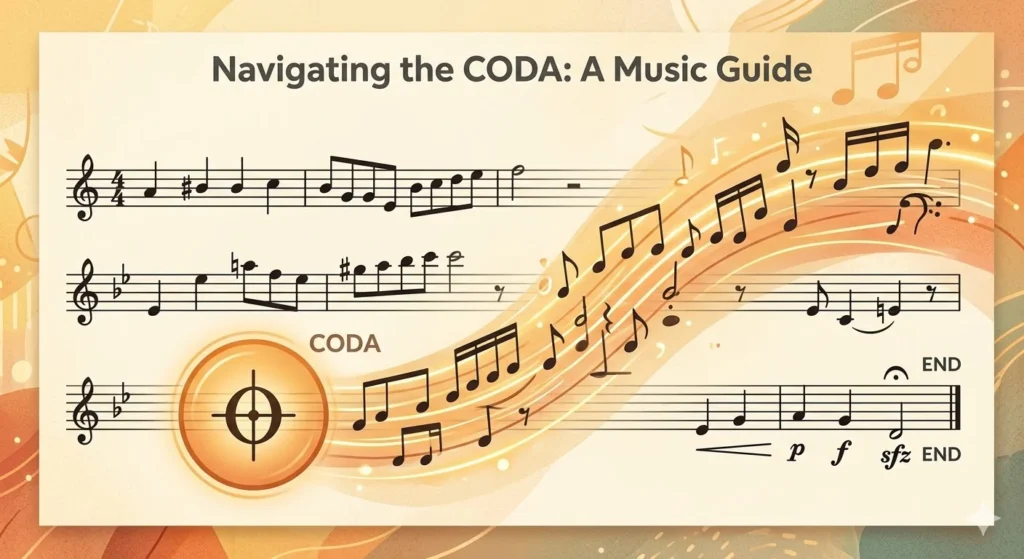

Coda in music refers to a final section of a piece that brings it to a clear and complete ending. It typically appears after the main structure and often summarizes or concludes the musical ideas.
If you have ever listened to a song or a classical piece and noticed a powerful or distinct ending that feels separate from the rest, you were likely hearing a coda. This musical term appears across genres, from classical compositions to modern songs, and plays an important role in shaping how a piece finishes.
Although the concept may sound technical at first, understanding what a coda means in music is actually quite simple. In this guide, you will learn its definition, origin, how it is used, and how to recognize it in real musical contexts.
What Does Coda Mean in Music?
In music, a coda is the closing section of a composition.
It usually appears at the end and serves to:
- Wrap up the musical ideas
- Provide a sense of closure
- Reinforce the main theme
- Create a memorable ending
In many cases, the coda feels slightly different from the main sections, giving the listener a clear signal that the piece is coming to an end.
Origin of the Word Coda
The word coda comes from the Italian word for “tail.”
In music terminology, Italian words are very common because many early composers were Italian or trained in Italian traditions.
Because a tail comes at the end of something, the term perfectly describes the role of a coda in music. Over time, it became a standard term used by composers, performers, and music teachers worldwide.
Why the Coda Is Important in Music
A coda is more than just an ending. It shapes how the listener remembers the piece.
For example:
- It can make the ending feel strong and satisfying
- It can add emotional impact
- It can revisit earlier themes in a new way
- It can create a dramatic or peaceful finish
Without a coda, some pieces might feel unfinished or abrupt.
How a Coda Works in Musical Structure
To understand the role of a coda, it helps to see where it fits in a typical musical structure.
A simple structure might look like this:
- Introduction
- Main sections or themes
- Development
- Recap or repetition
- Coda
The coda appears after the main structure is complete. It acts as a final statement.
Coda in Sheet Music
In written music, a coda is often marked with a special symbol that looks like a circle with a cross.
Composers use it to guide musicians during performance.
For example:
- “To Coda” tells the musician to jump to the coda section
- The coda symbol shows where that section begins
This is especially useful in longer compositions with repeated sections.
Examples of Coda in Music
To make the concept clearer, here are different types of coda usage.
1. Classical Music Example
In classical compositions, codas are often extended and highly expressive.
A composer might:
- Restate the main theme
- Add variation
- Build toward a dramatic ending
2. Pop and Modern Music Example
In modern songs, a coda can be simpler.
Examples include:
- A repeated chorus at the end
- A fade out section
- A final instrumental outro
3. Instrumental Ending Example
Sometimes the coda introduces new musical material that was not heard earlier.
This makes the ending feel fresh and distinct.
Emotional Tone of a Coda
A coda can change the emotional impact of a piece significantly.
Strong and Powerful Ending 🎶
- Loud dynamics
- Full instrumentation
- Clear resolution
Calm and Peaceful Ending
- Soft dynamics
- Slow tempo
- Gentle fade
Dramatic or Unexpected Ending
- Sudden changes
- New musical ideas
- Surprise elements
Because of this, the coda often leaves the final impression on the listener.
Coda vs Similar Musical Terms
To better understand coda, it helps to compare it with related terms.
Comparison Table
| Term | Meaning | Position in Music |
|---|---|---|
| Coda | Final concluding section | End |
| Outro | Ending section, often informal term | End |
| Bridge | Connects different sections | Middle |
| Chorus | Repeated main section | Throughout |
| Finale | Grand ending, often in large works | End |
Key Difference
A coda is more formal and structural, especially in classical music, while outro is more commonly used in modern music.
Examples of Coda in Context
Here are natural examples that show how the term is used.
Informational Tone
The piece ends with a short coda that repeats the main theme.
Educational Tone
In this composition, the coda provides a strong and satisfying conclusion.
Casual Tone
I love how the song’s coda fades out so smoothly 🎵
What Coda Does Not Mean
It is important not to confuse coda with other musical sections.
A coda is not:
- The main theme
- The beginning of a piece
- A repeated section in the middle
Instead, it specifically refers to the final concluding part.
Alternate Meanings of Coda
Although coda is mainly used in music, it can have other meanings.
- In literature, it can refer to a concluding section of a story
- In general language, it can mean a final part or finishing touch
However, in a musical context, it almost always refers to the ending section of a composition.
Polite and Professional Alternatives
If you want to explain coda without using the term directly, you can say:
- “final section of the piece”
- “closing passage”
- “ending segment”
- “concluding part of the composition”
These alternatives are useful in teaching or writing for beginners.
How to Identify a Coda When Listening
Recognizing a coda becomes easier with practice.
Here are some signs to look for:
- The main structure feels complete
- The music shifts toward an ending
- Themes are repeated or summarized
- The piece builds or settles into a conclusion
Listening carefully to endings will help you notice codas more easily.
Frequently Asked Questions
1. What does coda mean in music?
A coda is the final section of a piece that brings it to a clear ending.
2. Where does the coda appear in a song?
It appears at the end, after the main sections are finished.
3. Is a coda the same as an outro?
They are similar, but coda is a more formal musical term.
4. What is the purpose of a coda?
It provides closure and reinforces the musical ideas.
5. Do all songs have a coda?
No. Some songs end without a distinct coda.
6. How is a coda marked in sheet music?
It is marked with a special symbol and instructions like “To Coda.”
7. Can a coda introduce new music?
Yes. Some codas include new material to enhance the ending.
8. Is coda used outside music?
Yes. It can also refer to a concluding section in writing or general contexts.
Conclusion
So, what does coda mean in music? It is the final section of a composition that brings everything to a satisfying conclusion.
To recap:
- A coda appears at the end of a piece
- It helps create closure and emotional impact
- It can repeat or transform earlier ideas
- It is used in both classical and modern music
- It leaves a lasting impression on the listener
Understanding the role of a coda not only improves your musical knowledge but also helps you appreciate how songs and compositions are crafted from beginning to end.
Discover More Post
What Does Largo Mean in Music? Tempo, Meaning, and …
What Does Allusion Mean in Literature? Definition and Clear …
What Does Bougie Mean in Slang? Meaning, Origin and …