
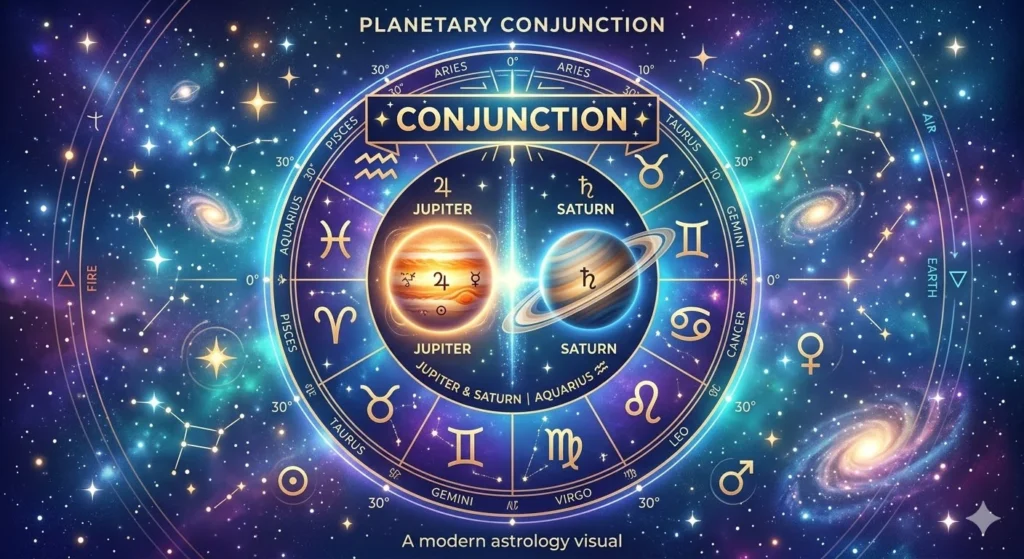

Conjunct in astrology refers to a planetary alignment where two or more planets appear very close together in the same zodiac degree or sign. This alignment is called a conjunction, and it blends the energy of the planets involved, often intensifying their influence in a birth chart or transit.
Astrology uses many specialized terms to describe how planets interact with one another. Among the most important of these is the concept of a conjunction, often described using the word conjunct. If you have ever read an astrology chart or horoscope and seen phrases such as “Venus conjunct Mars” or “Moon conjunct Jupiter,” you might wonder what this actually means.
Understanding what conjunct means in astrology helps you interpret birth charts, planetary transits, and compatibility readings more clearly. Essentially, when planets are conjunct, their energies combine and influence each other strongly. Sometimes this creates harmony and powerful focus, while in other cases it can amplify tension or challenges.
In this guide, we will explore the meaning of conjunct in astrology, how it works in charts, why it matters, and how astrologers interpret this powerful planetary alignment.
What Does Conjunct Mean in Astrology?
In astrology, conjunct means that two planets are positioned very close together in the same degree or zodiac sign. This alignment is known as a conjunction.
When planets are conjunct, their energies blend and act together. Because of this closeness, astrologers consider conjunctions to be one of the most powerful aspects in astrology.
For example:
Sun conjunct Mercury
This suggests a strong connection between identity and communication.
Venus conjunct Mars
This often indicates strong romantic or passionate energy.
Moon conjunct Jupiter
This can bring emotional optimism and generosity.
In each case, the planets work together rather than acting separately.
The Origin of the Term Conjunct
The word conjunct comes from the Latin word conjungere, which means “to join together.” Over time, this concept became part of astrology to describe moments when celestial bodies appear joined in the sky.
Astrologers later developed the concept of aspects, which are specific angles between planets. Among all astrological aspects, the conjunction is considered the most direct and powerful because the planets occupy nearly the same position.
Today, conjunctions are widely used in:
Birth chart interpretations
Compatibility readings
Daily horoscopes
Transit predictions
Because of this, the term conjunct appears frequently in astrology books, blogs, and chart readings.
How Conjunctions Work in Astrology
A conjunction happens when two planets are very close in degree within the zodiac.
Typically, astrologers allow a small margin of separation called an orb. If two planets are within about 0 to 10 degrees of each other, they are often considered conjunct.
This closeness causes the planets to share influence, meaning their qualities merge in the chart.
For example:
Mercury represents communication and thinking.
Venus represents love and beauty.
When Mercury is conjunct Venus, communication often becomes charming, artistic, or romantic.
Because the energies combine, the result is usually stronger than either planet alone.
Types of Conjunctions in Astrology
Although all conjunctions involve planets being close together, their effects can vary depending on the planets involved.
Beneficial Conjunctions
Some planetary combinations are generally positive.
Examples include:
Venus conjunct Jupiter
Often linked with generosity, pleasure, and social success.
Sun conjunct Venus
Associated with charm, creativity, and attraction.
Moon conjunct Venus
Often connected to warmth, affection, and emotional harmony.
These conjunctions tend to amplify supportive qualities.
Challenging Conjunctions
On the other hand, some conjunctions can intensify difficult traits.
Examples include:
Mars conjunct Saturn
May indicate frustration, discipline struggles, or pressure.
Moon conjunct Pluto
Can create deep emotional intensity.
Mercury conjunct Mars
Sometimes linked to sharp speech or impulsive thinking.
However, challenging conjunctions are not necessarily negative. Instead, they often represent areas of strong growth or powerful personality traits.
Conjunctions in a Birth Chart
In astrology, a birth chart maps the positions of planets at the moment someone is born.
When planets are conjunct in a birth chart, they form a core part of the person’s personality.
For instance:
Sun conjunct Mercury
This often indicates someone who identifies strongly with their thoughts and ideas.
Moon conjunct Venus
This may reflect emotional warmth and sensitivity.
Mars conjunct Jupiter
This could suggest boldness, ambition, and enthusiasm.
Because conjunctions combine planetary forces, they often highlight major life themes.
Conjunctions During Planetary Transits
Conjunctions also occur during transits, which are the current movements of planets across the sky.
During a transit, a planet may become conjunct a planet in your birth chart. As a result, the energy of that planet becomes temporarily stronger.
For example:
Jupiter conjunct your Sun
This transit may bring confidence, opportunity, or expansion.
Saturn conjunct your Moon
This could represent emotional challenges or responsibilities.
Although transit conjunctions are temporary, they can still influence important life events.
Examples of Conjunct in Astrology
Below are common examples of conjunctions and their typical interpretations.
Conjunction Example Table
| Planetary Conjunction | Possible Meaning |
|---|---|
| Sun conjunct Mercury | Strong focus on thinking and communication |
| Venus conjunct Mars | Passion, attraction, romantic intensity |
| Moon conjunct Jupiter | Emotional generosity and optimism |
| Mercury conjunct Venus | Artistic communication and charm |
| Mars conjunct Saturn | Discipline mixed with frustration or pressure |
Interpretation always depends on the entire chart, so astrologers rarely rely on one conjunction alone.
Conjunct Compared to Other Astrology Aspects
In astrology, a conjunction is only one type of aspect. Other aspects describe different angles between planets.
Astrology Aspect Comparison
| Aspect | Angle | General Meaning |
|---|---|---|
| Conjunction | 0 degrees | Energies merge and intensify |
| Sextile | 60 degrees | Opportunities and cooperation |
| Square | 90 degrees | Tension and challenge |
| Trine | 120 degrees | Harmony and natural flow |
| Opposition | 180 degrees | Balance or conflict |
Among these aspects, the conjunction is often the strongest because the planets occupy nearly the same place in the zodiac.
How Astrologers Interpret Conjunctions
Astrologers look at several factors when analyzing a conjunction.
First, they consider which planets are involved. Each planet represents a different life area such as emotions, communication, ambition, or relationships.
Next, they examine the zodiac sign where the conjunction occurs. The sign influences how the combined energy is expressed.
Finally, they analyze the house placement, which reveals the life area affected. For example, a conjunction in the tenth house may influence career or public reputation.
Because of these factors, the meaning of a conjunction can vary significantly from one chart to another.
Alternate Meanings of Conjunct
Outside astrology, the word conjunct can have other meanings depending on context.
In general English, conjunct means joined together or connected.
In grammar, it may refer to words that link phrases or clauses.
However, when used in astrology discussions or horoscope readings, conjunct almost always refers to a planetary conjunction.
Polite or Professional Alternatives to the Word Conjunct
In casual astrology discussions, the term conjunct is common. However, writers sometimes use more descriptive alternatives.
Examples include:
Planets aligned closely
Planets joined together
Planets sharing the same degree
A conjunction between planets
These alternatives can make explanations clearer for readers who are new to astrology.
Frequently Asked Questions
1. What does conjunct mean in astrology charts?
In astrology charts, conjunct means two planets are positioned very close together, causing their energies to combine.
2. Is a conjunction good or bad in astrology?
A conjunction is not automatically good or bad. Its effect depends on the planets involved and the rest of the chart.
3. How close do planets need to be to be conjunct?
Most astrologers consider planets conjunct if they are within about ten degrees of each other.
4. What does Sun conjunct Moon mean?
This conjunction often indicates strong alignment between identity and emotions.
5. Are conjunctions powerful in astrology?
Yes. Conjunctions are usually considered one of the strongest astrological aspects.
6. Can three planets be conjunct?
Yes. When three or more planets align closely, it is called a stellium, which creates very concentrated energy.
7. What is a transit conjunction?
A transit conjunction happens when a moving planet aligns with a planet in your birth chart.
8. Why do astrologers pay attention to conjunctions?
Because they strongly influence personality traits, life themes, and important periods of change.
Conclusion
Understanding what conjunct means in astrology can greatly improve your ability to read charts and interpret horoscopes. In simple terms, conjunct describes a moment when planets appear close together in the zodiac, allowing their energies to combine and strengthen one another.
Key points to remember include:
Conjunct refers to planets positioned very close together
This alignment is called a conjunction
The energies of the planets blend and intensify
Conjunctions can be supportive or challenging depending on the planets involved
They play an important role in birth charts and planetary transits
Once you recognize how conjunctions work, astrology charts become easier to understand and far more insightful.
Discover More Post
What Does SOB Mean in Medical Terms? Shortness of Breath …
What Does Enterprise Mean in Business? Definition and …
What Does Por Qué Mean in Spanish? Explanation for 2026