
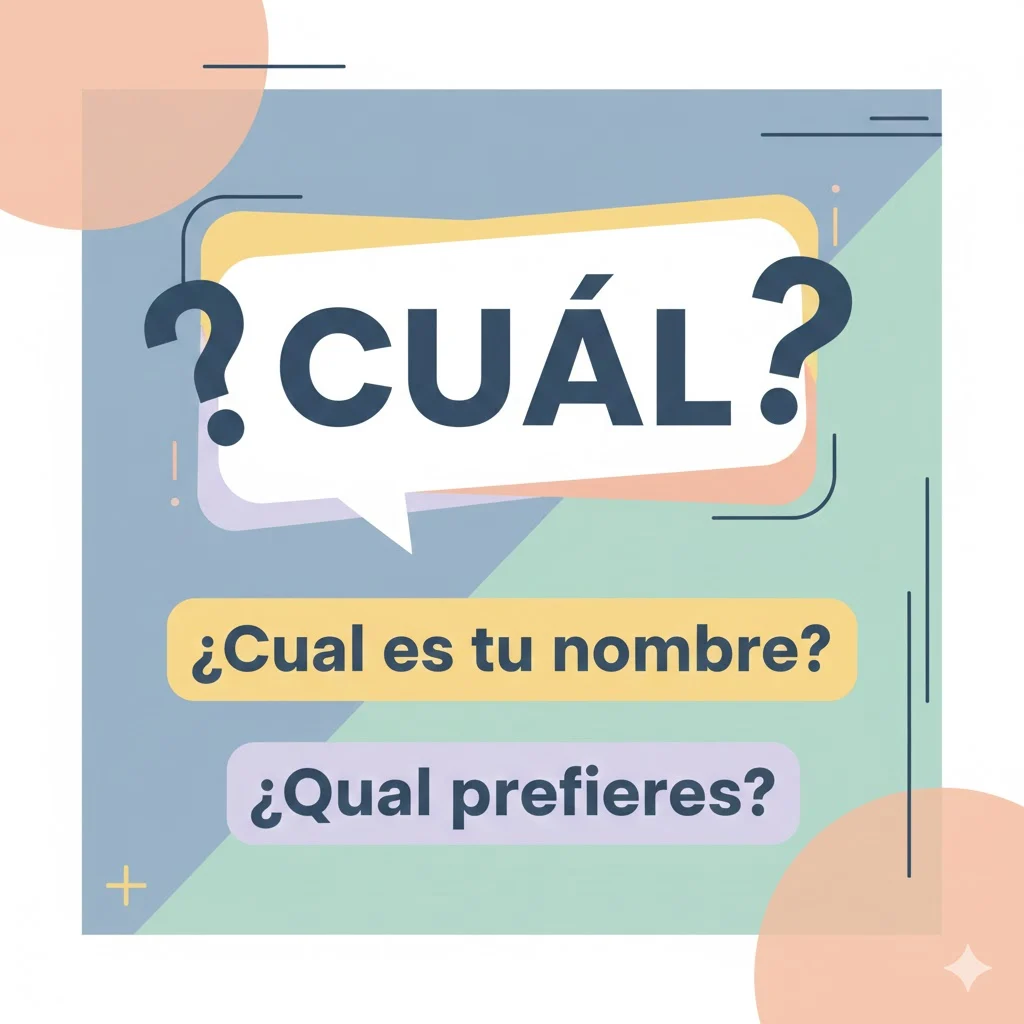

Cual is a Spanish question word that means “which” or “what” depending on the context. It is used to ask for a choice among options, or to request specific information when there are multiple possibilities.
If you are learning Spanish, you may have noticed that cual appears in many common questions. It looks simple, but it can be tricky because it changes depending on the situation. Knowing how to use cual correctly will help you ask clearer questions, sound more natural, and understand conversations faster.
In this guide, you will learn what cual means in Spanish, how it is used in real conversations, when to use it instead of similar question words, and how to form correct questions with it. By the end, you will feel confident using cual like a native speaker.
What Does Cual Mean in Spanish?
Cual is a Spanish question word that generally translates to “which” or “what.”
It is used when:
- You are choosing between multiple options
- You need specific information
- The question is based on a selection
In many cases, cual is followed by es, as in ¿Cuál es…?, meaning “Which is…?”
Cual vs Cuál: Accent Matters
The accent on cuál changes how it functions.
Cuál (with accent)
- Used as a question word
- Means “which” or “what”
- Always used in questions
Cual (without accent)
- Used in statements or relative clauses
- Means “which” or “that”
- Often appears after el, la, los, las
Example:
- La casa en la cual vivo
The house in which I live
So, the accent is important because it signals a question.
How to Use Cuál in Questions
1. Cuál + Verb
Examples:
- ¿Cuál es tu nombre?
What is your name? - ¿Cuál es tu color favorito?
Which is your favorite color? - ¿Cuál prefieres?
Which one do you prefer?
2. Cuál + Noun
Examples:
- ¿Cuál libro te gusta más?
Which book do you like more? - ¿Cuál comida es la mejor?
Which food is the best?
When cuál is followed by a noun, it still asks for a specific choice.
Cuál vs Qué: Key Difference
Many learners confuse cuál and qué, because both can mean “what.”
Here is the simplest way to remember the difference.
Use qué when:
- You ask for a definition or explanation
- You are not choosing between options
Examples:
- ¿Qué es esto?
What is this? - ¿Qué significa?
What does it mean?
Use cuál when:
- You choose between options
- You ask for a specific item from a group
Examples:
- ¿Cuál prefieres?
Which do you prefer? - ¿Cuál de estos es tu favorito?
Which of these is your favorite?
Examples of Cuál in Real Conversations
Here are examples that show how native speakers use cuál in different situations.
Friendly Tone 😊
- ¿Cuál es tu plan para hoy?
What is your plan for today? - ¿Cuál es tu música favorita?
Which music do you like the most?
Neutral Tone
- ¿Cuál es tu dirección?
What is your address? - ¿Cuál es el problema?
What is the problem?
Slightly Stronger or Serious Tone
- ¿Cuál es la razón?
What is the reason? - ¿Cuál es tu decisión?
What is your decision?
These questions can sound more serious depending on context.
Cual vs Cuál: Summary Table
| Word | Meaning | Use | Example |
|---|---|---|---|
| Cuál | Which or what | Questions | ¿Cuál es tu nombre? |
| Cual | Which or that | Statements | La razón por la cual lo hice |
| Qué | What | Definition or explanation | ¿Qué es eso? |
This table helps you quickly identify the right word in different situations.
Common Mistakes with Cuál
Even advanced learners can make mistakes with cuál. Here are some common ones.
Using Cuál Instead of Qué
Incorrect:
- ¿Cuál es esto?
Correct:
- ¿Qué es esto?
You use qué because you are asking for a definition.
Using Cuál Without Options
Incorrect:
- ¿Cuál es tu nombre? (This is correct, but it can feel like there are options)
Correct:
- ¿Cómo te llamas?
While ¿Cuál es tu nombre? is correct, ¿Cómo te llamas? is more natural in casual speech.
Common Phrases with Cuál
These phrases are very common in daily conversation and are worth memorizing.
Examples:
- ¿Cuál es tu número?
What is your number? - ¿Cuál es tu problema?
What is your problem? - ¿Cuál es la hora?
What time is it? - ¿Cuál es la diferencia?
What is the difference?
Polite and Professional Alternatives
In formal or professional settings, you may want to sound more polite.
Here are some alternatives:
- ¿Cuál sería su preferencia?
Which would be your preference? - ¿Cuál es su opinión?
What is your opinion? - ¿Cuál es el procedimiento correcto?
What is the correct procedure?
These phrases sound respectful and professional.
Alternate Meanings of Cual (without accent)
When cual is used without an accent, it is not a question word.
Instead, it is used in statements and means “which” or “that.”
Examples:
- La razón por la cual vine
The reason why I came - El lugar en el cual crecí
The place where I grew up
In these cases, cual connects ideas and creates more complex sentences.
Frequently Asked Questions
1. What does cual mean in Spanish?
Cuál means “which” or “what” when used in questions.
2. Is cual always a question word?
No. When written without an accent, cual can be used in statements.
3. What is the difference between cual and que?
Qué asks for definition or explanation, while cuál asks for choice between options.
4. Is “cuál es” always correct?
Yes, cuál es is common in questions, but sometimes a more natural phrase exists.
5. When do you use cual instead of qué?
Use cuál when there is a choice or specific option.
6. Can cual be used with a noun?
Yes. For example, ¿Cuál libro? means “Which book?”
7. Can cual be used in formal speech?
Yes, it is commonly used in both formal and casual speech.
8. Is it okay to use cuál in texting?
Yes, it is very common and natural in texting and online conversations.
Conclusion
So, what does cual mean in Spanish? It is a question word that means which or what and is used when you are choosing between options or asking for specific information.
To summarize:
- Cuáles is used for questions
- Cual without an accent is used in statements
- Qué is used for definitions and explanations
- Cuáles helps you ask clearer, more precise questions
Once you understand how cuál works, your Spanish questions will sound more natural and accurate.
Discover More Post
What Does PA Mean in Baseball? Complete Guide for Fans …
What Does Turnkey Mean in Real Estate? Definition …
7 Mean in Point Spread? Simple Betting Explanation for 2026