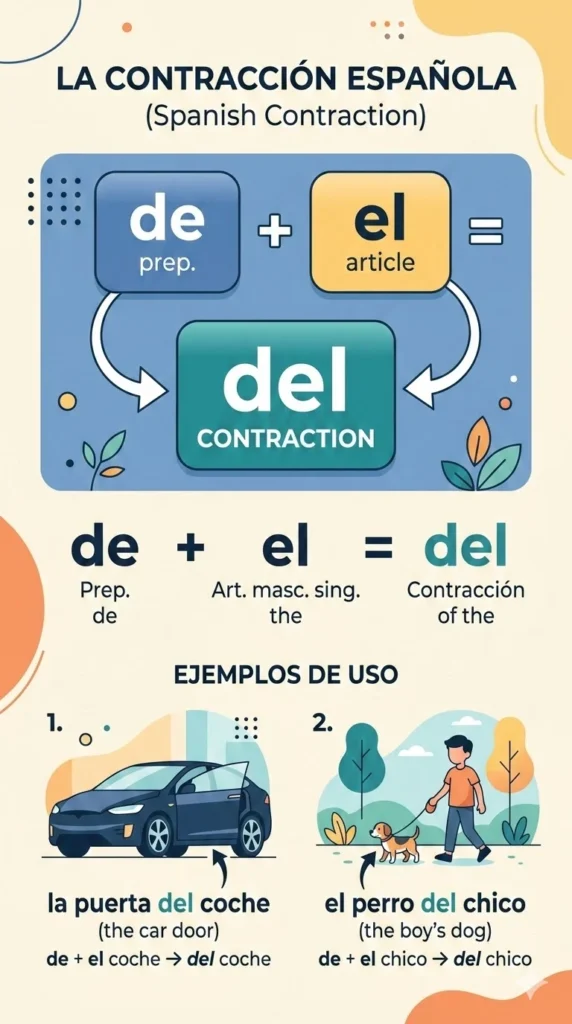

Del in Spanish is a contraction of “de” (of or from) and “el” (the). The word del therefore means “of the” or “from the” and is commonly used before masculine singular nouns.
If you are learning Spanish or reading Spanish content, you will likely notice the small word del appearing frequently in sentences. Even though it looks simple, this word plays an important grammatical role in Spanish.
Many beginners assume del is a standalone word with its own meaning. However, the truth is that del is actually a contraction, created by combining two separate words.
Understanding how del works will help you read Spanish more easily and build more natural sentences. In this guide, you will learn exactly what del means in Spanish, where it comes from, how it is used in real conversations, and how it compares with similar Spanish words.
What Does Del Mean in Spanish?
In Spanish, del means “of the” or “from the.”
It is formed by combining two words:
- de meaning “of,” “from,” or “about”
- el meaning “the” (masculine singular)
When these two words appear together, Spanish grammar requires them to merge into del.
For example:
Voy al centro del pueblo
I am going to the center of the town
Salimos del restaurante
We left the restaurant
Because of this rule, de el is almost never written separately. Instead, it becomes del.
Why Spanish Uses Del
Spanish grammar often simplifies combinations of common words. The contraction del exists to make sentences smoother and easier to pronounce.
Without this contraction, sentences would sound awkward.
For instance:
Incorrect form
La puerta de el coche
Correct form
La puerta del coche
The door of the car
Therefore, del is not optional. When de and el appear together, they must combine.
The Structure Behind Del
To understand del, it helps to break down its components.
De
The preposition de can mean several things depending on context:
- of
- from
- about
- belonging to
- made of
El
The article el means “the” and is used with masculine singular nouns.
Combined Meaning
When combined, de + el = del, which translates as:
- of the
- from the
- belonging to the
This contraction is one of the most common structures in Spanish sentences.
Common Situations Where Del Is Used
There are several everyday situations where del appears naturally.
1. Showing Possession
One of the most frequent uses of del is to indicate possession or belonging.
Examples:
La casa del profesor
The house of the teacher
El color del coche
The color of the car
La puerta del edificio
The door of the building
In each example, del connects the object with its owner or source.
2. Indicating Origin or Source
Another common use is describing where something comes from.
Examples:
Vengo del trabajo
I come from the work
Salimos del cine
We left the movie theater
El agua viene del río
The water comes from the river
Here, del clearly indicates the starting place.
3. Describing Parts of Something
Spanish also uses del when referring to parts of a larger object.
Examples:
La capital del país
The capital of the country
La página del libro
The page of the book
El techo del edificio
The roof of the building
This structure appears often in both spoken and written Spanish.
4. Talking About Time or Events
In some cases, del helps describe something related to a specific event or time.
Examples:
El comienzo del año
The beginning of the year
La historia del siglo
The history of the century
La música del concierto
The music of the concert
Although simple, these phrases are extremely common in everyday communication.
Examples of Del in Real Sentences
Looking at real sentences makes it easier to understand how del functions.
Friendly Tone
Vamos al parque del barrio
We are going to the neighborhood park
Me gusta el café del restaurante
I like the coffee from the restaurant
Neutral Tone
La puerta del hotel está abierta
The door of the hotel is open
El precio del producto es alto
The price of the product is high
Negative or Frustrated Tone
Estoy cansado del ruido
I am tired of the noise
No me gusta el final del libro
I do not like the ending of the book
In each example, del naturally links two parts of the sentence.
Del vs De: Understanding the Difference
One point that confuses many learners is the difference between de and del.
The rule is actually simple.
De is used by itself unless the next word is el.
Comparison Table
| Word | Meaning | Example |
|---|---|---|
| de | of, from | La casa de María |
| del | of the, from the | La casa del profesor |
Example sentences:
La puerta de María
The door of Maria
La puerta del coche
The door of the car
Whenever de is followed by el, they must combine to form del.
Del vs Al: Another Common Contraction
Spanish has another contraction similar to del.
Comparison Table
| Contraction | Words Combined | Meaning |
|---|---|---|
| del | de + el | of the, from the |
| al | a + el | to the |
Examples:
Voy al parque
I go to the park
Salgo del parque
I leave the park
Both contractions are extremely common in everyday Spanish.
Situations Where Del Is Not Used
Although del is common, it does not appear in every situation.
For example, it is not used before feminine nouns.
Incorrect
de la casa → del casa
Correct
de la casa
This happens because la is feminine, so the contraction rule does not apply.
Examples:
La puerta de la casa
The door of the house
La historia de la ciudad
The history of the city
Therefore, del only works with masculine singular nouns.
Common Mistakes with Del
Many Spanish learners make small errors when using del.
Writing De El Instead of Del
Incorrect
de el coche
Correct
del coche
Spanish grammar requires the contraction.
Using Del with Feminine Words
Incorrect
del casa
Correct
de la casa
Always check whether the noun is masculine or feminine.
Forgetting the Meaning of De
Because del includes de, it can express multiple meanings such as possession, origin, or description.
Understanding context helps determine the best translation.
Alternate Meanings of Del
In most situations, del simply means “of the” or “from the.”
However, the exact meaning depends on context.
For example:
La historia del libro
The story of the book
Salimos del restaurante
We left the restaurant
Although the translation changes slightly, the grammatical function stays the same.
Polite and Professional Uses of Del
Because del is part of standard grammar, it appears naturally in professional Spanish as well.
Examples:
El director del proyecto
The director of the project
El informe del departamento
The report of the department
La reunión del equipo
The meeting of the team
These expressions are common in business communication, academic writing, and formal speech.
Frequently Asked Questions
1. What does del literally mean in Spanish?
Del literally means “of the” or “from the.”
2. What two words make del?
Del is formed from de and el.
3. Can you write de el instead of del?
No. Spanish grammar requires the contraction del.
4. When is del used in Spanish?
It is used whenever de appears before the masculine article el.
5. Is del used before feminine nouns?
No. Feminine nouns use de la instead.
6. Is del formal or informal?
It is standard Spanish and used in all contexts.
7. Is del similar to al?
Yes. Both are contractions. Del comes from de + el, while al comes from a + el.
8. Is del common in everyday Spanish?
Yes. It appears very frequently in both spoken and written Spanish.
Conclusion
So, what does del mean in Spanish? In simple terms, del means “of the” or “from the.” It is formed by combining the words de and el, creating a contraction used before masculine singular nouns.
Here are the key points to remember:
Del comes from de + el
It means of the or from the
It is used for possession, origin, and description
It only appears before masculine nouns
It is one of the most common contractions in Spanish
Once you understand del, Spanish sentences become easier to read and build. With practice, recognizing and using this small word will feel completely natural.
Discover More Post
TS Meaning in Text: What Does TS Stand For in Messages? in …
SYBAU Meaning in Text Definition, Usage, and Examples for …