
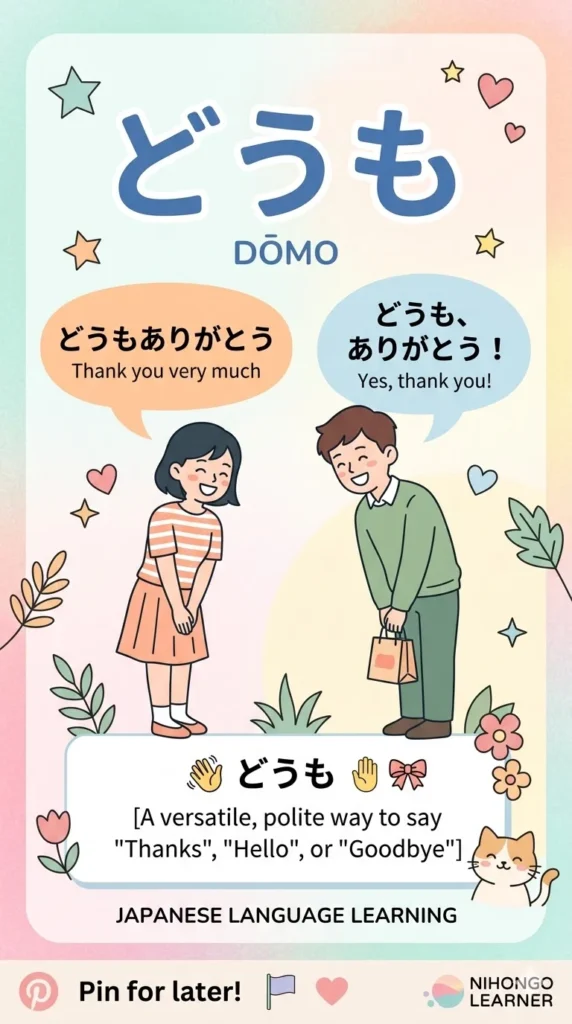

Domo is a Japanese word that generally means “thanks” or “very” depending on context. Most commonly, it is used to express gratitude, especially in phrases like domo arigatou, which means “thank you very much.”
If you have ever watched anime or explored Japanese culture, then you have likely heard the word domo. At first, it may seem like a simple expression. However, once you look closer, you will notice that it carries multiple meanings depending on how and where it is used.
In fact, domo is a great example of how context shapes meaning in Japanese. Sometimes it expresses appreciation, while at other times it acts as an intensifier or polite filler. Therefore, understanding it properly can make a big difference in how natural your Japanese sounds.
In this guide, you will learn exactly what domo means in Japanese, how it is used in real conversations, and when to avoid it. Along the way, you will also see practical examples and comparisons that make everything easier to understand.
What Does Domo Mean in Japanese?
In Japanese, domo can have several meanings depending on context. Most importantly, it is often used to express gratitude or emphasis.
In general, domo can mean:
- “Thanks” in a casual sense
- “Very” or “quite” as an intensifier
- A polite conversational expression
As a result, the meaning changes based on how it is used in a sentence. For example, when combined with other words, it often strengthens the level of politeness.
Origin and Meaning of Domo
To understand domo better, it helps to look at its origin.
The word comes from the Japanese adverb どうも, which is traditionally used to add emphasis. In other words, it originally functioned more like “very” or “really” rather than “thank you.”
Over time, however, it became strongly associated with expressions of gratitude. Consequently, phrases like domo arigatou became widely used, and domo started to feel like a shorthand for thanks.
How Domo Is Used in Real Life
Because domo is flexible, its meaning depends on the situation. Let’s explore the most common uses step by step.
1. As a Casual Way to Say Thanks
First of all, domo can be used alone as a quick and informal way to say “thanks.”
Examples:
- Domo
Thanks - Domo! 😊
Thanks!
In this case, it sounds friendly and relaxed. However, it is best used with people you know well.
2. As Part of “Domo Arigatou”
More commonly, domo appears in longer expressions.
For example:
- Domo arigatou
Thank you very much
Here, domo acts as an intensifier. In other words, it strengthens the meaning of arigatou.
As a result, the phrase sounds more appreciative and expressive.
3. In Formal Expressions
In addition, domo is often used in polite or formal phrases.
Examples:
- Domo arigatou gozaimasu
Thank you very much (formal) - Domo sumimasen
Thank you or excuse me (very polite)
In these situations, domo adds a level of politeness. Therefore, it helps the speaker sound more respectful.
4. As an Intensifier
Besides gratitude, domo can also function as an intensifier.
For instance:
- Domo okashii
Very strange - Domo muzukashii
Quite difficult
Although this usage is less common for beginners, it still appears in natural speech. So, recognizing it can improve your understanding.
Examples of Domo in Context
Now that you know the main uses, let’s look at how domo sounds in real conversations.
Friendly Tone 😊
- Domo! Tasukatta
Thanks! That helped - Domo arigatou
Thanks a lot
In these examples, the tone feels warm and casual.
Neutral Tone
- Domo arigatou gozaimasu
Thank you very much - Domo sumimasen
Thank you excuse me
Here, the tone becomes more polite and balanced.
Slightly Brief or Abrupt Tone 😐
- Domo
Thanks
On its own, domo can sound short. Therefore, tone and context matter a lot.
Domo vs Arigatou: Key Differences
Although both terms relate to gratitude, they are not identical.
Comparison Table
| Term | Meaning | Formality | Usage |
|---|---|---|---|
| Domo | Thanks or very | Flexible | Often casual or combined with phrases |
| Arigatou | Thank you | Neutral | Everyday use |
| Domo arigatou | Thank you very much | Polite | More expressive |
| Arigatou gozaimasu | Thank you | Formal | Respectful situations |
Key Insight
While arigatou is the main word for “thank you,” domo adds emphasis or tone. Therefore, it often works best alongside other words.
Common Phrases with Domo
To sound natural, it is helpful to learn common expressions.
For example:
- Domo arigatou
Thank you very much - Domo arigatou gozaimasu
Thank you very much (formal) - Domo sumimasen
Thank you excuse me - Domo domo
Thanks a lot or repeated gratitude
Because these phrases are widely used, they are worth remembering.
When Not to Use Domo
Even though domo is useful, there are situations where it may not be appropriate.
For instance, using it alone in formal settings can sound too casual. Similarly, when speaking to someone of higher status, it may feel insufficient.
Instead, you should use:
- Arigatou gozaimasu
- Domo arigatou gozaimasu
As a result, you will sound more polite and respectful.
Alternate Meanings of Domo
In standard Japanese, domo does not have completely separate meanings.
However, depending on tone, it can carry different nuances. For example, it may sound more casual, more polite, or more emphatic.
In addition, you might see domo in pop culture, such as character names or memes. Still, these uses are separate from its language meaning.
Polite and Professional Alternatives
If you want to sound more refined, there are several alternatives.
Casual but Clear
- Arigatou
Thank you
Polite
- Arigatou gozaimasu
Thank you very much
Very Formal
- Domo arigatou gozaimasu
Thank you very much
Choosing the right expression depends on the situation. Therefore, it is important to consider context.
Tips for Using Domo Naturally
To use domo correctly, keep these practical tips in mind:
- First, use it casually with friends or equals
- Next, combine it with other words for clarity
- Also, avoid using it alone in formal settings
- Finally, pay attention to tone and delivery
With time and practice, these choices will become natural.
Frequently Asked Questions
1. What does domo mean in Japanese?
It generally means “thanks” or “very,” depending on context.
2. Is domo polite?
It can be polite in phrases, but on its own it is usually casual.
3. What does domo arigatou mean?
It means “thank you very much.”
4. Can you say domo by itself?
Yes, but it sounds informal and should be used carefully.
5. Is domo the same as arigatou?
No. Arigatou means “thank you,” while domo adds emphasis.
6. Is domo commonly used in conversation?
Yes, especially in casual and semi formal situations.
7. What is the most polite way to say thank you?
Domo arigatou gozaimasu is a very polite option.
8. Can domo mean something other than thanks?
Yes. It can also act as an intensifier meaning “very.”
Conclusion
So, what does domo mean in Japanese? In simple terms, it is a flexible word that can mean “thanks” or “very,” depending on context.
To summarize:
- Domo often expresses gratitude
- It can also act as an intensifier
- It appears in both casual and polite phrases
- Context and tone are essential for correct use
Ultimately, once you understand how domo works, you will find it much easier to follow real Japanese conversations and respond naturally.
Discover More Post
What Does PCT Mean in Football? Simple … – DefineHubs.com –
What Does Excluded Mean in PowerSchool – DefineHubs.com –
What Does TS Mean in Snapchat? Full … – DefineHubs.com –