
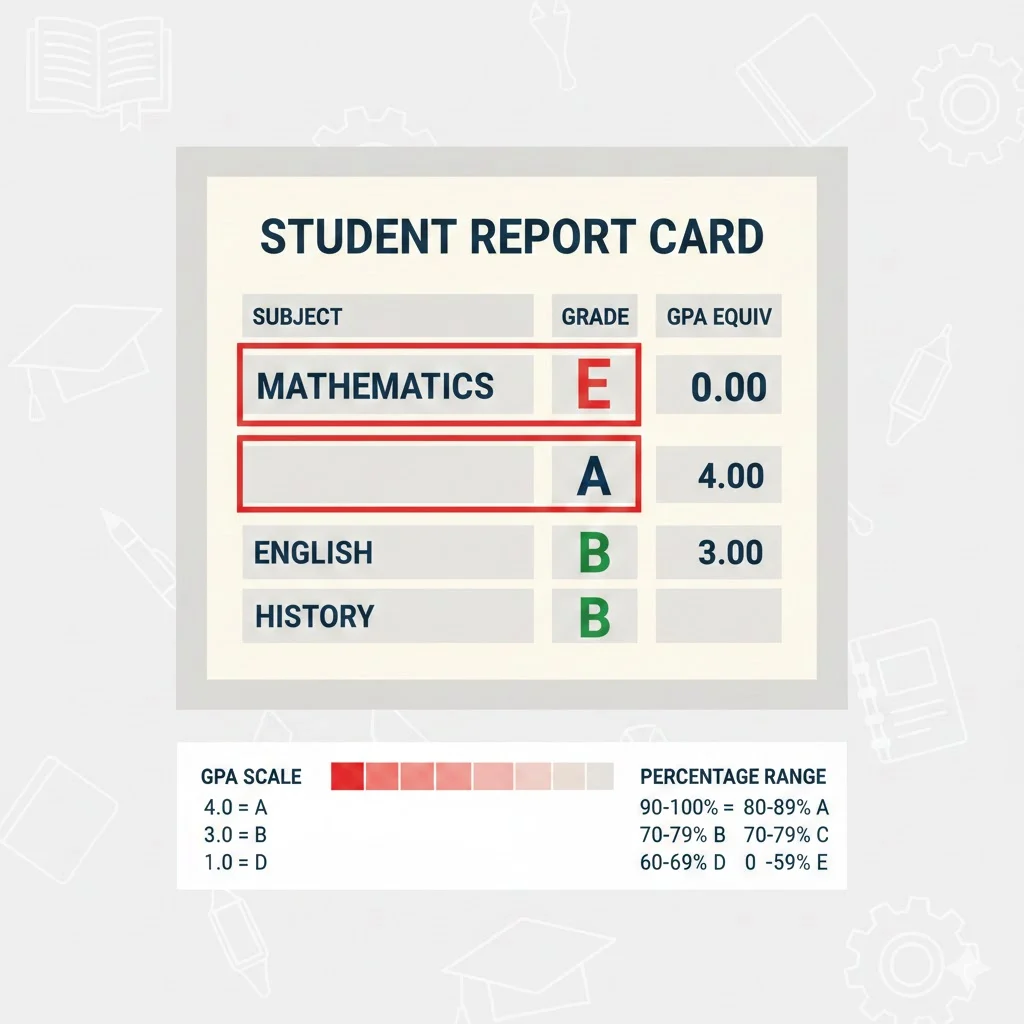

An E grade typically means “Failing” or “Not Passing.” In most grading systems, it represents performance below the minimum required standard and usually does not earn academic credit. However, the exact meaning can vary slightly depending on the country, school, or grading scale.
Seeing an unexpected letter on your report card can instantly raise questions. If you have ever asked yourself, “What does E mean in grades?” you are definitely not alone. While many people are familiar with A through F grading systems, the letter E can cause confusion because it is not used consistently everywhere.
In this guide, you will learn what an E grade usually means, how it affects GPA, how different countries treat it, and what steps you can take if you receive one. By the end, you will have a clear understanding of whether an E is failing, passing, or something in between.
What Does E Mean in Grades?
In most academic systems, an E grade means failing.
In other words, it indicates that a student did not meet the minimum academic requirements for the course or assignment. As a result, the student may not receive credit for that subject.
However, grading systems vary. Therefore, the exact meaning of E depends on the institution and location.
Why Is There an E Instead of an F?
This is one of the most common questions students ask.
In some grading systems, the letters go:
A
B
C
D
E
In these systems, E replaces F as the lowest grade. Historically, some schools skipped F to avoid confusion with “failure” as a label. Instead, E simply became the lowest performance category.
On the other hand, many schools use:
A
B
C
D
F
In that system, E does not appear at all.
Is an E Grade Passing or Failing?
In most cases, an E grade is failing.
Nevertheless, it is important to check your school’s grading policy because there are exceptions.
Typical Interpretation of an E Grade
- Below minimum passing threshold
- No course credit awarded
- May require retaking the course
- Usually affects GPA negatively
That said, some institutions may treat E as a low pass in rare grading scales. Always confirm with your school handbook or academic advisor.
E Grade in Different Countries
Because grading systems vary globally, the meaning of E can change depending on location.
United States
In most US schools and universities, E is equivalent to F, meaning failure. Some schools use E instead of F, while others skip E entirely.
United Kingdom
In GCSE and A Level grading, an E can sometimes be considered a low passing grade depending on the exam level and year. However, modern grading systems have shifted to number scales in many cases.
Australia and New Zealand
In some institutions, E may stand for “Elementary” or “Fail,” depending on the system used.
Europe
Some European grading systems use letters differently. Therefore, E might represent a specific percentage band rather than automatically meaning failure.
Because policies differ, it is always best to consult official academic documentation.
E Grade and GPA Impact
One of the biggest concerns students have is how an E affects their GPA.
Does an E Affect GPA?
Yes, in most systems, an E significantly lowers GPA.
In typical 4.0 GPA systems:
| Grade | GPA Value |
|---|---|
| A | 4.0 |
| B | 3.0 |
| C | 2.0 |
| D | 1.0 |
| E or F | 0.0 |
If an E equals 0.0 grade points, it can quickly lower cumulative GPA, especially if the course carries multiple credit hours.
What Percentage Is an E Grade?
Although it varies by institution, an E grade often corresponds to:
- Below 60 percent in many US systems
- Below the minimum passing mark
- Sometimes 40 to 49 percent in certain international systems
Since grading thresholds differ, confirm your school’s percentage scale for accuracy.
Common Reasons Students Receive an E
Understanding why E grades happen can help prevent them in the future.
Some common causes include:
- Missing assignments
- Poor exam performance
- Low attendance
- Incomplete coursework
- Academic misconduct
Sometimes, however, students receive an E due to personal challenges such as illness or family emergencies. In those situations, communication with instructors is especially important.
What Should You Do If You Get an E?
Receiving an E can feel discouraging. However, it does not define your academic ability or future success.
Here are practical steps you can take.
1. Review the Grading Breakdown
First, check how your final grade was calculated. Look at assignment weights and exam scores.
2. Talk to Your Teacher or Professor
Next, schedule a meeting. Ask for feedback and clarification. Sometimes errors can be corrected.
3. Ask About Retake Options
In many schools, students can:
- Retake the course
- Complete extra credit
- Apply for grade replacement
- Request academic probation guidance
4. Create a Recovery Plan
After understanding what went wrong, make a realistic study plan. Consider tutoring, study groups, or time management strategies.
Emotional Reactions to an E Grade
It is completely normal to feel:
- Disappointed
- Embarrassed
- Frustrated
- Anxious
However, many successful students have failed at some point. What matters most is how you respond afterward.
E Grade vs Other Low Grades
To better understand where E stands, here is a comparison.
| Grade | Meaning | Passing Status |
|---|---|---|
| D | Barely meets minimum | Usually passing |
| E | Below minimum standard | Usually failing |
| F | Failing | Failing |
In systems where both E and F exist, E may represent slightly higher performance than F but still not enough to pass.
Alternate Meanings of E in Academic Contexts
Although E typically means failing, there are a few alternate academic uses.
In some institutions, E may stand for:
- Excused
- Excellent in elementary grading scales
- Extended or incomplete in rare systems
Because meanings vary, context is key.
Professional and Academic Alternatives to E
Instead of listing E directly, some institutions use clearer terms such as:
- Fail
- Not Passed
- No Credit
- Unsatisfactory
These alternatives remove ambiguity and clearly communicate performance status.
Frequently Asked Questions
1. Is an E grade worse than a D?
Yes. In most grading systems, an E is lower than a D and typically considered failing.
2. Does an E mean I failed?
In most cases, yes. However, you should confirm with your school’s grading policy.
3. Can I graduate with an E grade?
It depends. If the course is required, you may need to retake it.
4. Does an E affect financial aid?
Possibly. Poor academic performance can affect eligibility for scholarships or aid programs.
5. Can an E be removed from my transcript?
Some schools allow grade replacement after retaking a course.
6. What percentage is usually an E?
Often below 60 percent, but it varies by institution.
7. Is E used in all schools?
No. Many schools use A through F without including E.
8. Can an E turn into an incomplete?
In some cases, if there were valid circumstances, an instructor may convert it to an incomplete before final grading deadlines.
Conclusion
So, what does E mean in grades? In most educational systems, it means failing or not passing, and it usually does not earn academic credit.
Although receiving an E can feel stressful, it is not the end of your academic journey. Instead, it is a signal to reassess your strategy, seek support, and take corrective action.
To summarize:
- E typically means failing
- It often equals 0.0 GPA points
- It may require course retake
- Policies vary by country and institution
- Recovery options are often available
If you ever receive an E, focus on learning from the experience and building a stronger plan moving forward. Academic setbacks happen, but persistence makes the difference.
Discover More Post
What Does Andante Mean in Music? Simple Explanation with …
What Does Fertile Mean in a Woman? Clear Meaning and …


