
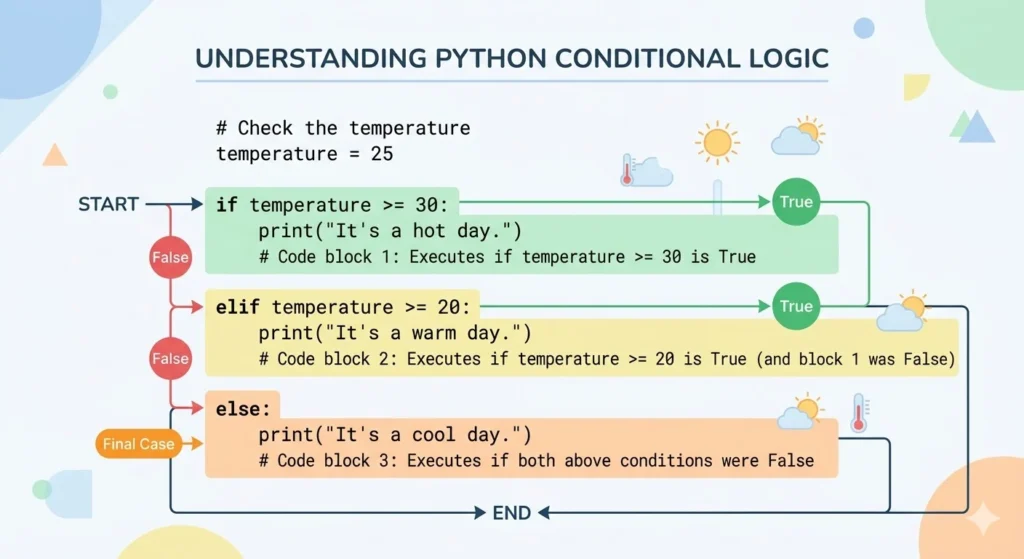

elifin Python means “else if.” It is used in conditional statements to check multiple conditions in sequence. If the first condition is false, Python evaluates theelifcondition next.
When you start learning Python, one of the first concepts you encounter is decision making. Programs often need to choose between different actions based on conditions, and that is where keywords like if, elif, and else come into play.
Among these, elif can feel slightly confusing at first. However, once you understand its purpose, it becomes a powerful tool for writing clean and efficient code. In this guide, you will learn exactly what elif means in Python, how it works, when to use it, and how it compares to similar structures.
What Does Elif Mean in Python?
In Python, elif stands for “else if.”
It is used in conditional statements to test additional conditions after an if statement. If the original if condition is false, Python moves on to the elif condition.
As a result, elif allows you to check multiple possibilities without writing separate if statements.
Why Elif Is Important in Python
When writing programs, you often need to evaluate more than one condition. Instead of writing many separate if statements, Python provides elif to keep your code organized.
Because of this, using elif helps you:
- Avoid unnecessary repetition
- Improve readability
- Make logic easier to follow
- Ensure only one block of code runs
In other words, elif makes your code cleaner and more efficient.
Basic Syntax of Elif
To understand how elif works, it helps to see the structure of a conditional statement.
if condition1:
    # code block 1
elif condition2:
    # code block 2
elif condition3:
    # code block 3
else:
    # code block 4
Here is how Python evaluates this structure:
- First, it checks the
ifcondition - If it is false, it checks the first
elif - If that is also false, it checks the next
elif - Finally, if none are true, it runs the
elseblock
How Elif Works Step by Step
Let’s look at a simple example.
age = 18if age < 13:
    print("Child")
elif age < 18:
    print("Teen")
else:
    print("Adult")
Explanation
- Python first checks if age is less than 13
- Since it is false, it moves to
elif - Next, it checks if age is less than 18
- That is also false
- Finally, it runs the
elseblock and prints “Adult”
This flow ensures that only one result is printed.
When to Use Elif
There are several common situations where elif is useful.
1. Checking Multiple Conditions
First, use elif when you have more than one possible condition.
score = 75if score >= 90:
    print("A")
elif score >= 70:
    print("B")
else:
    print("C")
In this case, Python checks each condition in order.
2. Creating Decision Trees
Next, elif is helpful when building logical decision paths.
temperature = 30if temperature > 35:
    print("Very hot")
elif temperature > 25:
    print("Warm")
else:
    print("Cool")
This structure clearly separates each outcome.
3. Avoiding Multiple If Statements
Instead of writing separate if statements, you can combine them with elif.
Less efficient approach:
if x == 1:
    print("One")if x == 2:
    print("Two")
Better approach:
if x == 1:
    print("One")
elif x == 2:
    print("Two")
This ensures only one condition runs.
Real World Examples of Elif
To make things clearer, here are practical examples.
Example 1: Login System
username = "admin"if username == "admin":
    print("Welcome Admin")
elif username == "guest":
    print("Welcome Guest")
else:
    print("Access Denied")
Example 2: Traffic Light System
light = "yellow"if light == "red":
    print("Stop")
elif light == "yellow":
    print("Slow down")
else:
    print("Go")
These examples show how elif simplifies real life logic in code.
Elif vs If vs Else
Understanding how elif compares to if and else is essential.
Comparison Table
| Keyword | Purpose | When It Runs |
|---|---|---|
| if | Checks the first condition | Always checked first |
| elif | Checks additional conditions | Runs if previous conditions are false |
| else | Default case | Runs if all conditions are false |
Key Insight
ifstarts the decisionelifadds more optionselsehandles everything else
Important Rules for Using Elif
To use elif correctly, keep these rules in mind.
Elif Must Follow If
You cannot use elif without an if.
You Can Use Multiple Elif Statements
Python allows as many elif conditions as needed.
Only One Block Executes
Once a condition is true, Python skips the rest.
Indentation Matters
Python relies on indentation to define code blocks.
Incorrect:
if x > 0:
print("Positive")
Correct:
if x > 0:
    print("Positive")
Common Mistakes with Elif
Even beginners quickly run into small errors.
Using Else If Instead of Elif
Incorrect:
else if x > 10:
Correct:
elif x > 10:
Python requires the keyword to be written as one word.
Forgetting the Colon
Each condition must end with a colon.
Overusing Elif
Sometimes too many elif statements make code harder to read. In such cases, consider using dictionaries or other structures.
Alternatives to Elif
Although elif is useful, there are other approaches.
Using Dictionaries
day = 1days = {
    1: "Monday",
    2: "Tuesday"
}print(days.get(day, "Unknown"))
Using Match Case (Python 3.10 and Above)
value = 2match value:
    case 1:
        print("One")
    case 2:
        print("Two")
This can replace long chains of elif.
Frequently Asked Questions
1. What does elif stand for in Python?
It stands for “else if.”
2. Can you use elif without if?
No. It must follow an if statement.
3. How many elif statements can you use?
You can use as many as needed.
4. Does Python check all elif conditions?
No. It stops once a true condition is found.
5. Is elif required in every if statement?
No. It is optional.
6. What is the difference between elif and else?
elif checks another condition, while else runs when all conditions are false.
7. Can elif have complex conditions?
Yes. You can use logical operators like and, or, and not.
8. Is elif faster than multiple if statements?
Yes. It is generally more efficient because it stops checking once a condition is met.
Conclusion
So, what does elif mean in Python? It means “else if” and is used to check additional conditions when the first if condition is false.
To summarize:
elifallows multiple conditions in a single structure- It improves readability and efficiency
- It ensures only one block of code runs
- It must follow an
ifstatement - It is widely used in decision making logic
By mastering elif, you can write cleaner, smarter, and more effective Python programs.
Discover More Post
What Does PF Mean in Fantasy Football? Complete Guide …
What Does Volume Mean in Science? Definition, Formula …
What Does PCT Mean in Football? Simple … – DefineHubs.com –