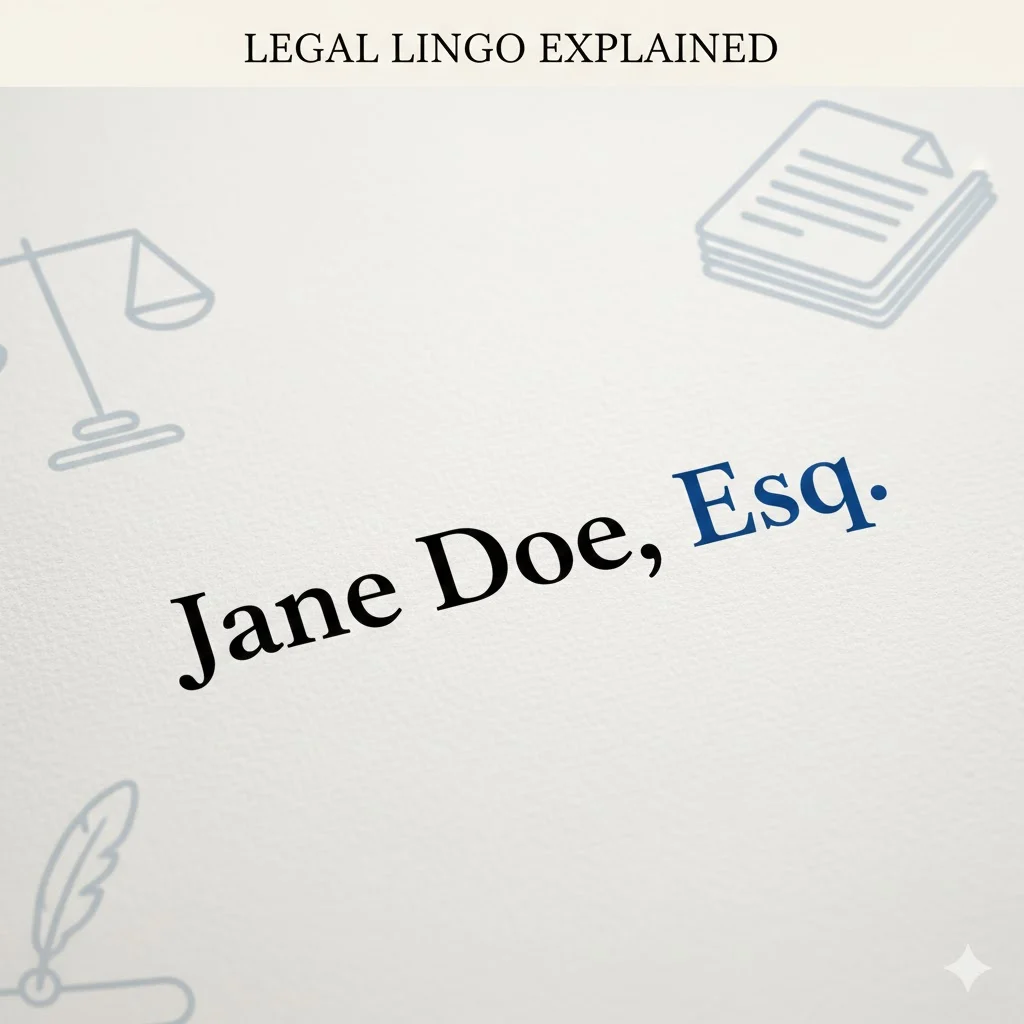

Esq means Esquire, a title used in law to show that a person is a licensed attorney. Lawyers place it after their name as a professional designation, not as an academic degree or job title.
Legal documents often contain abbreviations that confuse readers who do not work in the legal field. One of the most common examples is Esq. You may notice it after a lawyer’s name on letters, contracts, court filings, or email signatures and wonder what purpose it serves.
In simple terms, Esq signals that someone has the legal authority to practice law. This article explains what Esq means in law, where it comes from, how lawyers use it today, and how it differs from other legal titles.
What Does Esq Mean in Law?
In legal contexts, Esq stands for Esquire.
Lawyers place Esq after their full name to indicate that they hold a valid license to practice law. Unlike titles such as Mr or Ms, Esq never appears before a name.
Correct usage:
Jane Smith, Esq
Incorrect usage:
Esq Jane Smith
In modern practice, Esq functions as a written professional identifier, not a spoken form of address.
Origin and History of Esq
The word Esquire originated in medieval England. At that time, people used it to describe a man of higher social rank, usually someone just below a knight.
Over the centuries, the meaning shifted. As the legal profession developed, society began to associate Esquire with trained legal professionals. Eventually, lawyers adopted the shortened form Esq for written communication.
Today, the term no longer reflects social class. Instead, it serves one clear purpose: identifying a licensed attorney.
How Lawyers Use Esq Today
Modern lawyers use Esq primarily in writing.
You will commonly see it in:
- Legal letters and notices
- Court documents and pleadings
- Business cards
- Email signatures
- Professional legal directories
Although Esq signals professional status, it does not indicate seniority, specialization, or experience level.
When to Use Esq Correctly
Using Esq properly helps maintain professional accuracy and respect.
Correct Placement
Always place Esq after the full name.
Example:
Daniel Harris, Esq
Avoid combining it with other titles.
Incorrect:
Mr Daniel Harris, Esq
Correct:
Daniel Harris, Esq
Who May Use Esq?
Only licensed attorneys may use Esq.
People who should not use it include:
- Law students
- Paralegals
- Legal assistants
- Law school graduates who have not passed the bar
When you see Esq, you can reasonably assume the person has passed the bar exam and holds authorization to practice law.
Is Esq Used in Spoken Language?
Most lawyers do not say Esquire out loud.
In conversation, people usually address lawyers as:
- Mr or Ms
- Attorney
- Counselor
- Their professional role, such as Partner or Associate
Saying “Esquire” aloud often sounds outdated or overly formal in modern settings.
Esq vs JD vs Attorney
Legal titles often overlap, which can create confusion. A side by side comparison makes the differences clearer.
Legal Title Comparison Table
| Term | What It Means | How People Use It |
|---|---|---|
| Esq | Professional designation for a licensed lawyer | Written only |
| JD | Juris Doctor law degree | Academic credential |
| Attorney | Licensed legal professional | Spoken and written |
| Lawyer | General legal term | Formal and informal |
Someone may earn a JD but cannot use Esq unless they hold an active law license.
Examples of Esq in Context
Here are common ways lawyers and professionals use Esq correctly.
Formal Legal Writing
John R Williams, Esq
Attorney at Law
Dear Maria Lopez, Esq
Thank you for your recent correspondence.
Neutral Business Communication
Please contact Robert Chen, Esq, regarding the contract review.
Incorrect Example
Esq Robert Chen
This example places the title incorrectly.
Does Esq Apply Outside the United States?
Although Esq appears most often in the United States, some other common law countries recognize the term.
However, many regions prefer titles such as Solicitor or Barrister. Because of this, Esq does not function as a universal legal title worldwide.
Alternate Meanings of Esq
Outside legal usage, Esq has little modern meaning.
Historically, it referred to a gentleman of status. Today, people rarely use that definition, and most readers associate Esq exclusively with lawyers.
Professional Alternatives to Using Esq
In many situations, lawyers choose alternatives instead of Esq.
Common options include:
- Attorney at Law
- Counsel
- Legal Representative
In emails and casual correspondence, many lawyers rely on context and omit Esq entirely.
Common Mistakes with Esq
People frequently make the following errors:
- Placing Esq before a name
- Combining Esq with Mr or Ms
- Using Esq without a law license
- Assuming Esq reflects rank or seniority
Avoiding these mistakes ensures proper legal etiquette.
Frequently Asked Questions
1. What does Esq mean in law?
It means Esquire, a title that identifies a licensed attorney.
2. Is Esq the same as a law degree?
No. A law degree is a JD, while Esq shows professional licensing.
3. Can anyone add Esq after their name?
No. Only licensed lawyers should use it.
4. Do lawyers say Esq out loud?
No. Lawyers typically use it only in writing.
5. Do all attorneys use Esq?
No. Some prefer not to include it, especially in informal contexts.
6. Can law students use Esq?
No. Law students do not hold law licenses.
7. Does Esq exist outside the US?
Yes, but usage varies and is less common.
8. Is Esq still relevant today?
Yes. Legal professionals still recognize and respect it.
Conclusion
So, what does Esq mean in law? It identifies a person as a licensed attorney through a written professional designation.
To summarize:
- Esq stands for Esquire
- Lawyers place it after their name
- It does not represent a degree or rank
- Legal professionals mainly use it in writing
- Only licensed attorneys should use it
Understanding Esq makes legal documents easier to read and helps you communicate more confidently in professional legal settings.