
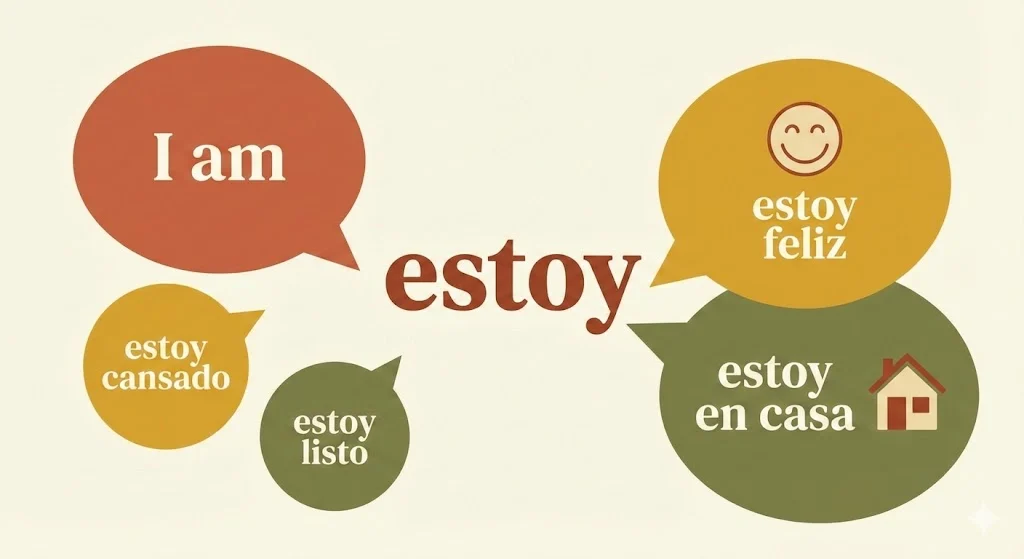

Estoy is a Spanish verb form that means “I am” when referring to a temporary state, condition, location, or feeling. It comes from the verb estar and is used to describe how someone is at a particular moment rather than something permanent.
Spanish is full of small words that carry big meaning, and estoy is one of them. At first glance, it looks like a simple translation of “I am.” However, once you start learning Spanish, you quickly realize that estoy follows its own rules and plays a key role in sounding natural and fluent.
Because Spanish uses two verbs for “to be,” understanding estoy is essential. In this guide, you will learn what estoy means in Spanish, when to use it, how it differs from similar forms, and how native speakers use it in real conversations.
What Does Estoy Mean in Spanish?
In Spanish, estoy means “I am,” but only in specific situations.
More precisely, estoy is the first person singular present tense form of the verb estar. It is used to describe states or situations that are temporary or changeable.
As a result, estoy commonly appears when talking about feelings, health, location, or what is happening right now.
The Verb Behind Estoy: Estar
To fully understand estoy, it helps to look at the verb it comes from.
Spanish has two different verbs that translate to “to be” in English:
- Ser
- Estar
Although they share the same English meaning, they are used in very different contexts.
Understanding Estar
In general, estar is used for conditions that can change over time. These include emotions, physical states, locations, and temporary situations.
Because estoy comes from estar, it naturally follows the same rules.
Present Tense Forms of Estar
| Subject | Form |
|---|---|
| Yo | estoy |
| Tú | estás |
| Él Ella Usted | está |
| Nosotros | estamos |
| Ellos Ustedes | están |
Knowing this conjugation helps you recognize and use estoy correctly in everyday speech.
When to Use Estoy
There are several common situations where estoy is the correct and natural choice. Below are the most important ones.
1. Temporary Physical or Emotional States
First of all, estoy is widely used to describe how someone feels at a given moment.
Examples:
- Estoy cansado
I am tired - Estoy feliz
I am happy - Estoy nervioso
I am nervous
Since emotions and physical feelings can change, Spanish uses estar instead of ser here.
2. Health and Well Being
In addition, health related expressions almost always use estoy.
Examples:
- Estoy enfermo
I am sick - Estoy mejor hoy
I am better today - Estoy agotada después del trabajo
I am exhausted after work
This usage sounds natural and is very common in daily conversations.
3. Location and Position
Another important use of estoy is to describe location.
Examples:
- Estoy en casa
I am at home - Estoy en España
I am in Spain - Estoy aquí ahora
I am here now
Unlike English, Spanish always uses estar for location, even when the place itself is permanent.
4. Temporary Situations or Conditions
Furthermore, estoy works well when describing situations that are happening for now.
Examples:
- Estoy ocupado ahora
I am busy right now - Estoy de vacaciones
I am on vacation - Estoy en una reunión
I am in a meeting
These situations are expected to change, which is why estoy is appropriate.
5. Ongoing Actions with the Present Progressive
Finally, estoy is used to form the present progressive tense, which is similar to “I am doing” in English.
The structure is:
estoy + gerund
Examples:
- Estoy estudiando
I am studying - Estoy trabajando
I am working - Estoy aprendiendo español
I am learning Spanish
This form emphasizes that the action is happening right now.
Examples of Estoy in Real Conversations
To better understand how estoy sounds in daily life, here are examples with different tones.
Friendly Tone 😊
- Estoy muy contento de verte
I am very happy to see you - Estoy bien gracias
I am good thanks
Neutral Tone
- Estoy en la oficina ahora
I am at the office now - Estoy listo
I am ready
Negative or Frustrated Tone 😐
- Estoy cansado de esto
I am tired of this - Estoy confundido
I am confused
In each case, estoy reflects a state that can change.
Estoy vs Soy: Key Differences
One of the most common challenges for Spanish learners is choosing between estoy and soy.
Although both mean “I am,” they serve different purposes.
Comparison Table
| Estoy | Soy |
|---|---|
| Temporary states | Permanent traits |
| Emotions and feelings | Identity and personality |
| Location | Origin |
| Conditions that change | Defining characteristics |
Example Comparison
- Estoy cansado
I am tired - Soy alto
I am tall - Estoy en casa
I am at home - Soy de México
I am from Mexico
A helpful way to remember this is that estoy describes how you are, while soy describes who you are.
Common Phrases with Estoy
Spanish speakers frequently use estoy in everyday expressions. Learning these phrases can improve fluency quickly.
Examples include:
- Estoy bien
I am fine - Estoy mal
I am not well - Estoy de acuerdo
I agree - Estoy seguro
I am sure - Estoy listo
I am ready
Because these phrases are so common, they are worth memorizing.
Common Mistakes with Estoy
Even though estoy is simple, learners still make predictable errors.
Using Estoy for Permanent Traits
Incorrect:
- Estoy inteligente
Correct:
- Soy inteligente
Intelligence is considered a permanent quality, so ser is required.
Forgetting Adjective Agreement
Additionally, adjectives used with estoy must agree in gender and number.
Examples:
- Estoy cansado
- Estoy cansada
- Estoy cansados
- Estoy cansadas
Ignoring agreement is a frequent beginner mistake.
Alternate Meanings of Estoy
In standard Spanish, estoy does not have separate dictionary meanings.
However, in informal speech, it can be used figuratively for emphasis.
Example:
- Estoy muerto
Literally, this means “I am dead,” but in casual conversation it usually means “I am extremely tired.”
Polite and Professional Uses of Estoy
Fortunately, estoy works well in professional and formal settings.
Examples:
- Estoy disponible para la reunión
I am available for the meeting - Estoy interesado en el puesto
I am interested in the position - Estoy agradecido por la oportunidad
I am grateful for the opportunity
These expressions are common in emails, interviews, and workplace conversations.
Frequently Asked Questions
1. What does estoy literally mean in Spanish?
Literally, estoy means “I am” and comes from the verb estar.
2. Is estoy used for permanent things?
No. It is used for temporary states, feelings, and locations.
3. What verb does estoy come from?
It comes from the verb estar.
4. Can estoy mean “I am feeling”?
Yes. In many cases, it naturally translates as “I am feeling.”
5. Why does Spanish use soy and estoy?
Spanish separates permanent identity from temporary states, which is why it has two verbs for “to be.”
6. Is estoy formal or informal?
It works in both formal and informal contexts.
7. Can estoy describe emotions?
Yes. Emotions are one of its most common uses.
8. How can I tell when to use estoy?
If the situation can change, estoy is usually the correct choice.
Conclusion
So, what does estoy mean in Spanish? In simple terms, it means “I am” when describing how you feel, where you are, or what condition you are in at the moment.
To summarize:
- Estoy comes from the verb estar
- It describes temporary states and locations
- It is different from soy, which describes permanent traits
- It is widely used in daily speech
- It fits casual, formal, and professional situations
Once you understand estoy, you are much closer to speaking Spanish naturally and confidently.
Discover More Post
What Does Mahalo Mean in Hawaiian? Real Meaning, Usage …
What Does KMSL Mean in Text? Full Meaning, Usage …