
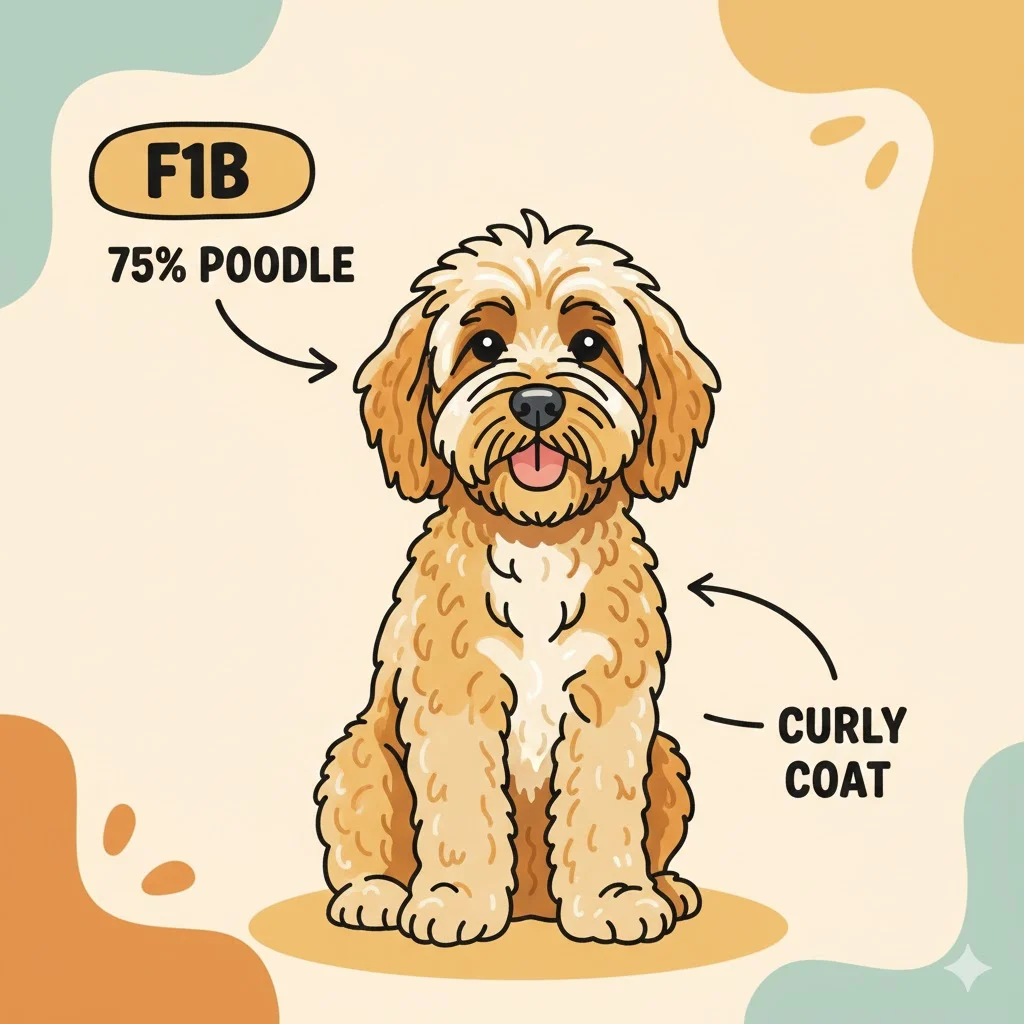

F1B in dogs refers to a first generation backcross, meaning a dog bred from an F1 hybrid dog and a purebred parent, most commonly a Poodle. This type of breeding is often used to increase specific traits such as coat type, allergy friendliness, or predictability.
If you have been researching designer dogs or browsing breeder websites, you may have noticed labels like F1, F1B, or even F2B next to puppy descriptions. At first, these terms can feel confusing, especially if you are new to dog breeding terminology.
Among them, F1B is one of the most common and most misunderstood labels. Many people assume it automatically means hypoallergenic or better quality, while others are unsure what makes it different from an F1 dog.
In this in depth guide, you will learn what F1B means in dogs, how F1B dogs are bred, why breeders use this method, what traits you can realistically expect, and whether an F1B dog is the right fit for your home.
What Does F1B Mean in Dogs?
In dog breeding, F1B means first generation backcross.
An F1B dog is produced by breeding:
- One F1 dog which is a 50 percent mix of two pure breeds
- One purebred dog from one of the original parent breeds
In most cases, especially with popular mixes like Goldendoodles or Labradoodles, the purebred parent is a Poodle.
As a result, an F1B dog is usually:
- 75 percent Poodle
- 25 percent of the other breed such as Golden Retriever or Labrador
This backcrossing is done intentionally to emphasize certain traits, most often coat type.
Understanding the F Generation System in Dogs
To truly understand F1B, it helps to look at the full generation system used in dog breeding.
What Does F Mean?
The letter F stands for filial, a term used in genetics to describe generations.
Each number or letter that follows shows how many generations removed the dog is from its original purebred parents.
Common Dog Generation Labels Explained
| Label | Meaning |
|---|---|
| F1 | First generation mix of two purebred dogs |
| F1B | F1 dog bred back to a purebred |
| F2 | Two F1 dogs bred together |
| F2B | F2 dog bred back to a purebred |
| Multigen | Multiple generations of mixed breeding |
This system helps breeders and buyers understand a dog’s genetic makeup more clearly.
How F1B Dogs Are Bred
An F1B dog comes from a very specific pairing.
The breeding looks like this:
- One parent is an F1 hybrid such as a Goldendoodle
- The other parent is a purebred dog, usually a Poodle
Because Poodles are known for their curly coats and low shedding qualities, they are commonly chosen for the backcross.
Consequently, many F1B dogs inherit:
- Curlier coats
- Less shedding
- More predictable coat textures
However, no breeding method can guarantee identical traits in every puppy.
Why Breeders Choose F1B Breeding
There are several reasons breeders intentionally produce F1B dogs.
1. More Predictable Coat Type
One major advantage of F1B breeding is coat consistency. Since the dog has a higher percentage of Poodle genetics, the coat is more likely to be curly or wavy.
This is especially appealing to families concerned about shedding.
2. Increased Allergy Friendly Potential
Although no dog is truly hypoallergenic, many people with allergies tolerate F1B dogs better.
This is because:
- Curly coats tend to trap dander
- Reduced shedding spreads less allergen
Still, individual reactions vary from person to person.
3. Strong Demand from Buyers
Another reason breeders produce F1B dogs is simple demand.
Many buyers specifically search for:
- F1B Goldendoodles
- F1B Labradoodles
- F1B Bernedoodles
As a result, F1B puppies are often easier to place in homes.
F1 vs F1B Dogs: What Is the Difference?
While F1 and F1B dogs may look similar, they are not genetically the same.
Key Differences Explained
| Trait | F1 Dog | F1B Dog |
|---|---|---|
| Breed Mix | 50 percent and 50 percent | 75 percent and 25 percent |
| Coat Type | Variable | More predictable |
| Shedding | Moderate to low | Lower in many cases |
| Appearance | Wide variation | Often more uniform |
| Allergy Friendly Potential | Moderate | Higher for some people |
Because of these differences, buyers often choose based on lifestyle and expectations.
Appearance and Coat Types in F1B Dogs
F1B dogs are best known for their coats, but not all coats are identical.
Common F1B Coat Types
- Curly coat similar to a Poodle
- Wavy coat sometimes called fleece
- Occasionally straight coat, though less common
Even within the same litter, puppies can look different.
Grooming Needs
Since many F1B dogs have curlier coats, grooming is essential.
Owners should expect:
- Regular brushing
- Professional grooming every 6 to 8 weeks
- Extra care to prevent matting
Therefore, lower shedding often comes with higher grooming responsibility.
Temperament of F1B Dogs
Temperament depends on both genetics and environment.
That said, F1B dogs often inherit strong personality traits from both parents.
Common Temperament Traits
- Intelligent and quick learners
- Affectionate and people oriented
- Social and family friendly
- Energetic but adaptable
Because Poodles are highly intelligent, F1B dogs often respond well to training.
Health Considerations for F1B Dogs
Many people assume mixed breed dogs are always healthier, but this is not always true.
Hybrid Vigor Explained
F1 dogs often benefit from hybrid vigor, which means a lower chance of inherited diseases.
However, with F1B dogs:
- Genetic diversity is reduced slightly
- Some breed specific conditions may become more likely
Common Health Concerns
Depending on the breeds involved, potential issues may include:
- Hip dysplasia
- Eye conditions
- Skin sensitivities
- Ear infections
Responsible breeders perform health testing to reduce these risks.
Are F1B Dogs Hypoallergenic?
This is one of the most common questions buyers ask.
The honest answer is no dog is completely hypoallergenic.
However, F1B dogs are often:
- Lower shedding
- More tolerable for allergy sufferers
That said, reactions vary widely.
Before committing, it is always wise to:
- Spend time with the breed
- Visit the breeder
- Test your allergy response
Common Dog Breeds Labeled as F1B
F1B is most commonly used with popular designer breeds.
Examples include:
- F1B Goldendoodle
- F1B Labradoodle
- F1B Bernedoodle
- F1B Sheepadoodle
- F1B Cockapoo
In nearly all cases, the backcross parent is a Poodle.
Common Misconceptions About F1B Dogs
Despite their popularity, there are many myths surrounding F1B dogs.
Myth 1: F1B Dogs Are Always Better
In reality, “better” depends on lifestyle, grooming tolerance, and expectations.
Myth 2: F1B Dogs Never Shed
Most F1B dogs shed less, but shedding can still occur.
Myth 3: F1B Means Guaranteed Health
Health depends on responsible breeding, not just generation labels.
Is an F1B Dog Right for You?
Choosing an F1B dog should be based on lifestyle, not trends.
An F1B dog may be a good fit if:
- You want lower shedding
- You are comfortable with regular grooming
- You enjoy training and interaction
On the other hand, an F1B dog may not be ideal if:
- You want minimal grooming
- You expect zero shedding
- You prefer a very independent dog
Alternate Meanings of F1B
Outside of dog breeding, F1B has other meanings.
For example:
- In genetics, it refers to a backcross generation
- In immigration, F1B is a type of US visa
However, in the context of dogs, F1B almost always refers to breeding generation.
Polite and Clear Ways Breeders Explain F1B
Responsible breeders often explain F1B in simple terms.
Examples:
- “This puppy is an F1B, meaning it is three quarters Poodle.”
- “An F1B is bred for a more consistent coat and lower shedding.”
Clear explanations help buyers make informed decisions.
Frequently Asked Questions
1. What does F1B mean in dogs?
F1B means a first generation dog bred back to a purebred parent, usually a Poodle.
2. Are F1B dogs purebred?
No. F1B dogs are mixed breed dogs with a higher percentage of one breed.
3. Do F1B dogs shed?
Many F1B dogs shed less, but shedding is still possible.
4. Are F1B dogs good for allergies?
They may be easier for some allergy sufferers, but results vary.
5. Is F1B better than F1?
Neither is better universally. The right choice depends on coat preference and lifestyle.
6. Are F1B dogs healthier?
Health depends on breeding practices, not just generation labels.
7. Why are most F1B dogs bred with Poodles?
Poodles contribute low shedding coats and high intelligence.
8. Do all breeders use the term F1B correctly?
Unfortunately, no. Always ask breeders to explain their breeding program.
Conclusion
So, what does F1B mean in dogs? It refers to a first generation backcross, usually created by breeding an F1 hybrid dog with a purebred Poodle. This results in a dog that often has a curlier coat, lower shedding potential, and more predictable traits.
To recap:
- F1B dogs are typically 75 percent Poodle
- They are bred for coat consistency and allergy friendliness
- Grooming needs are higher
- Health depends on responsible breeding
Ultimately, understanding F1B helps you make smarter, more informed decisions when choosing a dog. When expectations match reality, both owners and dogs thrive.
Discover More Post
What Does Delta H Mean in Chemistry? Simple Explanation …
What Does Holy Mean in the Bible? Biblical Meaning …