
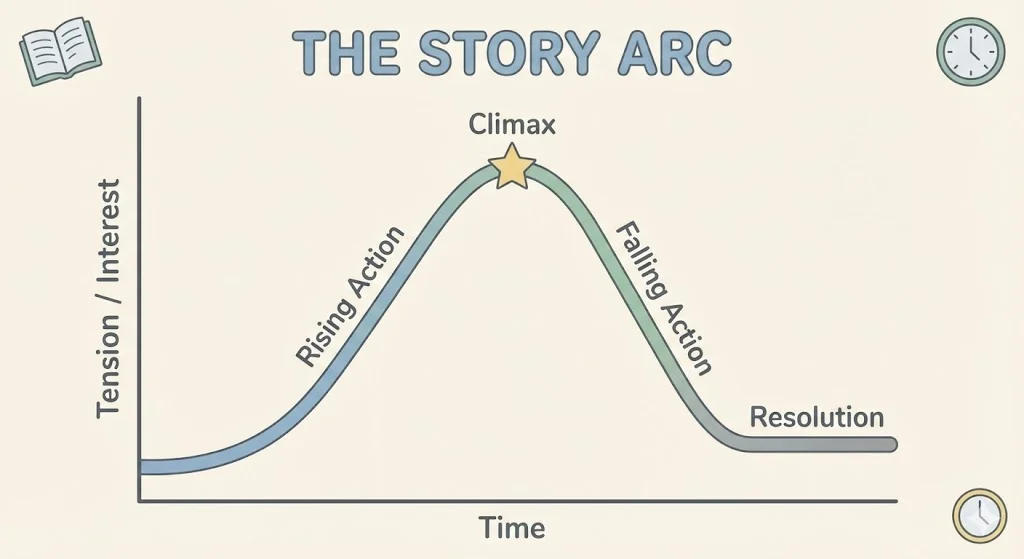

Falling action in a story is the part of the plot that comes after the climax and shows how the conflict begins to resolve. It connects the most intense moment of the story to the ending by revealing the consequences of the climax and guiding the narrative toward closure.
Every good story has a rhythm. Tension builds, reaches a peak, and then slowly settles. That calming phase after the big turning point is known as the falling action. Although it may not feel as dramatic as the climax, falling action plays a crucial role in helping the story make sense and feel complete.
In this guide, you will learn what falling action means in a story, why it matters, how it works within plot structure, and how writers use it effectively. Clear examples and comparisons will help you recognize falling action in novels, short stories, movies, and even personal narratives.
What Does Falling Action Mean in a Story?
In storytelling, falling action refers to the section of the plot that follows the climax.
At this stage, the main conflict has already reached its highest point. Now, the story begins to slow down as loose ends are tied up and outcomes become clearer.
In other words, falling action shows what happens after the big moment and how characters respond to it.
Where Falling Action Fits in Story Structure
To understand falling action fully, it helps to see where it fits within a typical plot.
Most stories follow a classic five part structure:
- Exposition
- Rising action
- Climax
- Falling action
- Resolution
The falling action sits between the climax and the resolution. While the climax answers the question “What happens at the turning point,” the falling action answers “What happens because of it?”
The Purpose of Falling Action
Although it is quieter than the climax, falling action serves several important functions.
First, it allows readers to process what just happened. After intense moments, readers need space to understand the consequences.
Second, it shows how characters change as a result of the climax. Their decisions and emotions often look different now.
Finally, falling action prepares the audience for the ending, making the resolution feel earned rather than abrupt.
Key Elements of Falling Action
Falling action often includes a combination of the following elements.
- Consequences of the climax
- Reduced tension
- Character reactions and reflection
- Remaining conflicts beginning to resolve
- A shift toward closure
Not every story includes all of these, but most include at least a few.
Falling Action Explained with a Simple Example
Consider a story where the main conflict is a hero fighting a villain.
- The climax is the final battle
- The falling action shows what happens after the fight
- The resolution reveals how life settles afterward
For example, after the villain is defeated, the falling action may show the hero returning home, reuniting with loved ones, or dealing with the emotional impact of the battle.
Falling Action Example from a Short Story
Imagine a story about a student trying to pass a difficult exam.
- Climax: The student finishes the exam and hands it in
- Falling action: The student waits for the results, reflects on the effort, and talks with friends
- Resolution: The student learns whether they passed or failed
The waiting and reflection stage is the falling action because it connects the major event to the final outcome.
Falling Action in Popular Stories and Movies
Falling action appears in nearly every narrative format.
In movies, it often includes scenes that show what happens after the big showdown.
novels, it may appear as several chapters where characters react to major events.
In short stories, falling action is usually brief but still present.
For example, after the final conflict in a mystery story, the falling action may involve the detective explaining how the crime was solved and what happens to the criminal.
Falling Action vs Rising Action
One common point of confusion is the difference between rising action and falling action.
Here is a clear comparison.
| Rising Action | Falling Action |
|---|---|
| Builds tension | Releases tension |
| Leads to the climax | Follows the climax |
| Introduces complications | Shows consequences |
| Raises questions | Begins answering questions |
While rising action pulls readers forward with suspense, falling action helps them slow down and understand the outcome.
Falling Action vs Resolution
Although they are closely related, falling action and resolution are not the same.
Falling action focuses on the transition from conflict to closure. Resolution, on the other hand, delivers the final outcome of the story.
Think of falling action as the bridge and resolution as the destination.
Why Falling Action Is Important for Readers
Without falling action, a story can feel rushed or incomplete.
Readers need time to emotionally adjust after the climax. Falling action provides that space.
It also helps readers see the meaning of the story by showing how events affect the characters and their world.
Because of this, falling action increases satisfaction and clarity.
How Long Should Falling Action Be?
The length of falling action depends on the type of story.
In a short story, it may be just a paragraph.
a novel, it can span several chapters.
In a film, it may take the form of a few closing scenes.
What matters most is not length, but balance. Falling action should feel natural and purposeful.
Common Mistakes When Writing Falling Action
Writers sometimes misunderstand or misuse falling action.
One common mistake is skipping it entirely, which can make the ending feel abrupt.
Another mistake is introducing a brand new conflict during falling action. At this stage, the story should be resolving, not restarting.
Finally, dragging the falling action too long can reduce the impact of the climax.
Tips for Writing Effective Falling Action
To write strong falling action, consider the following tips.
- Show how the climax affects the characters
- Resolve smaller conflicts one by one
- Slow the pacing compared to earlier scenes
- Prepare the reader emotionally for the ending
- Avoid introducing major new problems
By focusing on consequences and reflection, falling action will feel meaningful rather than filler.
Frequently Asked Questions
1. What does falling action mean in a story?
Falling action is the part of the plot that follows the climax and shows how the conflict begins to resolve.
2. Is falling action always necessary?
While not always long, falling action is usually necessary to make a story feel complete.
3. Can falling action be very short?
Yes. In short stories or flash fiction, it can be just a few sentences.
4. Does falling action include the ending?
No. Falling action leads to the ending, but the resolution is the actual ending.
5. Where does falling action appear in plot structure?
It appears after the climax and before the resolution.
6. What happens during falling action?
Characters react to the climax, consequences unfold, and tension decreases.
7. Can falling action include emotional moments?
Yes. Emotional reflection is a common and effective part of falling action.
8. How can I identify falling action in a story?
Look for the section after the most intense moment where events slow down and outcomes become clearer.
Conclusion
So, what does falling action mean in a story? It is the stage of the plot that follows the climax and shows how the story begins to settle.
To recap:
- Falling action comes after the climax
- It shows consequences and reactions
- It reduces tension and guides the story toward closure
- It prepares readers for the resolution
When used effectively, falling action gives a story depth, clarity, and emotional balance. It ensures that the ending feels natural rather than rushed, making the overall narrative more satisfying.
Discover More Post
What Does PIM Mean in Hockey? Simple Explanation for New …
What Does AOE Mean in Games? Full Meaning, Examples …