
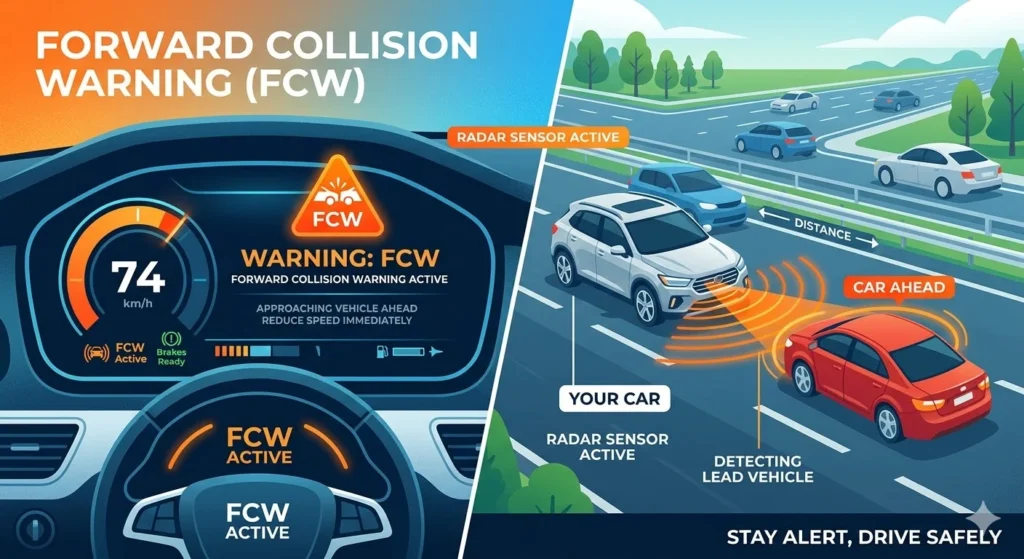

FCW in a car stands for Forward Collision Warning. It is an advanced driver assistance safety feature that alerts the driver when the vehicle is approaching another car, obstacle, or object too quickly and a collision risk is detected.
Modern cars are packed with smart safety technology designed to protect drivers and passengers. Among these features, FCW has become one of the most common and important systems in today’s vehicles. If you have seen FCW on a dashboard alert, in a vehicle manual, or while researching car safety features, you may wonder what it actually means.
Simply put, FCW helps prevent accidents by warning drivers before a potential crash occurs. Instead of waiting for the driver to notice danger, the system constantly monitors the road ahead and provides an alert when something seems risky.
In this guide, you will learn exactly what FCW means in a car, how it works, why manufacturers include it, and how it compares with similar safety technologies.
What Does FCW Mean in a Car?
In the automotive world, FCW stands for Forward Collision Warning.
This system is designed to detect possible front end collisions and notify the driver so they can react in time.
Typically, FCW works by monitoring the distance between your vehicle and objects in front of it. If the system detects that the gap is closing too quickly, it issues a warning.
Drivers may receive alerts through:
• Visual warnings on the dashboard
• Audible alarms
• Steering wheel or seat vibrations
• Heads up display alerts
The purpose is simple. Give the driver extra reaction time to brake or steer away from danger.
Why FCW Is Important in Modern Cars
Road accidents often happen because drivers do not react quickly enough to sudden changes in traffic.
For example, a car ahead might brake suddenly, or traffic might stop unexpectedly. In those moments, every second matters.
FCW improves safety because it:
• Detects danger faster than human reaction time
• Alerts drivers immediately
• Reduces rear end collision risks
• Helps prevent distracted driving accidents
Because of these benefits, many manufacturers now include FCW in their vehicles as standard or optional equipment.
How Forward Collision Warning Works
The Forward Collision Warning system uses sensors and cameras to monitor the road ahead.
Although the exact technology varies between manufacturers, most systems include the following components.
Radar Sensors
Radar units mounted in the front bumper measure the distance and speed of vehicles ahead.
Cameras
A front facing camera near the windshield identifies vehicles, cyclists, pedestrians, or obstacles.
Computer Processing
The car’s onboard computer analyzes data from sensors and calculates collision risk in real time.
Warning System
When a potential crash is detected, the system sends an alert to the driver.
In many cars, FCW works alongside other safety technologies for added protection.
What Happens When FCW Is Triggered
When the system detects danger, it typically follows a warning sequence.
- The system detects a vehicle or object ahead.
- The computer calculates closing speed and distance.
- If collision risk increases, the system issues an alert.
- The driver is expected to brake or steer to avoid impact.
Importantly, FCW itself usually does not apply the brakes. Instead, it focuses on warning the driver.
However, some vehicles combine FCW with automatic braking systems.
Real World Examples of FCW Alerts
The way FCW alerts appear can vary depending on the vehicle brand and model.
Here are some common scenarios.
Friendly Reminder Style Alert
A dashboard message may appear:
FCW Warning
Brake Now
This alert encourages quick action but is not overly aggressive.
Neutral Warning
Some vehicles flash a red vehicle icon on the dashboard along with a beep.
This simply signals that the car ahead is getting too close.
Urgent Safety Warning
In higher risk situations, the system may trigger:
• Loud warning sounds
• Flashing lights
• Steering wheel vibration
The goal is to grab the driver’s attention immediately.
FCW vs Similar Safety Systems
Forward Collision Warning is often confused with other driver assistance technologies. While they work together, each system has a different purpose.
Safety Feature Comparison Table
| System | Meaning | What It Does |
|---|---|---|
| FCW | Forward Collision Warning | Alerts driver of possible front collision |
| AEB | Automatic Emergency Braking | Applies brakes automatically to avoid impact |
| ACC | Adaptive Cruise Control | Adjusts speed to maintain safe distance |
| LDW | Lane Departure Warning | Alerts if the vehicle drifts out of its lane |
| Blind Spot Monitoring | Detects vehicles in blind spots | Warns during lane changes |
In many modern vehicles, these systems work together to create a comprehensive safety network.
Origin and Growth of FCW Technology
Forward Collision Warning systems began appearing in luxury vehicles during the early 2000s.
Initially, the technology was expensive and limited to premium models. However, as sensor technology improved, the cost decreased significantly.
Because of this progress, FCW is now available in many vehicles including:
• Sedans
• SUVs
• Pickup trucks
• Electric vehicles
Additionally, safety organizations around the world have encouraged manufacturers to adopt these systems to reduce accidents.
Advantages of FCW in Cars
Drivers benefit from FCW in several important ways.
Faster Reaction Time
The system detects danger quickly and alerts the driver earlier than normal human reaction.
Reduced Accident Risk
Rear end collisions are among the most common types of accidents. FCW helps reduce this risk.
Increased Driver Awareness
Even attentive drivers can miss sudden changes in traffic. FCW acts as an extra set of eyes on the road.
Integration with Other Safety Systems
FCW often works with automatic braking and adaptive cruise control for better safety coverage.
Limitations of FCW Systems
Although FCW is helpful, it is not perfect.
Drivers should understand its limitations.
Weather Conditions
Heavy rain, fog, or snow can interfere with sensors and cameras.
False Alerts
Occasionally the system may warn drivers when there is no real danger.
Not a Replacement for Safe Driving
Most importantly, FCW is only a warning system. The driver must still react and take control.
Because of this, manufacturers emphasize that driver attention is always required.
Alternate Meanings of FCW
Although FCW usually refers to Forward Collision Warning in the automotive world, the abbreviation can have other meanings in different contexts.
Examples include:
• Fully Connected Wireless in technology
• Field Construction Work in engineering documents
• First Class Wheel in railway terminology
However, when discussing vehicles or car safety features, FCW almost always refers to Forward Collision Warning.
Polite or Professional Ways to Refer to FCW
In professional automotive writing, FCW may be described using slightly different terms.
Examples include:
Forward collision alert system
Collision warning technology
Front collision detection system
Driver collision warning feature
These variations describe the same safety concept while fitting different technical contexts.
Tips for Drivers Using FCW
Drivers can get the most benefit from FCW by following a few simple tips.
Pay attention to alerts immediately.
Keep sensors clean and unobstructed.
Avoid relying solely on technology for braking decisions.
Read your vehicle’s manual to understand how the system works in your model.
Most importantly, treat FCW as an assistant rather than a replacement for careful driving.
Frequently Asked Questions
1. What does FCW mean in a car dashboard warning?
FCW stands for Forward Collision Warning. It means the car has detected a potential collision risk ahead.
2. Does FCW automatically stop the car?
No. FCW usually only warns the driver. However, some vehicles combine it with automatic emergency braking.
3. Is FCW the same as automatic braking?
No. FCW provides warnings, while automatic emergency braking can apply the brakes if needed.
4. Is FCW standard in modern cars?
Many newer vehicles include FCW as a standard or optional safety feature.
5. Can FCW be turned off?
Yes. In most cars, drivers can disable or adjust FCW settings through the vehicle’s safety menu.
6. Does FCW work at night?
Yes. Radar sensors typically work day and night, although visibility conditions can still affect camera performance.
7. Why does FCW activate sometimes when there is no danger?
Sensors may occasionally misinterpret objects or road conditions, leading to false alerts.
8. Is FCW required by law?
In some regions, advanced safety systems like FCW are strongly encouraged but not always mandatory.
Conclusion
Understanding what FCW means in a car is important because it highlights one of the most valuable safety technologies in modern vehicles.
FCW stands for Forward Collision Warning, a system designed to detect potential front end crashes and alert the driver before impact occurs.
Key points to remember:
FCW monitors the road ahead using sensors and cameras
It alerts drivers when collision risk increases
It improves reaction time and accident prevention
It often works with other safety technologies
It supports drivers but does not replace attentive driving
As vehicle technology continues to evolve, systems like FCW are helping make roads safer for everyone.
Discover More post
ASL Meaning in Text What Does ASL Stand For? in 2026
MBN Meaning in Text What Does MBN Stand For? in 2026
HMU Meaning in Text What Does HMU Stand For? in 2026