
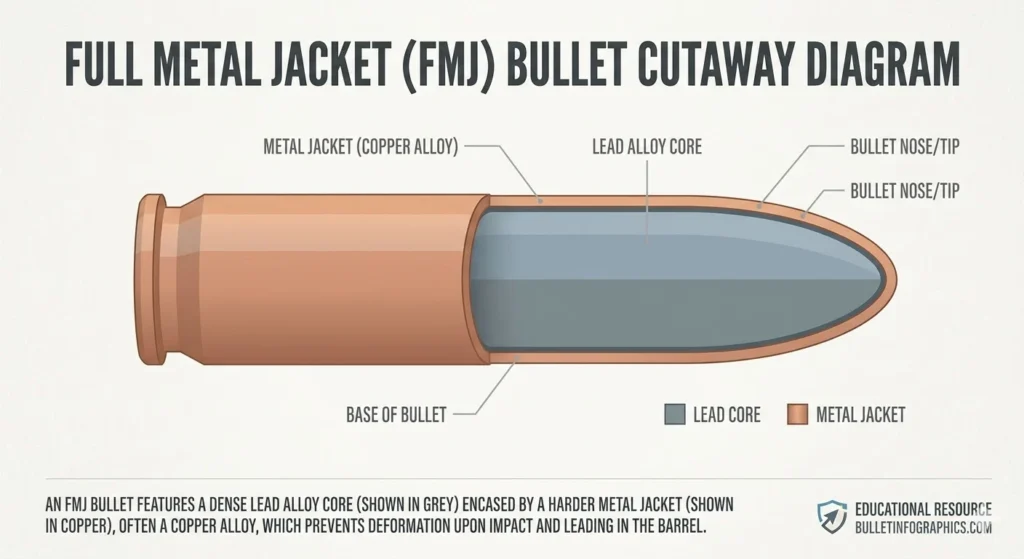

FMJ stands for Full Metal Jacket, a type of bullet in which a soft lead core is completely encased in a harder metal shell, usually copper. It is commonly used for target shooting, training, and military applications because of its reliability, penetration, and lower cost.
If you have ever browsed ammunition options or heard shooters talking at a range, you have likely come across the term FMJ. At first, it may sound technical or confusing. However, once you understand what it means, it becomes one of the easiest and most important ammo types to recognize.
In this guide, you will learn exactly what FMJ means in ammo, how it works, why it is widely used, and how it compares to other types of bullets. By the end, you will have a clear understanding of when and why FMJ ammunition is used in real world situations.
What Does FMJ Mean in Ammo?
In simple terms, FMJ means Full Metal Jacket.
This refers to the construction of the bullet, not the entire cartridge. Specifically, an FMJ bullet has:
- A lead core inside
- A metal outer coating that fully surrounds the core
Because of this design, FMJ bullets are more durable and less likely to deform when fired.
As a result, they are widely used for practice shooting, range training, and military use.
How FMJ Bullets Are Made
To understand FMJ better, it helps to look at how these bullets are constructed.
Basic Structure of an FMJ Bullet
| Component | Description |
|---|---|
| Core | Usually made of soft lead |
| Jacket | Thin outer layer of copper or similar metal |
| Shape | Typically rounded or pointed |
The metal jacket covers the entire lead core, except sometimes at the base.
Because of this full coverage, the bullet maintains its shape during firing and impact.
Why FMJ Ammo Is So Popular
There are several reasons why FMJ ammunition is one of the most commonly used types in the world.
1. Reliability
First, FMJ rounds feed smoothly in most firearms. Therefore, they are less likely to jam compared to more complex bullet designs.
2. Cost Effectiveness
In addition, FMJ ammo is usually cheaper than other types. For that reason, it is ideal for high volume practice sessions.
3. Penetration
Another advantage is that FMJ bullets penetrate targets deeply. Because they do not expand much, they travel further through material.
4. Reduced Barrel Fouling
Moreover, the metal jacket reduces direct contact between the lead core and the barrel. As a result, there is less buildup inside the firearm.
Common Uses of FMJ Ammo
FMJ ammunition is used in several practical situations.
Target Shooting
Most shooters use FMJ rounds at the range because they are affordable and consistent.
Example:
A beginner practicing aim and accuracy will almost always choose FMJ ammo.
Training and Practice
Military and law enforcement training often relies on FMJ rounds. This is because they mimic real ammunition performance while keeping costs manageable.
Military Use
Historically, FMJ bullets have been standard in military settings. International agreements have influenced this choice, encouraging the use of non expanding bullets.
Real World Examples of FMJ Usage
Here are a few scenarios showing how FMJ ammo is used.
Neutral Example
A shooter at a range uses FMJ rounds for consistent target practice.
Practical Example
A training program uses FMJ ammunition because it is affordable for repeated drills.
Technical Example
A firearm functions more reliably with FMJ rounds due to their smooth shape and consistent feeding.
FMJ vs Other Types of Ammo
To fully understand FMJ, it helps to compare it with other common bullet types.
Comparison Table
| Ammo Type | Description | Expansion | Common Use |
|---|---|---|---|
| FMJ | Full metal jacket bullet | Minimal | Training and target shooting |
| Hollow Point | Open tip design | Expands on impact | Self defense |
| Soft Point | Exposed lead tip | Partial expansion | Hunting |
| Ball Ammo | Often refers to FMJ | Minimal | Military and practice |
Key Differences Explained
FMJ vs Hollow Point
FMJ bullets do not expand, while hollow point bullets are designed to expand on impact. Because of this, hollow points are often used for self defense, while FMJ is preferred for training.
FMJ vs Soft Point
Soft point bullets expand slightly, making them more suitable for hunting. In contrast, FMJ bullets maintain their shape and penetrate deeper.
Advantages and Disadvantages of FMJ Ammo
Understanding both sides helps you make informed decisions.
Advantages
- Affordable for frequent use
- Reliable feeding in most firearms
- Consistent performance
- Lower barrel wear
Disadvantages
- Limited expansion on impact
- Higher risk of over penetration
- Not ideal for self defense in many cases
Alternate Meanings of FMJ
In most contexts, especially related to firearms, FMJ means Full Metal Jacket.
However, in other fields, FMJ can occasionally stand for different phrases. These are far less common and rarely relevant outside technical or niche discussions.
Polite and Professional Alternatives to Saying FMJ
In formal writing or professional discussions, you might use:
- Full metal jacket ammunition
- Jacketed bullet rounds
- Non expanding training ammunition
These alternatives can sound clearer in technical or educational contexts.
Common Misconceptions About FMJ
There are a few misunderstandings worth clearing up.
FMJ Is Not More Powerful
FMJ does not mean stronger or more powerful. It only describes the bullet’s construction.
FMJ Is Not Designed for Expansion
Unlike some other bullet types, FMJ is designed to stay intact rather than expand.
FMJ Is Not Only for the Military
Although widely used by the military, FMJ is also the most common choice for civilian training and practice.
Frequently Asked Questions
1. What does FMJ stand for in ammo?
FMJ stands for Full Metal Jacket.
2. Is FMJ ammo good for self defense?
Generally, it is not the first choice because it does not expand and may over penetrate.
3. Why is FMJ ammo cheaper?
It is simpler to manufacture and widely produced, which lowers the cost.
4. Does FMJ damage the barrel?
No. In fact, the jacket helps reduce wear compared to exposed lead bullets.
5. Is FMJ the same as ball ammo?
In many cases, yes. Ball ammo often refers to FMJ rounds.
6. Does FMJ expand on impact?
No. It is designed to keep its shape.
7. Can beginners use FMJ ammo?
Yes. It is one of the best options for beginners due to its reliability and affordability.
8. Why do militaries use FMJ?
FMJ is reliable, consistent, and complies with certain international guidelines.
Conclusion
So, what does FMJ mean in ammo? It stands for Full Metal Jacket, a bullet design where a lead core is fully enclosed in a metal coating.
To recap:
- FMJ bullets are durable and reliable
- They are widely used for training and target shooting
- They offer deep penetration but minimal expansion
- They are affordable and ideal for practice
Understanding FMJ helps you make informed choices about ammunition and improves your overall knowledge of how firearms and bullets function.
Discover More Post
MB Meaning in Text What Does MB Stand For in Messages …
FT Meaning in Text What Does FT Stand For in Messages?
TTYL Meaning in Text What It Stands For and How to Use It in …