
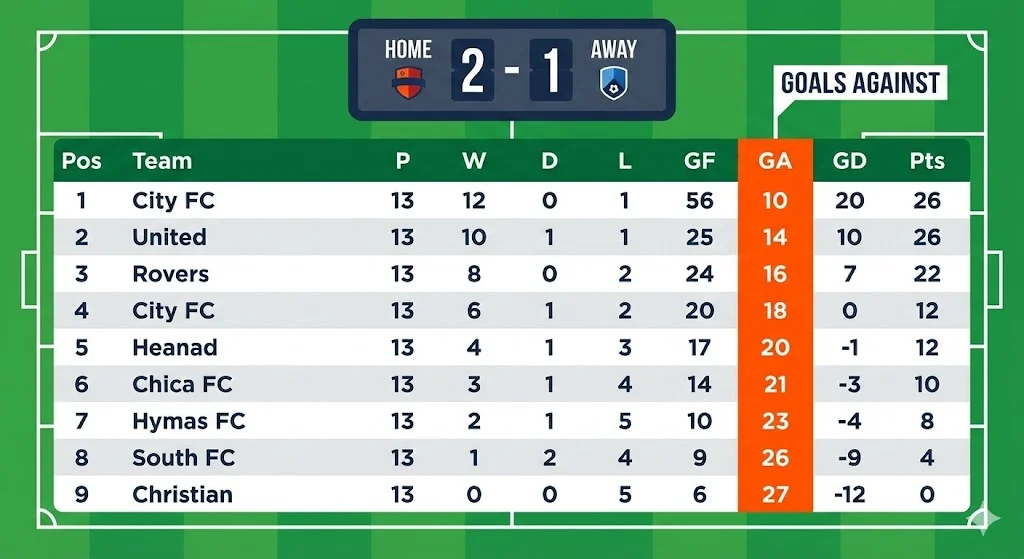

GA in soccer stands for “Goals Against.” It refers to the total number of goals a team or goalkeeper has conceded during a match, season, or competition.
If you follow soccer standings, watch match analysis, or browse league tables, you have probably seen the abbreviation GA next to team names and wondered what it actually means. While it looks simple, GA plays a crucial role in understanding team performance, defensive strength, and league rankings.
In this complete guide, you will learn what GA means in soccer, how it is calculated, why it matters, how it differs from similar stats, and how coaches, analysts, and fans use it in real situations. By the end, you will be able to read soccer tables and statistics with far more confidence.
What Does GA Mean in Soccer?
In soccer, GA means Goals Against.
It represents the number of goals a team has allowed or conceded to opposing teams.
For example:
- If a team concedes 2 goals in a match, their GA for that match is 2.
- If a team concedes 30 goals over a season, their season GA is 30.
Simply put, GA measures defensive performance.
Where You See GA Used in Soccer
GA is one of the most commonly used statistics in soccer and appears in several places.
You will often see GA in:
- League tables and standings
- Tournament group stages
- Team season summaries
- Goalkeeper statistics
- Defensive performance analysis
Because of its importance, GA is considered a core stat alongside goals scored and points earned.
Why GA Is Important in Soccer
Goals Against is more than just a number. It helps explain how well a team defends.
Here is why GA matters so much.
First, a lower GA usually means a stronger defense. Teams that concede fewer goals tend to be more consistent and competitive.
Second, GA often affects league rankings. In many competitions, goal related stats are used as tiebreakers.
Finally, GA provides context. A team that scores many goals but also has a high GA may be exciting to watch but defensively weak.
How GA Is Calculated
GA is very straightforward to calculate.
Every goal scored by the opposing team counts as one goal against.
Example:
- Match ends 3 to 1
- Losing team GA equals 3
- Winning team GA equals 1
Over a season, GA is simply the total number of goals conceded across all matches.
There is no weighting, adjustment, or complexity. It is a direct count.
GA in League Tables Explained
Most soccer league tables include GA as a standard column.
A typical table includes:
- Played
- Wins
- Draws
- Losses
- Goals For
- Goals Against
- Goal Difference
- Points
Sample League Table Section
| Team | GF | GA | GD | Points |
|---|---|---|---|---|
| Team A | 45 | 20 | +25 | 60 |
| Team B | 40 | 30 | +10 | 55 |
| Team C | 38 | 35 | +3 | 50 |
In this example, Team A has the best GA, meaning they conceded the fewest goals.
GA vs Related Soccer Stats
To fully understand GA, it helps to compare it with similar terms.
GA vs GF
GF means Goals For. It counts how many goals a team scores.
GA counts how many goals a team concedes.
Together, they show balance between offense and defense.
GA vs GD
GD means Goal Difference.
It is calculated as:
Goals For minus Goals Against
For example:
- GF 40
- GA 25
- GD equals +15
GA is a building block of GD.
GA vs Clean Sheets
Clean sheets count how many matches a team or goalkeeper finishes without conceding a goal.
GA measures total goals conceded, while clean sheets measure defensive shutouts.
A team can have a low GA even if they concede one goal in many matches.
GA and Goalkeepers
GA is especially important for goalkeepers.
Goalkeeper statistics often include:
- Goals Against
- Saves
- Clean sheets
- Save percentage
However, GA alone does not always reflect a goalkeeper’s quality. Defensive errors, team tactics, and opponent strength also play a role.
That said, a consistently low GA usually indicates strong goalkeeping combined with good team defense.
GA in Tournaments and Group Stages
In tournaments like the World Cup or continental competitions, GA can directly affect qualification.
When teams are tied on points, organizers often use:
- Goal difference
- Goals for
- Goals against
In some competitions, conceding fewer goals can be the deciding factor between advancing or being eliminated.
Because of this, teams sometimes prioritize defensive stability in group stages.
Examples of GA in Match Context
Seeing GA used in context makes it easier to understand.
Match Example
Scoreline:
Team Red 2
Team Blue 2
GA:
- Team Red GA equals 2
- Team Blue GA equals 2
Season Example
After 10 matches:
- Team Alpha has conceded 8 goals
- Their GA is 8
This suggests a very strong defense.
Defensive Comparison Example
Team One:
- GA 18 in 20 matches
Team Two:
- GA 35 in 20 matches
Even if both teams score similar goals, Team One is defensively stronger.
Low GA vs High GA Explained
Low GA
A low GA generally means:
- Strong defensive organization
- Good goalkeeper performance
- Tactical discipline
Teams with low GA often win titles or finish high in the table.
High GA
A high GA can indicate:
- Weak defense
- Poor positioning
- Risky attacking style
However, some teams accept a high GA in exchange for scoring more goals.
GA and Playing Style
GA is closely tied to a team’s style of play.
Defensive teams often focus on:
- Compact shape
- Fewer chances conceded
- Lower GA
Attacking teams may:
- Press high
- Take risks
- Accept a higher GA
Neither approach is inherently right or wrong. GA simply reflects the outcome.
Common Misunderstandings About GA
Some fans misunderstand what GA actually represents.
One common mistake is blaming GA entirely on the goalkeeper. In reality, GA reflects the entire team’s defensive performance.
Another misconception is thinking GA only matters for defensive teams. In truth, even attacking teams need to control GA to succeed consistently.
Alternate Meanings of GA in Sports
In soccer specifically, GA almost always means Goals Against.
However, in other sports or contexts, GA can mean:
- Games Ahead in standings
- General Admission for tickets
- Geographic Area
In soccer statistics, context makes the meaning clear.
Polite and Professional Use of GA in Writing and Commentary
GA is widely accepted in professional soccer analysis.
Examples:
- The team finished the season with the lowest GA in the league.
- Their defensive improvement reduced their GA significantly.
- A low GA helped them secure the title.
Using GA is standard in reports, commentary, and analysis.
Frequently Asked Questions
1. What does GA mean in soccer standings?
GA means Goals Against and shows how many goals a team has conceded.
2. Is GA good or bad?
A lower GA is generally good because it means fewer goals conceded.
3. How is GA different from GD?
GA counts goals conceded. GD compares goals scored to goals conceded.
4. Does GA only apply to teams?
No. GA can also apply to individual goalkeepers.
5. Can a team win with a high GA?
Yes, but it is harder. Most successful teams keep GA relatively low.
6. Is GA used as a tiebreaker?
Yes. In many competitions, GA helps break ties.
7. What is a good GA for a season?
That depends on the league, but lower than average GA usually indicates strong defense.
8. Does GA include own goals?
Yes. Any goal conceded, including own goals, counts toward GA.
Conclusion
So, what does GA mean in soccer? It stands for Goals Against, a key statistic that shows how many goals a team or goalkeeper has conceded.
To recap:
- GA measures defensive performance
- It appears in league tables and statistics
- A lower GA usually signals a stronger defense
- It plays a role in rankings and tiebreakers
- It reflects team effort, not just goalkeeping
Understanding GA helps you read soccer stats more clearly and appreciate the tactical side of the game. Once you know what to look for, league tables and match analysis start to tell a much richer story
Discover More Post
What Does PIM Mean in Hockey? Simple Explanation for New …
What Does KMSL Mean in Text? Full Meaning, Usage …
What Does Simba Mean in Swahili? Meaning, Origin …


