
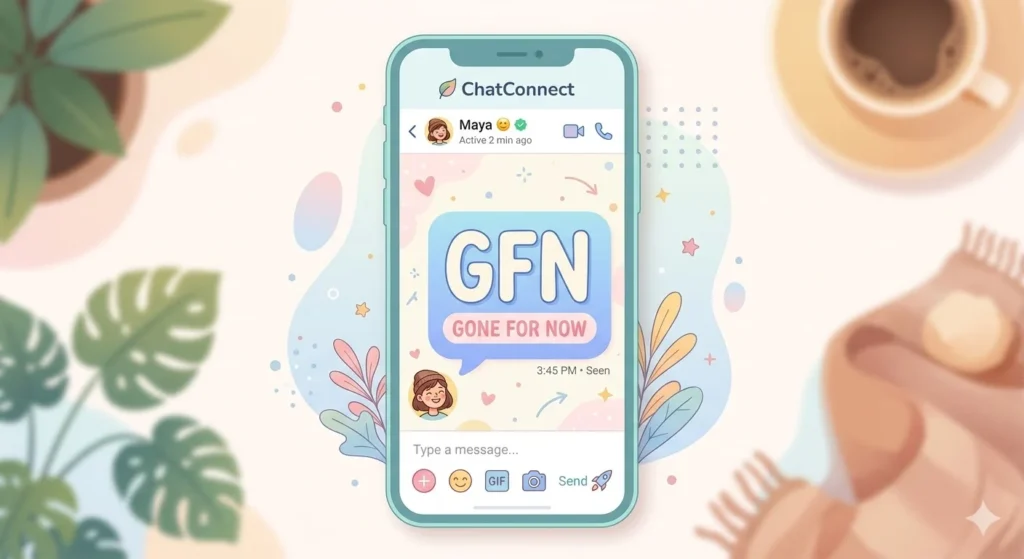

GFN in text most commonly stands for “Gone For Now.” It is used in chats, messaging apps, and online conversations to let someone know you are leaving temporarily but may return later.
In today’s fast paced digital communication, short forms and abbreviations make texting quicker and easier. One such abbreviation you might come across is GFN. At first glance, it may seem unclear or even confusing. However, once you understand its meaning, it becomes a simple and useful way to communicate availability.
So, what does GFN mean in text? More importantly, when should you use it, and how does it compare to similar expressions like “BRB” or “TTYL”? This guide explains everything in a clear and practical way so you can use GFN confidently in everyday conversations.
What Does GFN Mean in Text?
In texting, GFN stands for “Gone For Now.”
People use it to indicate that:
- They are stepping away temporarily
- They might return later
- The conversation is paused, not ended
Because of this, GFN is softer than a final goodbye. It leaves the door open for future interaction.
Origin and Popularity of GFN
Like many texting abbreviations, GFN emerged from early internet chat culture. As messaging platforms became more popular, users began shortening phrases to save time and effort.
Although GFN is not as widely used as some other abbreviations, it still appears in:
- Text messages
- Online chats
- Gaming conversations
- Social media comments
Over time, it has remained a niche but useful expression for temporary departures.
How GFN Is Used in Real Conversations
People use GFN in casual and informal settings. It often appears at the end of a message to signal a short break.
1. Leaving a Chat Temporarily
Example:
- “I need to step out for a bit, GFN!”
In this case, the person is not ending the conversation completely.
2. Taking a Break from Messaging
Example:
- “Busy with work right now, GFN.”
Here, the message communicates limited availability.
3. Ending a Conversation Lightly
Example:
- “Got to go eat, GFN 😊”
This keeps the tone friendly and open.
Emotional Tone of GFN
The tone of GFN depends on how it is used. In most cases, it feels neutral or friendly.
Friendly Tone 😊
- “Talk later, GFN!”
- Suggests warmth and openness.
Neutral Tone
- “Heading out, GFN.”
- Straightforward and informational.
Slightly Distant Tone 😐
- “Busy now, GFN.”
- Can feel brief or slightly detached, depending on context.
Because tone can vary, adding context or emojis can make your intent clearer.
Examples of GFN in Context
Here are a few examples that show how GFN works in everyday texting.
Casual Chat
- “I will message you later, GFN!”
Work Related Message
- “Stepping into a meeting, GFN.”
Gaming Conversation
- “Logging off for now, GFN.”
Friendly Conversation
- “Going out with friends, GFN 😊”
Each example shows a temporary exit rather than a permanent goodbye.
GFN vs Similar Texting Abbreviations
To better understand GFN, it helps to compare it with similar terms.
Comparison Table
| Abbreviation | Meaning | Use Case | Tone |
|---|---|---|---|
| GFN | Gone For Now | Temporary leave | Neutral to friendly |
| BRB | Be Right Back | Very short break | Casual |
| TTYL | Talk To You Later | Ending conversation | Friendly |
| GTG | Got To Go | Leaving quickly | Neutral |
| AFK | Away From Keyboard | Not available | Informal |
Key Differences
- GFN suggests you might return later
- BRB implies a very quick return
- TTYL feels more like a closing statement
- GTG sounds more urgent
As a result, GFN sits somewhere in the middle in terms of tone and intent.
When to Use GFN
Using GFN correctly depends on timing and context.
Good Situations to Use GFN
- When stepping away briefly
- When you plan to return later
- In casual or friendly conversations
- During online chats or gaming
Situations to Avoid GFN
- In formal or professional communication
- When clarity is critical
- In serious or emotional conversations
In professional settings, it is usually better to write out a full sentence.
Polite and Professional Alternatives
If you want a more polished way to say the same thing, consider these alternatives.
Casual Alternatives
- “Talk soon”
- “I will be back later”
- “Catching up later”
Professional Alternatives
- “I will reconnect shortly”
- “Stepping away for now”
- “I will follow up later”
These options are clearer and more appropriate in formal communication.
Alternate Meanings of GFN
Although GFN usually means “Gone For Now,” it can have other meanings depending on context.
Some less common interpretations include:
- Good For Nothing
- Global Food Network
- Gaming related shorthand in niche communities
However, in texting and casual chat, GFN almost always means Gone For Now.
Common Mistakes with GFN
Even simple abbreviations can be misunderstood.
Assuming Everyone Knows It
Not everyone is familiar with GFN, so it may confuse some people.
Using It in Formal Contexts
It can seem unprofessional in emails or workplace communication.
Using It Without Context
Without explanation, the tone might feel abrupt or unclear.
Adding a short sentence before GFN can make your message more natural.
Frequently Asked Questions
1. What does GFN mean in texting?
GFN means “Gone For Now,” indicating a temporary break from the conversation.
2. Is GFN the same as BRB?
Not exactly. BRB suggests a quick return, while GFN is less specific about timing.
3. Is GFN rude?
No. It is generally neutral or friendly, especially when used with context.
4. Can I use GFN in professional messages?
It is better to avoid it in formal settings and use full sentences instead.
5. Do people still use GFN?
Yes, although it is less common than abbreviations like BRB or TTYL.
6. What is the tone of GFN?
It is usually neutral, but it can feel friendly depending on the wording.
7. Can GFN mean something else?
Yes, but in texting it almost always means “Gone For Now.”
8. When should I use GFN?
Use it when you are stepping away temporarily but may return later.
Conclusion
So, what does GFN mean in text? Simply put, it stands for “Gone For Now” and is used to signal a temporary pause in a conversation.
Here are the key points to remember:
- GFN indicates a short term absence
- It is commonly used in casual messaging
- It suggests you may return later
- It is best avoided in formal communication
- Context and tone help make it clearer
By understanding how and when to use GFN, you can communicate more smoothly and naturally in digital conversations.
Discover More Post
What Does Excluded Mean in PowerSchool – DefineHubs.com –
What Does Bloody Mean in England? British Usage Explained …
What Does SOB Mean in Medical Terms? Shortness of Breath …