
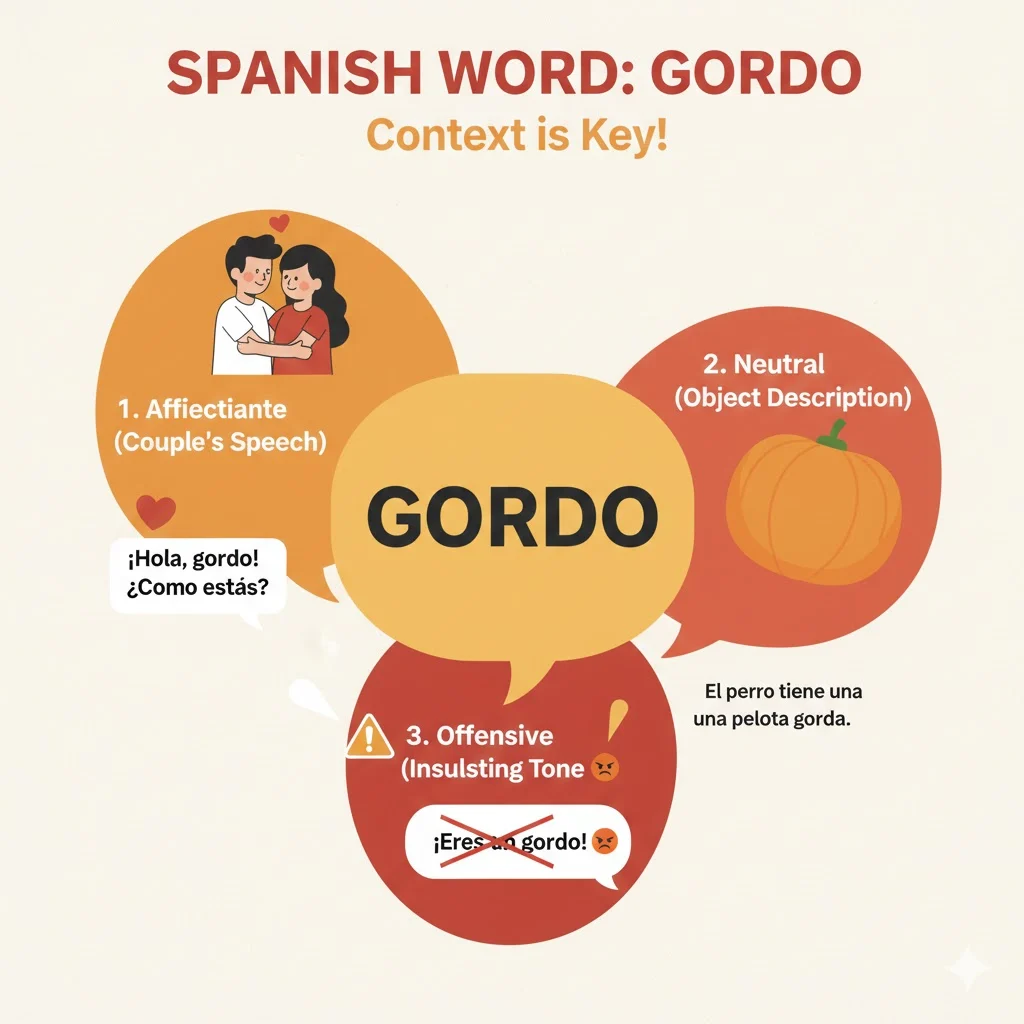

Gordo is a Spanish adjective that literally means “fat” or “having a larger or heavier body.” Depending on context, tone, and region, it can be descriptive, affectionate, neutral, or insulting.
Spanish words often carry emotional and cultural layers that go far beyond a direct translation, and gordo is a strong example of this. You may hear it used casually among couples, spoken bluntly in conversation, or applied to objects with no emotional meaning at all. Because of this flexibility, the word can feel confusing for learners.
In this article, you will learn exactly what gordo means in Spanish, how native speakers use it in real life, when it can sound affectionate, when it can feel insensitive, and which alternatives are more respectful in delicate situations.
What Does Gordo Mean in Spanish?
In Spanish, gordo literally means “fat” or “having a heavier or larger body.”
It is an adjective commonly used to describe:
- People
- Animals
- Objects that are thick or wide
- Situations or things that are figuratively large or serious
However, its emotional impact depends entirely on tone, relationship, and context. As a result, the same word can sound loving in one situation and offensive in another.
Basic Meaning and Grammar of Gordo
Before looking at usage, it helps to understand how gordo works grammatically.
Gender and Number Forms
| Form | Usage |
|---|---|
| gordo | masculine singular |
| gorda | feminine singular |
| gordos | masculine plural |
| gordas | feminine plural |
Examples:
- Un hombre gordo
A man with a larger body - Una mujer gorda
A woman with a heavier body - Animales gordos
Animals with heavier bodies
As with most Spanish adjectives, gordo must agree in gender and number with the noun it describes.
Literal and Descriptive Uses of Gordo
Describing People or Animals
In its most literal sense, gordo refers to someone or something with a heavier body.
Examples:
- El perro está gordo
The dog has gained weight - El bebé está gordito
The baby is chubby
When used for animals or babies, the word is often neutral or even affectionate.
Describing Objects
In addition, gordo is commonly used for objects that are thick or wide.
Examples:
- Un libro gordo
A thick book - Un cable gordo
A thick cable
In these cases, the word is purely descriptive and carries no emotional meaning.
Gordo as a Term of Affection
In many Spanish speaking cultures, gordo and gorda are frequently used as terms of endearment.
Affectionate Uses ❤️
Among couples, family members, or close friends, gordo can mean:
- Babe
- Honey
- Sweetheart
Examples:
- Hola gordo, ¿cómo estás?
Hi babe, how are you? - Ven aquí, gorda
Come here, sweetheart
In these situations, the word usually has nothing to do with body size and instead expresses closeness and affection.
Cultural Context Is Essential
Because gordo can be affectionate or hurtful, cultural awareness is essential.
In many Spanish speaking communities:
- Physical traits are often used as nicknames
- Tone matters more than literal translation
- Familiarity allows more playful language
Even so, cultural norms do not remove the need for sensitivity.
When Gordo Can Be Offensive or Insensitive
Although common, gordo can feel hurtful if used without care.
Situations Where It May Cause Discomfort 😐
- Talking about someone you do not know well
- Commenting directly on a person’s body
- Using a blunt, joking, or mocking tone
- Speaking in professional or public settings
Examples:
- Estás gordo
You have gained weight - Ella es muy gorda
She has a much heavier body
Even when not intended as an insult, these comments can feel intrusive or judgmental.
How Tone Changes the Meaning
Tone plays a major role in how gordo is interpreted.
Friendly or Loving Tone 😊
- Mi gordo lindo
My sweet love
Neutral Descriptive Tone
- El gato está gordo
The cat has gained weight
Negative or Mocking Tone 😠
- Qué gordo estás
You have gotten very heavy
The wording stays the same, but the emotional impact changes completely.
Gordo Compared to Related Spanish Words
Spanish offers several alternatives that vary in tone and sensitivity.
Comparison Table
| Word | Meaning | Typical Tone |
|---|---|---|
| gordo | fat heavier body | affectionate neutral or offensive |
| de mayor peso | of higher weight | neutral respectful |
| rellenito | chubby | gentle polite |
| corpulento | large built | neutral |
| robusto | sturdy strong | neutral positive |
Because of these options, speakers often choose words carefully depending on context.
Diminutives of Gordo
Spanish frequently softens meaning with diminutives.
Common Forms
- gordito
- gordita
Examples:
- El niño está gordito
The child is chubby - Hola gordita
Hi sweetheart
Diminutives usually sound warmer, but tone and relationship still matter.
Figurative Meanings of Gordo
Beyond physical descriptions, gordo is often used figuratively.
Examples:
- Un error gordo
A big mistake - Un problema gordo
A serious problem - Ganancias gordas
Large profits
Here, gordo means large, serious, or significant.
Regional Differences in Usage
Usage of gordo is broadly similar across Spanish speaking regions, though tone and frequency vary.
In Latin America:
- Very common as an affectionate nickname
- Widely accepted in close relationships
Spain:
- Also used affectionately
- More direct in descriptive contexts
In all regions, awareness of personal boundaries remains important.
Polite and Respectful Alternatives
When talking about body size, many speakers prefer gentler or more neutral language.
More Respectful Alternatives
- de mayor peso
- de complexión fuerte
- de complexión grande
Neutral Descriptions
- corpulento
- robusto
- grande
Choosing these alternatives can help avoid discomfort, especially in sensitive conversations.
Common Mistakes with Gordo
Mistake 1: Being Too Direct
Directly calling someone gordo can sound abrupt or insensitive, even if unintended.
Mistake 2: Assuming It Is Always Negative
In many close relationships, gordo is loving and completely normal. Context determines meaning.
Frequently Asked Questions
1. What does gordo literally mean in Spanish?
It literally means fat or having a heavier body.
2. Is gordo always rude?
No. It can be affectionate, neutral, or offensive depending on context.
3. Can gordo be a nickname?
Yes. It is commonly used as a term of endearment among close people.
4. Is it polite to call someone gordo?
Usually not, unless you know the person well and they are comfortable with it.
5. What is the difference between gordo and gordito?
Gordito sounds softer and more affectionate.
6. Can gordo describe objects?
Yes. It is often used to describe thick or wide objects.
7. Does gordo mean the same everywhere?
The core meaning is the same, but social acceptance varies by region.
8. What is a safer alternative to gordo?
Phrases like de mayor peso or rellenito are often safer choices.
Conclusion
So, what does gordo mean in Spanish? At its core, it refers to having a larger or heavier body, but its true meaning depends on tone, relationship, and cultural context.
Key points to remember:
- Gordo is a descriptive adjective with many uses
- It can be affectionate, neutral, or hurtful
- Tone and familiarity matter more than translation
- It is often used lovingly among close people
- Respectful alternatives are available when sensitivity is needed
Understanding gordo helps you communicate more naturally while also showing cultural awareness and respect.
Discover More Post
What Does IB Mean in School – Complete Guide for Students …
What Does Rollback Mean at Walmart? Real Meaning …
What Does #REF Mean in Excel? Causes, Fixes, and Easy …


