
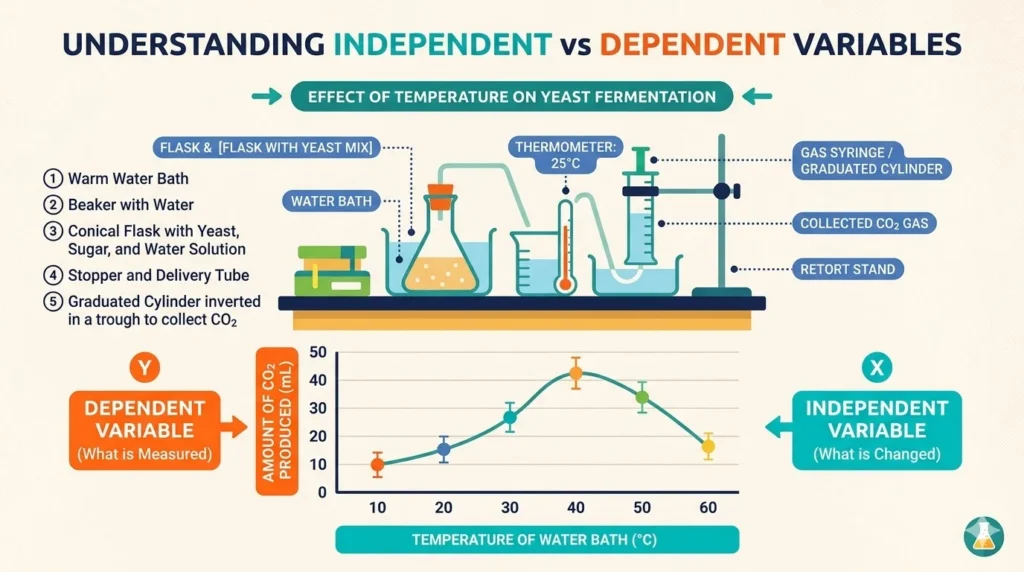

An independent variable in science is the factor that a researcher intentionally changes or manipulates in an experiment to observe its effect on another variable, known as the dependent variable.
If you have ever done a science experiment, even a simple one, you have already worked with an independent variable. Whether you changed the amount of water a plant receives or adjusted the temperature in a test, you were controlling one key factor to see what happens next.
Understanding the independent variable is essential for making sense of experiments, analyzing results, and drawing accurate conclusions. In this guide, you will learn exactly what an independent variable means in science, how it works, how to identify it, and how it compares to other variables.
What Does Independent Variable Mean in Science?
In scientific experiments, the independent variable is the factor that the researcher changes on purpose.
It is called “independent” because it does not depend on other variables in the experiment. Instead, it is the starting point that influences everything else.
As a result, scientists use the independent variable to test cause and effect relationships.
Why the Independent Variable Matters
The independent variable plays a central role in scientific experiments.
First, it allows researchers to test ideas and hypotheses.
Next, it helps determine cause and effect relationships.
In addition, it provides a clear structure for experiments.
Finally, it makes results easier to measure and compare.
Without an independent variable, an experiment would lack direction and purpose.
Independent Variable vs Dependent Variable
To fully understand the independent variable, it helps to compare it with the dependent variable.
Comparison Table
| Variable Type | Definition | Role in Experiment | Example |
|---|---|---|---|
| Independent Variable | The factor you change | Cause | Amount of sunlight |
| Dependent Variable | The factor you measure | Effect | Plant growth |
Simple Explanation
The independent variable is what you change.
The dependent variable is what you observe or measure.
Example
If you are testing how sunlight affects plant growth:
- Independent variable: Amount of sunlight
- Dependent variable: Plant height
Because the sunlight is controlled by the researcher, it is the independent variable.
How to Identify the Independent Variable
Identifying the independent variable becomes easier once you know what to look for.
Here are a few helpful questions:
- What is being changed in the experiment?
- What is the researcher controlling?
- What comes first in the cause and effect relationship?
In most cases, the independent variable answers the question:
“What am I changing?”
Real Life Examples of Independent Variables
Let’s look at practical examples to make the concept clearer.
Example 1: Plant Growth Experiment
A student wants to see how water affects plant growth.
- Independent variable: Amount of water
- Dependent variable: Growth of the plant
The student changes the water levels to observe the results.
Example 2: Temperature and Solubility
A scientist tests how temperature affects how much sugar dissolves in water.
- Independent variable: Temperature of the water
- Dependent variable: Amount of sugar dissolved
Here, temperature is controlled and changed intentionally.
Example 3: Study Time and Test Scores
A teacher studies how study time affects exam results.
- Independent variable: Hours of study
- Dependent variable: Test scores
Since study time is adjusted, it is the independent variable.
Types of Independent Variables
Although the concept is simple, independent variables can take different forms depending on the experiment.
1. Quantitative Independent Variables
These involve numerical values.
Examples:
- Temperature in degrees
- Time in minutes
- Amount of water in milliliters
2. Qualitative Independent Variables
These involve categories rather than numbers.
Examples:
- Type of fertilizer
- Color of light
- Material type
Independent Variable in Graphs
The independent variable is usually displayed on a graph.
In most cases:
- It appears on the horizontal axis, also called the x axis
- The dependent variable appears on the vertical axis
This layout helps show how changes in one variable affect another.
Common Mistakes with Independent Variables
Even though the idea is straightforward, mistakes can happen.
Confusing Independent and Dependent Variables
Many learners mix them up.
Tip:
The independent variable is the cause.
The dependent variable is the effect.
Changing Too Many Variables
If more than one variable is changed at the same time, the results become unclear.
A good experiment changes only one independent variable at a time.
Misidentifying the Control
The control group is not the independent variable.
Instead, it is the baseline used for comparison.
Independent Variable vs Control Variable
Another important comparison is between independent and control variables.
Comparison Table
| Variable Type | Purpose | Example |
|---|---|---|
| Independent Variable | The factor you change | Amount of sunlight |
| Control Variable | Factors kept constant | Soil type, pot size |
Control variables ensure that the experiment remains fair and accurate.
Alternate Meanings of Independent Variable
In most contexts, the term “independent variable” is used in science and mathematics.
However, it can also appear in:
- Statistics
- Research studies
- Social sciences
Despite the different fields, the meaning remains largely the same: a variable that is controlled or manipulated.
Polite and Professional Alternatives
In formal writing or research papers, the independent variable may be described in different ways.
Common alternatives include:
- Manipulated variable
- Predictor variable
- Explanatory variable
Each of these terms emphasizes the role of influencing outcomes.
Frequently Asked Questions
1. What is an independent variable in simple terms?
It is the variable that you change in an experiment to see what happens.
2. How is the independent variable different from the dependent variable?
The independent variable is the cause, while the dependent variable is the effect.
3. Where is the independent variable shown on a graph?
It is usually placed on the horizontal axis.
4. Can there be more than one independent variable?
Yes, but in simple experiments, it is best to use only one at a time.
5. Why is it called independent?
Because it does not depend on other variables in the experiment.
6. Is time always an independent variable?
Not always, but it often is when it is the factor being controlled.
7. What happens if you change multiple independent variables?
It becomes difficult to determine which variable caused the result.
8. Is the control group the independent variable?
No. The control group is used for comparison, not manipulation.
Conclusion
So, what does an independent variable mean in science? It is the factor that you intentionally change in an experiment to observe its effect on another variable.
To recap:
- The independent variable is the cause in an experiment
- It is controlled and changed by the researcher
- It affects the dependent variable
- It is essential for testing hypotheses and understanding results
Once you understand how independent variables work, you will find it much easier to design experiments, interpret data, and think scientifically.
Discover More Post
What Does TS Mean in Snapchat? Full … – DefineHubs.com –
What Does Volume Mean in Science? Definition, Formula …
What Does “…” Mean in Text? Ellipsis Meaning Explained in …