
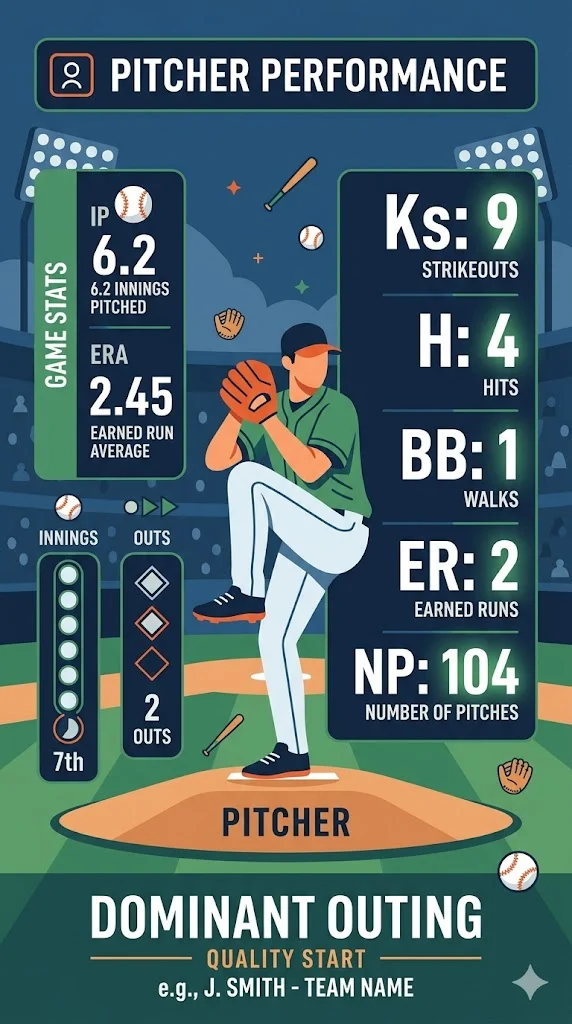

IP in baseball stands for “Innings Pitched.” It is a statistic used to measure how many innings a pitcher has completed in a game, season, or career. Each inning consists of three outs, and IP helps track a pitcher’s workload and performance.
Baseball is a sport full of stats, abbreviations, and numbers that can seem confusing at first. If you have ever looked at a box score or watched a game broadcast, you have likely seen the term IP next to a pitcher’s name.
At first glance, it might seem technical. However, once you understand it, IP becomes one of the easiest and most important baseball stats to read. In this guide, you will learn exactly what IP means in baseball, how it is calculated, why it matters, and how it is used in real game situations.
What Does IP Mean in Baseball?
In baseball, IP means “Innings Pitched.”
This stat shows how long a pitcher stays in the game by counting how many innings they complete.
Since each inning consists of three outs, pitchers earn credit for:
- Full innings
- Partial innings based on outs recorded
For example:
- 1 inning pitched equals 3 outs
- 2 innings pitched equals 6 outs
As a result, IP gives a clear picture of a pitcher’s contribution during a game.
How Innings Pitched Are Calculated
Understanding IP becomes much easier when you know how innings are recorded.
In baseball scoring, innings pitched are written in a special format:
- .1 means one out
- .2 means two outs
Example Breakdown
| IP Value | Meaning | Outs Recorded |
|---|---|---|
| 1.0 | One full inning | 3 outs |
| 2.0 | Two full innings | 6 outs |
| 3.1 | Three innings plus one out | 10 outs |
| 5.2 | Five innings plus two outs | 17 outs |
This system might look unusual at first. However, it quickly becomes intuitive once you remember that each decimal represents outs, not fractions of an inning.
Why IP Matters in Baseball
Innings pitched is more than just a number. It plays a major role in evaluating pitchers.
1. Measures Workload
First, IP shows how much a pitcher has contributed in a game.
A pitcher with high innings pitched:
- Lasts longer in games
- Reduces strain on the bullpen
- Demonstrates endurance
2. Evaluates Performance
In addition, many important pitching stats depend on IP.
Examples include:
- ERA which measures earned runs per nine innings
- WHIP which tracks walks and hits per inning
Without IP, these stats would not have context.
3. Indicates Game Control
A higher IP often suggests that a pitcher:
- Maintains control
- Limits hits and walks
- Keeps pitch count manageable
Therefore, IP is closely tied to overall effectiveness.
Real Game Examples of IP
To understand IP better, here are realistic examples from a game context.
Example 1: Strong Starting Pitcher
Pitcher A
IP 7.0
Runs 2
Meaning:
The pitcher completed 7 full innings, which equals 21 outs.
Example 2: Short Appearance
Pitcher B
IP 2.1
Meaning:
The pitcher completed 2 innings plus 1 out.
Example 3: Reliever Performance
Pitcher C
IP 1.2
Meaning:
The pitcher recorded 2 outs in the second inning of work.
Tone and Usage in Commentary
You will often hear IP used in commentary and analysis.
Neutral Tone
“He pitched 6 innings today.”
Positive Tone 😊
“Seven innings pitched, what a dominant performance.”
Critical Tone 😐
“He only lasted 3 innings, not a great outing.”
In each case, IP helps tell the story of the game.
IP vs Related Baseball Stats
IP is often used alongside other stats. Understanding how it compares can make reading box scores much easier.
Comparison Table
| Stat | Meaning | What It Measures |
|---|---|---|
| IP | Innings Pitched | How long a pitcher played |
| ERA | Earned Run Average | Runs allowed per 9 innings |
| WHIP | Walks and Hits per Inning | Base runners allowed |
| SO | Strikeouts | Batters struck out |
| BB | Walks | Free passes given |
While IP measures duration, other stats measure effectiveness.
Common Situations Where IP Is Used
IP appears in several contexts across baseball.
1. Box Scores
After every game, IP is listed next to each pitcher.
2. Player Statistics
Season and career stats always include total innings pitched.
3. Fantasy Baseball
Fantasy players track IP to:
- Evaluate pitchers
- Meet league requirements
- Compare performance
Common Mistakes When Reading IP
Although IP is straightforward, beginners sometimes misunderstand it.
Confusing Decimals
One common mistake is assuming:
- 1.2 means one and a half innings
In reality:
- 1.2 means 1 inning and 2 outs
Ignoring Partial Innings
Another mistake is overlooking partial innings.
Even a single out contributes to IP, which can affect overall stats.
Alternate Meanings of IP
While IP in baseball means Innings Pitched, it can have other meanings in different contexts.
Examples include:
- Internet Protocol in technology
- Intellectual Property in business and law
However, in baseball discussions, IP almost always refers to innings pitched.
Polite and Professional Alternatives
In formal writing or commentary, IP can be written in full.
Examples:
- “He recorded six innings pitched.”
- “The pitcher completed five innings.”
These alternatives are useful for audiences unfamiliar with abbreviations.
Tips for Understanding IP Easily
To remember IP more easily, keep these tips in mind:
- Each inning equals 3 outs
- Decimal points represent outs, not fractions
- Higher IP usually means stronger performance
- Always read IP alongside other stats
With practice, reading IP becomes second nature.
Frequently Asked Questions
1. What does IP stand for in baseball?
IP stands for innings pitched.
2. How many outs are in one inning pitched?
There are three outs in one inning.
3. What does 5.2 IP mean?
It means five innings and two outs.
4. Is IP important in baseball stats?
Yes. It is essential for measuring workload and calculating other stats.
5. Do relief pitchers have IP?
Yes. Every pitcher earns IP based on outs recorded.
6. What is a good IP for a starting pitcher?
Typically, 6 or more innings is considered strong.
7. Why are innings written with decimals?
Decimals represent outs rather than fractions.
8. Can a pitcher have 0.1 IP?
Yes. That means the pitcher recorded one out.
Conclusion
So, what does IP mean in baseball? It stands for innings pitched, a key statistic that shows how long a pitcher stays in the game and how much they contribute.
To recap:
- IP measures outs recorded in innings
- It includes both full and partial innings
- It plays a major role in evaluating pitchers
- It supports other important stats like ERA and WHIP
Once you understand IP, reading baseball stats becomes much clearer and more enjoyable. Whether you are watching a game, checking a box score, or following a season, IP is one of the most useful stats to know.
Discover More Post
What Does TS Mean in Snapchat? Full … – DefineHubs.com –
What Does Volume Mean in Science? Definition, Formula …
What Does “…” Mean in Text? Ellipsis Meaning Explained in …