
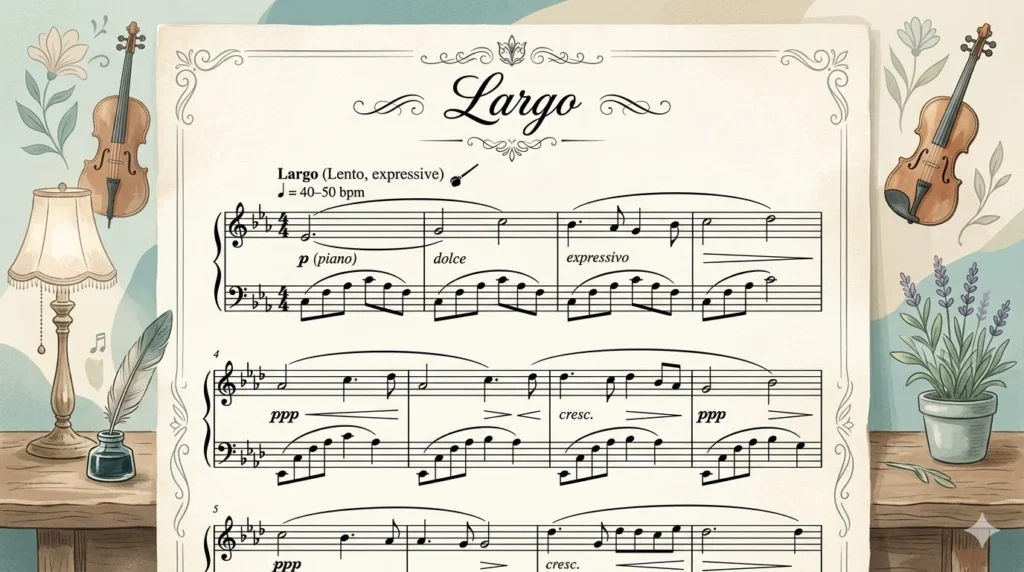

Largo in music means “very slow and broad in tempo.” It is an Italian term used to indicate that a piece should be played slowly, with a calm, spacious, and often expressive feeling.
If you have ever looked at sheet music or listened to classical compositions, you may have come across the term largo. At first, it might seem like just another unfamiliar word. However, in music, largo carries a very specific meaning that shapes how a piece is performed and experienced.
Understanding tempo markings like largo is essential for musicians, students, and even casual listeners who want to appreciate music more deeply. In this guide, you will learn exactly what largo means in music, where it comes from, how it is used, and how it compares to other tempo terms.
What Does Largo Mean in Music?
In musical terminology, largo means very slow tempo.
More importantly, it does not just indicate speed. It also suggests a broad, dignified, and expressive style of playing.
Typically, largo falls within a tempo range of about 40 to 60 beats per minute. This makes it one of the slowest tempo markings used in music.
Because of its slow pace, largo often creates a sense of:
- Calmness
- Seriousness
- Grandeur
- Emotional depth
Origin of the Term Largo
To understand largo, it helps to look at its origin.
The word comes from Italian, which has historically been the primary language of musical notation. During the Baroque and Classical periods, Italian composers and musicians established many of the tempo markings still used today.
In Italian, largo literally means “wide” or “broad.”
As a result, when musicians see largo, they interpret it not only as slow but also as expansive and flowing in character.
Why Tempo Markings Like Largo Matter
Tempo markings guide performers on how fast or slow to play a piece. However, they also influence the emotional tone.
In the case of largo, the slow tempo allows:
- Notes to breathe
- Phrases to feel more expressive
- Listeners to absorb the emotion
Therefore, playing a piece marked largo too quickly would change its entire mood and meaning.
How Largo Is Used in Music
You will usually find largo written at the beginning of a piece or section of music. It tells the performer to adopt a slow and steady pace from that point onward.
In addition, it can appear alongside other instructions, such as dynamics or expression markings.
For example:
- Largo e dolce means slow and sweet
- Largo maestoso means slow and majestic
These combinations give even more detail about how the music should feel.
Examples of Largo in Musical Context
To better understand how largo works, here are some examples with different expressive tones.
Calm and Peaceful Tone 😊
The music flows slowly and gently, creating a relaxing atmosphere.
Example:
A soft orchestral passage marked largo, allowing each note to linger.
Serious and Emotional Tone
The slow tempo highlights deep emotion and intensity.
Example:
A dramatic string section playing a largo movement filled with tension and feeling.
Grand and Majestic Tone 🎼
The broad tempo creates a sense of importance and scale.
Example:
A symphony opening marked largo maestoso, emphasizing power and dignity.
Largo vs Other Tempo Markings
To fully understand largo, it helps to compare it with similar tempo terms.
Tempo Comparison Table
| Term | Speed | Description |
|---|---|---|
| Largo | Very slow | Broad and expressive |
| Adagio | Slow | Calm and lyrical |
| Andante | Moderate | Walking pace |
| Moderato | Medium | Balanced tempo |
| Allegro | Fast | Lively and quick |
Key Differences
- Largo vs Adagio
Largo is generally slower and more expansive than adagio. - Largo vs Andante
Andante is much faster and feels like a natural walking speed. - Largo vs Allegro
Allegro is the opposite of largo, being fast and energetic.
Emotional Impact of Largo
Tempo plays a major role in how music feels. In particular, largo creates a strong emotional effect.
Because of its slow pace, it often conveys:
- Reflection
- Sadness
- Peacefulness
- Grandeur
At the same time, it can also feel powerful and dramatic depending on the context.
Common Uses of Largo in Music
Largo is often used in:
- Symphonies
- Concertos
- Film scores
- Religious or sacred music
In many cases, composers choose largo for slow movements that contrast with faster sections.
Alternate Meanings of Largo
Outside of music, largo can have other meanings depending on context.
In Italian and Spanish, it can mean:
- Wide
- Broad
- Long
However, in musical contexts, largo almost always refers to tempo.
Polite and Professional Alternatives to Largo
In modern or educational settings, musicians may describe largo using plain language.
Examples include:
- Very slow tempo
- Slow and expressive
- Broad and sustained
These alternatives are especially useful for beginners who are still learning musical terminology.
Tips for Performing Largo Correctly
If you are playing music marked largo, keep these tips in mind.
- Maintain a steady and slow pace
- Avoid rushing through notes
- Focus on expression and phrasing
- Let the music breathe naturally
Additionally, listening carefully to timing will help preserve the intended mood.
Common Mistakes with Largo
Even experienced musicians can misunderstand largo.
Playing Too Fast
Some performers treat largo like adagio, which reduces its intended depth.
Ignoring Expression
Largo is not just slow. It should also feel broad and expressive.
Losing Control of Timing
Playing too slowly without structure can make the music feel disconnected.
Frequently Asked Questions
1. What does largo mean in music?
Largo means very slow tempo with a broad and expressive style.
2. How fast is largo in beats per minute?
It is typically around 40 to 60 beats per minute.
3. Is largo slower than adagio?
Yes. Largo is generally slower and more expansive than adagio.
4. What language does largo come from?
It comes from Italian, the traditional language of music notation.
5. Does largo describe mood or speed?
It describes both. It indicates a slow speed and a broad, expressive mood.
6. Where is largo written in music?
It usually appears at the beginning of a piece or section.
7. Can largo be combined with other terms?
Yes. For example, largo maestoso means slow and majestic.
8. Is largo used in modern music?
Yes. It appears in classical, film, and sometimes contemporary compositions.
Conclusion
So, what does largo mean in music? It means very slow tempo, combined with a broad, expressive, and often powerful style of performance.
To recap:
- Largo indicates one of the slowest tempos in music
- It comes from Italian and means broad or wide
- It shapes both speed and emotional tone
- It is commonly used in classical and orchestral music
- It requires careful control and expressive playing
Understanding largo helps you not only play music correctly but also appreciate the emotion and intention behind each piece.
Discover More Post
What Does Infer Mean in Reading? Clear Definition and …
What Does FTE Mean in Workday? Full Time Equivalent …
What Does ARO Mean in Shipping? Definition and Business …