
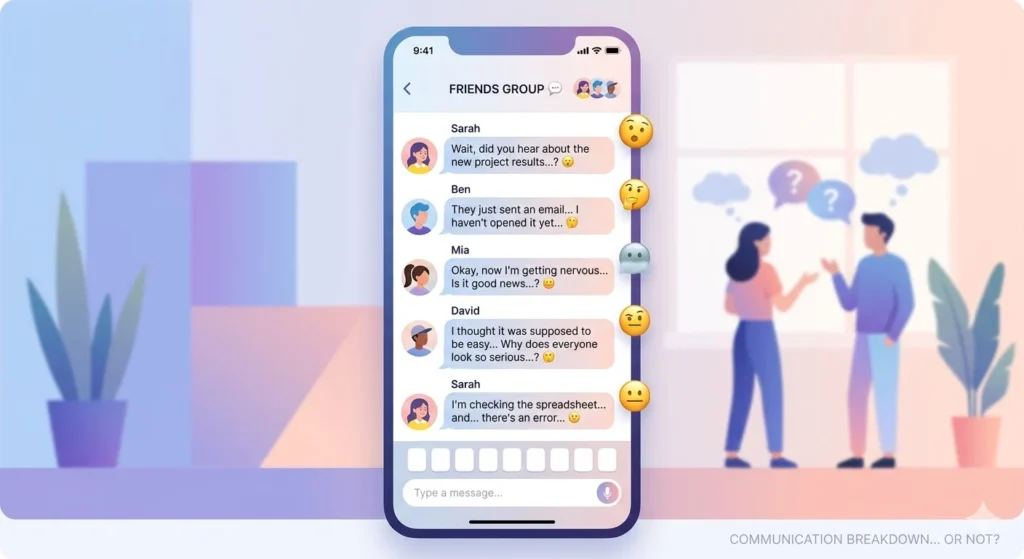

In texting, “…” (an ellipsis) represents a pause, hesitation, or unfinished thought. It can also suggest emotion, suspense, awkwardness, or something left unsaid, depending on context and tone.
If you have ever received a message that simply ends with “…”, you may have paused and wondered what the sender really meant. Was it thoughtful, awkward, dramatic, or even passive aggressive?
The truth is, those three tiny dots can carry a surprising amount of meaning in modern texting. While “…” originally came from formal writing, it has evolved into a powerful tool in digital communication.
In this guide, you will learn exactly what “…” means in text, how tone changes its meaning, when to use it, when to avoid it, and how it compares to other punctuation and texting styles.
What Does “…” Mean in Text?
In texting, “…” indicates a pause or something left unsaid.
Depending on the situation, it can express:
- Hesitation
- Suspense
- Uncertainty
- Emotional tone
- Awkward silence
- A trailing or incomplete thought
Because texting lacks voice tone and facial expressions, people use punctuation like “…” to fill in emotional context.
Origin of “…” and How It Became Popular in Texting
Originally, “…” is called an ellipsis and comes from traditional writing.
In formal grammar, it is used to:
- Show omitted words in a quote
- Indicate a trailing thought
- Create suspense in storytelling
However, as texting and online messaging grew, the ellipsis took on new meanings.
Today, it is widely used in:
- Text messages
- Social media chats
- Messaging apps
- Emails and informal writing
Over time, its meaning became more emotional and tone based rather than strictly grammatical.
Common Meanings of “…” in Texting
The meaning of “…” depends heavily on context. Below are the most common interpretations.
1. A Pause or Thinking Moment
First, “…” often signals that someone is thinking or pausing before continuing.
Example:
- “I mean… I am not sure.”
In this case, the sender is considering their words carefully.
2. Something Left Unsaid
In many cases, “…” implies that something is intentionally not being said.
Example:
- “You know what happened…”
Here, the sender expects the other person to understand without explanation.
3. Awkward or Uncomfortable Tone
Sometimes, “…” creates a sense of awkwardness or tension.
Example:
- “Oh… okay.”
This can feel uncertain or slightly uncomfortable depending on context.
4. Suspense or Drama
Additionally, people use “…” to build suspense or anticipation.
Example:
- “Guess what happened today…”
This invites curiosity and keeps the reader engaged.
5. Passive Aggressive or Negative Tone
In some situations, “…” can come across as passive aggressive or dismissive.
Example:
- “Sure…”
This might suggest doubt, annoyance, or sarcasm.
Because tone is unclear in text, this usage can easily be misunderstood.
Examples of “…” in Different Contexts
To better understand how meaning changes, here are examples across tones.
Friendly Tone 😊
- “Haha… that was funny”
- “Wait… really?”
In these cases, the ellipsis feels playful or curious.
Neutral Tone
- “I think… we should talk later”
- “Maybe… it depends”
Here, it simply shows hesitation or thought.
Negative or Dismissive Tone 😐
- “Okay…”
- “If you say so…”
These can feel cold, doubtful, or slightly irritated.
Example Table: Meaning of “…” Based on Context
| Text Message | Likely Meaning | Tone |
|---|---|---|
| “I guess…” | Uncertainty | Neutral |
| “Oh…” | Surprise or awkwardness | Mixed |
| “Sure…” | Possible sarcasm | Negative |
| “Wait…” | Curiosity or suspense | Friendly |
| “Well…” | Hesitation | Neutral |
This table shows how the same punctuation can shift meaning depending on wording.
When to Use “…” in Texting
Using “…” effectively can make your messages feel more natural and expressive.
Good Situations to Use It
- To show hesitation
- To create suspense
- To soften a statement
- To sound thoughtful
- To imply something without saying it directly
Example:
- “I was thinking… maybe we could meet tomorrow”
When to Avoid Using “…”
Although useful, “…” can sometimes create confusion or unintended tone.
Avoid It When
- You want to sound clear and direct
- The message could be misunderstood
- You are in professional communication
- You want to avoid sounding passive aggressive
Example:
- “Okay…” may feel less positive than “Okay!”
“…” vs Other Texting Punctuation
Understanding how “…” compares to other punctuation can help you choose the right tone.
Comparison Table
| Symbol | Meaning | Tone |
|---|---|---|
| … | Pause or unfinished thought | Emotional or unclear |
| . | Full stop | Neutral or firm |
| ! | Excitement | Positive |
| ? | Question | Curious |
| ?? | Strong curiosity | Emphasized |
For example:
- “Okay.” feels neutral
- “Okay!” feels enthusiastic
- “Okay…” may feel unsure or reluctant
Polite and Clear Alternatives to “…”
If you want to avoid confusion, you can replace **“…” with clearer wording.
Alternatives
Instead of:
- “Okay…”
Try:
- “Okay, that makes sense”
- “Alright, I understand”
- “Sounds good”
Instead of:
- “I guess…”
Try:
- “I am not completely sure”
- “I need more time to decide”
These alternatives reduce ambiguity and improve clarity.
Common Misinterpretations of “…”
Because texting lacks tone, “…” is often misunderstood.
Some people see it as:
- Rude
- Passive aggressive
- Dismissive
Others see it as:
- Thoughtful
- Natural
- Expressive
Therefore, context, relationship, and communication style all play a role in how it is received.
Alternate Meanings of “…”
Outside texting, “…” has formal meanings.
In writing, it is used to:
- Indicate missing words in quotes
- Show a trailing thought in literature
- Create dramatic pauses
However, in texting, its meaning is much more flexible and emotional.
Frequently Asked Questions
1. What does “…” mean in texting?
It usually means a pause, hesitation, or something left unsaid.
2. Is “…” rude in text messages?
Not always, but it can feel rude or passive aggressive depending on context.
3. Why do people use “…” instead of a period?
They want to show emotion, hesitation, or a softer tone instead of a firm stop.
4. Does “…” mean someone is upset?
Sometimes, but not always. It depends on the message and relationship.
5. Is it okay to use “…” in professional messages?
It is better to avoid it in formal communication to prevent confusion.
6. What does “Okay…” mean in a text?
It can suggest hesitation, doubt, or mild frustration.
7. How is “…” different from “.”?
A period is clear and neutral, while an ellipsis suggests tone or emotion.
8. Can “…” be friendly?
Yes. It can sound curious, playful, or thoughtful in the right context.
Conclusion
So, what does “…” mean in text? It represents a pause, hesitation, or an unfinished thought, but its meaning can shift depending on tone and context.
To recap:
- It adds emotional nuance to messages
- It can express hesitation, suspense, or awkwardness
- It may be misunderstood if used carelessly
- It works best in casual conversations
- Clear alternatives can improve communication when needed
Understanding how to use and interpret “…” will help you read between the lines and communicate more effectively in today’s digital world.
Discover More Post
What Does Allusion Mean in Literature? Definition and Clear …
What Does Bougie Mean in Slang? Meaning, Origin and …
What Does BR Mean in Text? Simple Meaning and Examples …