
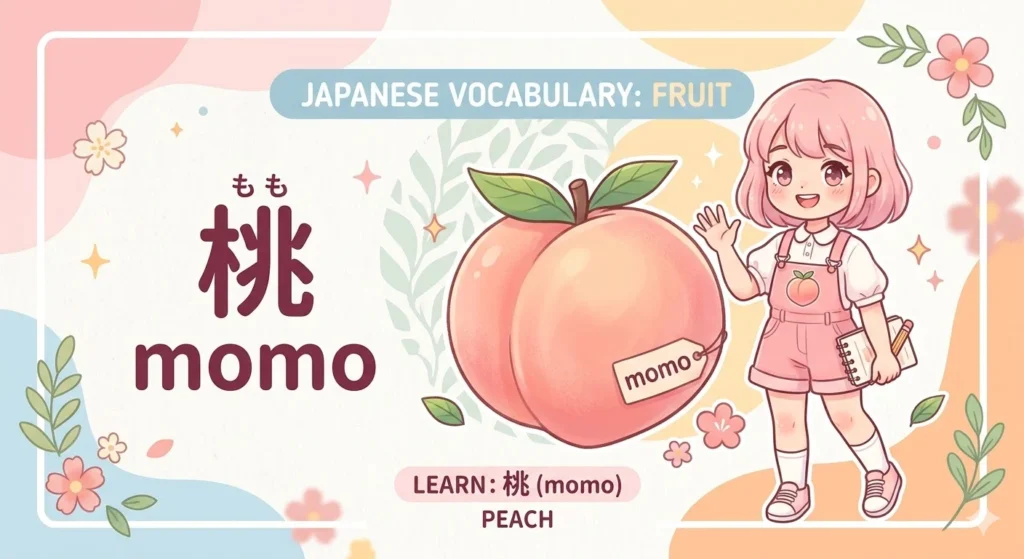

Momo in Japanese most commonly means “peach” (桃). It can also be used as a name, a term of endearment, or appear in pop culture and folklore, depending on the context.
If you have come across the word momo in anime, social media, or Japanese conversations, you might be wondering what it actually means. At first, it seems simple. However, like many Japanese words, momo can carry different meanings depending on how and where it is used.
In this guide, you will learn the primary meaning of momo, its cultural background, how it appears in everyday language, and how tone and context shape its meaning. By the end, you will have a clear and confident understanding of this popular Japanese word.
What Does Momo Mean in Japanese?
In Japanese, momo (桃) means “peach,” the fruit.
However, the meaning does not stop there. Depending on context, momo can also refer to:
- A given name
- A nickname or affectionate term
- A symbol in Japanese culture
- A word used in anime, manga, and pop culture
Because Japanese relies heavily on context, the meaning of momo becomes clearer based on how it is used in a sentence or conversation.
The Origin and Cultural Meaning of Momo
Understanding momo becomes easier when you look at its cultural roots.
The Peach in Japanese Culture
In Japan, the peach is more than just a fruit. It carries symbolic meaning.
Traditionally, peaches are associated with:
- Protection from evil
- Longevity and health
- Good fortune
For example, in Japanese folklore, the famous story of Momotarō tells of a boy who was born from a giant peach and became a hero.
Because of this story, the word momo often feels warm, positive, and culturally rich.
How Momo Is Used in Everyday Japanese
Although momo literally means peach, it appears in many everyday situations.
1. Referring to the Fruit
First of all, momo is used in the most direct sense to describe a peach.
Examples:
- Momo o tabemasu
I eat peaches - Kono momo wa amai
This peach is sweet
This is the most straightforward and common meaning.
2. As a Name
In addition, momo is often used as a given name, especially for girls.
It can appear on its own or as part of longer names.
Examples:
- Momo
- Momoka
- Momoko
As a name, it often conveys softness, beauty, and charm.
3. As a Nickname or Term of Endearment
In casual conversation, momo may be used as a cute nickname.
For instance, someone might call a friend or partner “Momo” as a playful or affectionate label.
This usage is especially common in:
- Friend groups
- Online communities
- Fan culture
4. In Pop Culture and Anime
Furthermore, momo appears frequently in anime, manga, and games.
You might see characters named Momo or hear the word used in dialogue.
Because of this exposure, many non native speakers recognize the word even without studying Japanese.
Examples of Momo in Context
To understand how meaning changes with context, here are some examples with tone variations.
Friendly Tone 😊
- Momo ga daisuki
I love peaches - Momo chan wa kawaii
Momo is cute
In these cases, the word feels warm and positive.
Neutral Tone
- Momo o kaimashita
I bought peaches - Kare no namae wa Momo desu
His name is Momo
Here, the word is simply descriptive.
Playful or Affectionate Tone
- Oi Momo
Hey Momo - Momo tte yonde mo ii
Can I call you Momo
This usage feels casual and friendly.
Different Meanings of Momo Based on Context
Because Japanese words can have multiple meanings, context plays a key role.
Meaning Table
| Context | Meaning |
|---|---|
| Food | Peach |
| Name | Personal name |
| Nickname | Cute or affectionate label |
| Culture | Symbol of protection and good fortune |
| Pop culture | Character name or reference |
As you can see, the same word can shift meaning depending on how it is used.
Momo vs Similar Japanese Words
Although momo is simple, it can sometimes be confused with other words.
Comparison Table
| Word | Meaning | Notes |
|---|---|---|
| Momo | Peach | Most common meaning |
| Momo chan | Cute nickname | Friendly tone |
| Momotarō | Peach boy | Folklore reference |
| Momoiro | Peach colored | Describes color |
This comparison helps clarify how the root word changes in different forms.
Alternate Meanings Outside Japanese
While momo in Japanese usually means peach, it can have other meanings in different cultures.
For example:
- In some regions, momo refers to a type of dumpling
- In internet culture, it may appear in memes or viral trends
Because of this, it is important to consider context before interpreting the word.
Polite and Natural Ways to Use Momo
If you are learning Japanese, you can use momo naturally in simple sentences.
Examples:
- Momo ga suki desu
I like peaches - Momo wa oishii desu
Peaches are delicious
When used as a name or nickname, it is polite to add honorifics like “chan” for a softer tone.
Common Mistakes with Momo
Even though the word is simple, learners sometimes make small mistakes.
Assuming Only One Meaning
Some people think momo always means fruit.
However, it can also be a name or nickname depending on context.
Ignoring Cultural Context
Another mistake is missing the cultural meaning behind the word.
Understanding its link to folklore adds depth to its usage.
Frequently Asked Questions
1. What does momo mean in Japanese?
It most commonly means “peach.”
2. Is momo a name in Japanese?
Yes. It is often used as a given name, especially for girls.
3. Can momo be a nickname?
Yes. It is commonly used as a cute or affectionate nickname.
4. What does momo symbolize in Japan?
It represents protection, good fortune, and longevity.
5. Is momo used in anime?
Yes. Many characters in anime and manga are named Momo.
6. Does momo have negative meanings?
No. It is generally positive or neutral in Japanese.
7. Is momo only used for fruit?
No. It can also refer to names, nicknames, and cultural symbols.
8. How do you pronounce momo?
It is pronounced as “mo mo,” with both syllables sounding the same.
Conclusion
So, what does momo mean in Japanese? In its simplest form, it means “peach.” However, its meaning expands depending on context.
To recap:
- Momo primarily means peach
- It is also used as a name and nickname
- It carries cultural symbolism in Japan
- It appears often in anime and pop culture
- Context determines its exact meaning
By understanding these layers, you can recognize and use momo more naturally in both language learning and everyday conversations.
Discover More Post
GTS Meaning in Text: What It Stands For and How to Use It in …
WYO Meaning in Text: What Does WYO Stand For? for 2026
What Does Por Qué Mean in Spanish? Explanation for 2026