
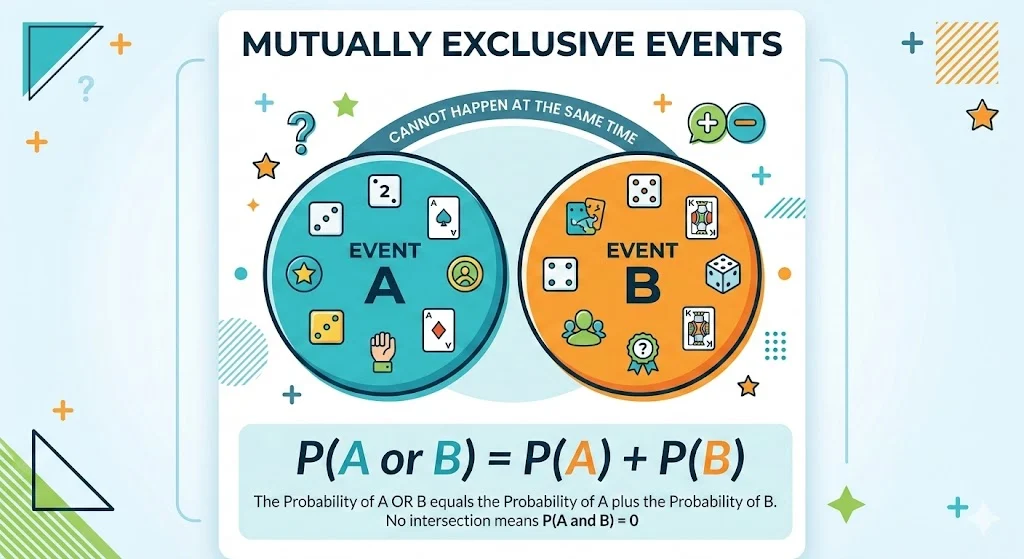

In probability, mutually exclusive events are events that cannot happen at the same time. If one event occurs, the other event cannot occur. Mathematically, mutually exclusive events have no shared outcomes and their intersection equals zero.
Probability can sometimes feel abstract. However, certain concepts make everything clearer once you understand them. One of those essential ideas is mutually exclusive events. Whether you are studying math, preparing for exams, or simply trying to understand probability better, knowing what mutually exclusive means is fundamental.
In this complete guide, you will learn exactly what mutually exclusive means in probability, how to identify such events, how to calculate probabilities involving them, and how they compare to similar concepts like independent events. By the end, the idea will feel logical and easy to apply.
What Does Mutually Exclusive Mean in Probability?
In probability, mutually exclusive events are two or more events that cannot occur simultaneously.
In other words, if one event happens, the other is automatically ruled out.
Simple Explanation
If Event A happens, Event B cannot happen at the same time.
Mathematically, this means:
P A and B equals 0
This shows there are no common outcomes between the two events.
Breaking Down the Meaning
To understand this concept better, let us look at the phrase itself.
- Mutually means shared between two or more
- Exclusive means excluding others
Therefore, mutually exclusive events exclude each other.
Basic Real Life Examples
Examples make probability concepts much easier to understand. So let us look at simple everyday situations.
Example 1: Flipping a Coin
When flipping a coin once:
Event A: Getting heads
Event B: Getting tails
You cannot get both heads and tails in a single flip. Therefore, these events are mutually exclusive.
Example 2: Rolling a Die
If you roll one six sided die:
Event A: Rolling a 2
Event B: Rolling a 5
Since you can only roll one number at a time, these two events cannot occur together. As a result, they are mutually exclusive.
Example 3: Drawing a Card
From a standard deck:
Event A: Drawing a heart
Event B: Drawing a spade
A card cannot be both a heart and a spade at the same time. Thus, these events are mutually exclusive.
Mathematical Definition
In probability notation:
Two events A and B are mutually exclusive if:
P A ∩ B equals 0
The symbol ∩ means intersection. It represents outcomes shared by both events.
Since mutually exclusive events have no shared outcomes, their intersection probability equals zero.
Probability Formula for Mutually Exclusive Events
One major advantage of identifying mutually exclusive events is that calculating their combined probability becomes easier.
For mutually exclusive events:
P A or B equals P A plus P B
Because they cannot overlap, you do not subtract anything.
Example Calculation
Suppose:
P A equals 0.3
P B equals 0.4
Since the events are mutually exclusive:
P A or B equals 0.3 plus 0.4 equals 0.7
The calculation is straightforward because there is no overlap.
Visual Understanding
Imagine two circles in a diagram.
For mutually exclusive events, the circles do not touch or overlap at all.
This visual representation shows clearly that the events have nothing in common.
Mutually Exclusive vs Independent Events
Students often confuse mutually exclusive events with independent events. However, these concepts are very different.
Comparison Table
| Feature | Mutually Exclusive | Independent |
|---|---|---|
| Can happen at the same time | No | Yes |
| Intersection probability | Zero | Not necessarily zero |
| Example | Heads and tails in one flip | Two separate coin flips |
| Formula for both | P A ∩ B equals 0 | P A ∩ B equals P A times P B |
Key Difference
Mutually exclusive events cannot occur together.
Independent events can occur together, but one does not affect the probability of the other.
Important Rule
If two events are mutually exclusive and both have non zero probability, they cannot be independent.
This is because independence requires:
P A ∩ B equals P A times P B
However, mutually exclusive events have:
P A ∩ B equals 0
Therefore, unless one probability is zero, they cannot be independent.
More Detailed Examples
Let us explore a few more situations.
Example 1: Weather Events
Event A: It is raining
Event B: It is snowing
In some climates, rain and snow cannot happen at the same time. In that case, they are mutually exclusive.
However, in other regions, rain and snow can mix. Therefore, context matters.
Example 2: Exam Results
Event A: Passing the test
Event B: Failing the test
A student cannot both pass and fail the same test. Thus, these events are mutually exclusive.
Example 3: Age Categories
Event A: A person is under 18
Event B: A person is over 18
A person cannot be both under and over 18 at the same time. Therefore, these categories are mutually exclusive.
Common Mistakes
Although the concept seems simple, students often make mistakes.
Mistake 1: Confusing With Independent Events
Some assume that if events do not affect each other, they are mutually exclusive. However, that is not correct.
For example:
Event A: Rolling an even number
Event B: Rolling a number greater than 3
You can roll a 4 or 6, which satisfies both events. Therefore, they are not mutually exclusive.
Mistake 2: Forgetting to Check Overlap
Before labeling events as mutually exclusive, always ask:
Can both happen at the same time?
If yes, they are not mutually exclusive.
Alternate Meanings of Mutually Exclusive
Outside probability, mutually exclusive is also used in everyday language.
For example:
Two job offers might be mutually exclusive if you must choose only one.
Two schedules might be mutually exclusive if they conflict completely.
In general English, it means two things cannot exist or happen together.
Why This Concept Matters in Probability
Understanding mutually exclusive events helps you:
- Apply the correct probability formula
- Avoid calculation errors
- Interpret real world data accurately
- Perform better on exams
Additionally, many advanced probability rules build on this concept.
Quick Identification Checklist
To determine if events are mutually exclusive, ask:
- Can both events happen at the same time?
- Do they share any outcomes?
- Is their intersection probability zero?
If the answer to the first question is no, then they are mutually exclusive.
Frequently Asked Questions
1. What does mutually exclusive mean in simple terms?
It means two events cannot happen at the same time.
2. Can mutually exclusive events ever occur together?
No. If one happens, the other cannot.
3. What is the formula for mutually exclusive events?
P A or B equals P A plus P B.
4. Are mutually exclusive events independent?
No, unless one event has zero probability.
5. Can events be both mutually exclusive and independent?
Only if one of the events has probability zero.
6. How do I test if events are mutually exclusive?
Check whether they share any outcomes.
7. What is an example with dice?
Rolling a 1 and rolling a 6 on the same single roll are mutually exclusive.
8. Why is the intersection zero?
Because there are no outcomes that satisfy both events.
Conclusion
So, what does mutually exclusive mean in probability?
It describes events that cannot occur at the same time. If one event happens, the other is automatically excluded. Mathematically, their intersection equals zero, and their combined probability is simply the sum of their individual probabilities.
To summarize:
- Mutually exclusive events cannot overlap
- Their intersection probability equals zero
- Their combined probability is found by addition
- They are different from independent events
- Always check for shared outcomes before labeling events
Once you understand this concept, many probability problems become clearer and easier to solve.
Discover More Post
What Does Infer Mean in Reading? Clear Definition and …
What Does Enterprise Mean in Business? Definition and …