
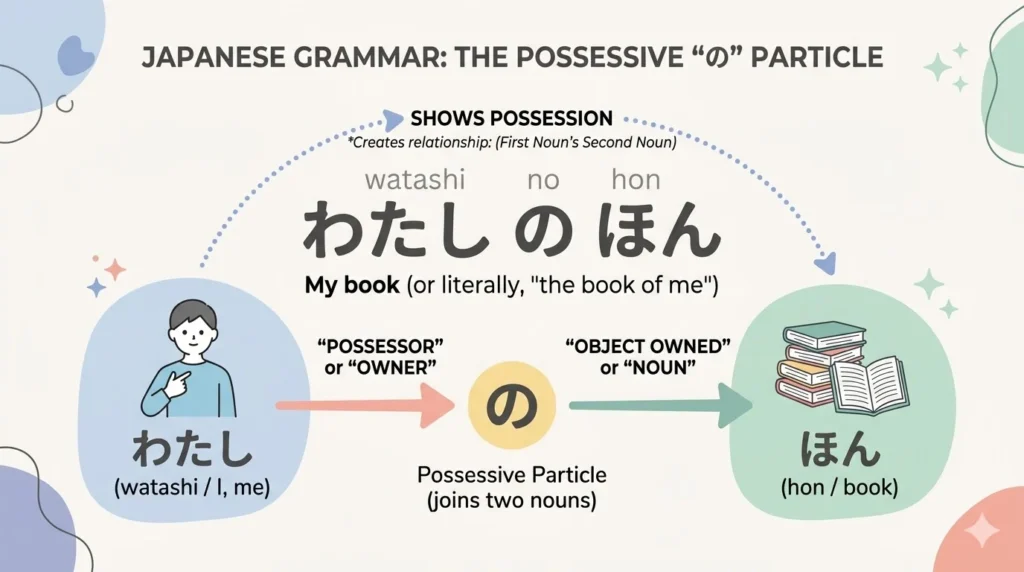

No in Japanese is a particle written as の that shows possession, connection, or description between two words. It often works like “of,” “’s,” or “belonging to” in English.
If you are learning Japanese or exploring the language through anime, music, or everyday phrases, you have probably noticed the small but powerful word no. At first, it may seem simple, but in reality, it plays a crucial role in Japanese sentence structure.
Unlike English, Japanese relies heavily on particles to show relationships between words. Among these, no is one of the most commonly used and easiest to recognize. Understanding it will immediately improve your ability to form natural sounding phrases.
In this guide, you will learn exactly what no means in Japanese, how it works in different situations, how to use it correctly, and how it compares to similar grammar structures.
What Does No Mean in Japanese?
In Japanese, no (の) is a particle used to connect two nouns.
It usually indicates:
- Possession
- Relationship
- Description
- Category or type
In simple terms, no links one word to another, showing how they are related.
Core Meaning of No
The most common way to understand no is as a marker of possession.
For example:
Watashi no hon
My book
Here:
- Watashi means I or me
- No shows possession
- Hon means book
So, no functions like “my” or “of” in English.
Main Uses of No in Japanese
Although its basic meaning is simple, no has several important uses. Let’s explore them one by one.
1. Showing Possession
First of all, no is used to show that something belongs to someone.
Examples:
- Watashi no kuruma
My car - Tanaka san no ie
Mr Tanaka’s house - Kare no baggu
His bag
In each case, no connects the owner to the object.
2. Describing Relationships
In addition, no can show relationships between people or things.
Examples:
- Tomodachi no imouto
My friend’s younger sister - Gakkou no sensei
School teacher - Nihon no bunka
Japanese culture
Here, no helps define how two nouns are connected.
3. Indicating Category or Type
Another common use is to describe what type of thing something is.
Examples:
- Nihon no tabemono
Japanese food - Eigo no hon
English book - Ongaku no sensei
Music teacher
In these cases, no acts like an adjective by adding detail to the noun.
4. Turning Nouns into Descriptions
Sometimes, no allows one noun to describe another noun, similar to how adjectives work in English.
Examples:
- Kirei na hana
A beautiful flower - Hana no iro
The color of the flower
Although this may seem subtle, it is very important in Japanese sentence building.
5. Softening Tone in Casual Speech
In casual conversation, especially in spoken Japanese, no can appear at the end of a sentence.
Examples:
- Iku no
Are you going - Daijoubu na no
Are you okay
In this case, no adds a softer or more emotional tone, often used in informal or feminine speech.
Examples of No in Real Context
To better understand how no works, here are examples with different tones.
Friendly Tone 😊
- Watashi no neko
My cat - Anata no namae wa
Your name is
Neutral Tone
- Tokyo no eki
Tokyo station - Kare no kuruma
His car
Slightly Emotional or Casual Tone
- Nani shiteru no
What are you doing - Dou shita no
What happened
In each example, no connects ideas or softens the sentence.
No vs Similar Japanese Particles
Japanese has several particles, and beginners often confuse them.
Here is a simple comparison.
Comparison Table
| Particle | Function | Example Meaning |
|---|---|---|
| No | Possession or connection | My book |
| Wa | Topic marker | As for me |
| Ga | Subject marker | I am the one |
| Ni | Direction or time | To or at |
| O | Object marker | Direct object |
Example Comparison
- Watashi no hon
My book - Watashi wa gakusei desu
I am a student - Watashi ga ikimasu
I will go
As you can see, no is specifically used to connect nouns, while other particles have different roles.
Common Phrases with No
Many everyday Japanese expressions include no.
Examples:
- Watashi no
Mine - Anata no
Yours - Kore no
This one’s - Sore no
That one’s
Because these phrases are simple and useful, they are great for beginners to practice.
Common Mistakes with No
Even though no is easy to learn, it is also easy to misuse.
Overusing No
Sometimes learners add no where it is not needed.
Incorrect:
Watashi no wa gakusei
Correct:
Watashi wa gakusei desu
Confusing Word Order
In Japanese, the order is usually:
Owner + no + object
Incorrect:
Hon no watashi
Correct:
Watashi no hon
Alternate Meanings of No
While no (の) is mainly a particle, it can also appear in other forms.
For example:
- As a pronoun replacement in casual speech
- As a sentence ending particle that softens tone
However, in most beginner contexts, it simply acts as a connector between nouns.
Polite and Natural Usage Tips
To sound more natural when using no, keep these tips in mind:
- Keep word order clear
- Avoid unnecessary repetition
- Use it only when connecting nouns
- Practice with simple phrases first
For example:
Watashi no hon desu
This is my book
This sentence is natural, clear, and polite.
Frequently Asked Questions
1. What does no mean in Japanese?
No is a particle that shows possession or connection between two nouns.
2. Is no the same as “of” in English?
Yes, in many cases it works like “of” or “’s.”
3. How do you use no in a sentence?
Place it between two nouns to show their relationship.
4. Can no be used for people?
Yes. It is commonly used to show ownership or relationships between people.
5. Is no formal or informal?
It is used in both formal and informal Japanese.
6. Can no be used at the end of a sentence?
Yes, in casual speech it can soften the tone or add emotion.
7. Is no difficult to learn?
No. It is one of the easiest and most common particles in Japanese.
8. What is the difference between no and wa?
No shows connection, while wa marks the topic of a sentence.
Conclusion
So, what does no mean in Japanese? In simple terms, it is a particle that connects nouns and shows possession, relationships, or description.
To recap:
- No links two nouns together
- It often means “of” or “belonging to”
- It is used for possession, relationships, and categories
- It appears in both casual and formal speech
- It is essential for building natural Japanese sentences
Once you understand how no works, you will find it much easier to read, speak, and understand Japanese. With practice, it quickly becomes second nature.
Discover More Post
What Does Jireh Mean in the Bible? Meaning and Biblical …
What Does PF Mean in Fantasy Football? Complete Guide …