
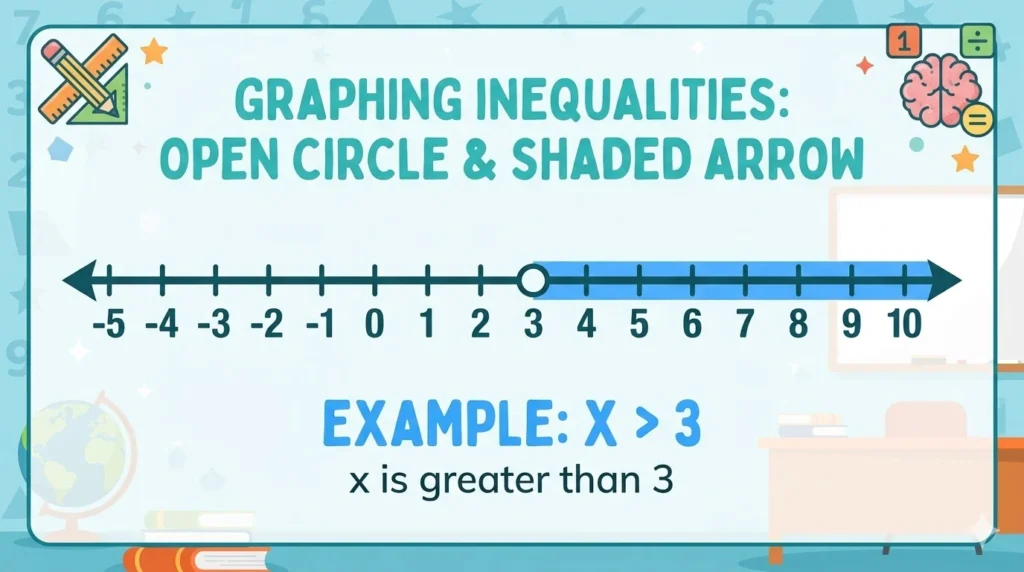

An open circle in math is a hollow circle that shows a point is not included in a solution, graph, or set. It marks a value that a line or curve may approach but does not actually include.
If you have ever looked at a number line or graph and noticed a small hollow circle, you may have wondered what it represents. Although it looks simple, it plays a crucial role in understanding mathematical relationships.
Many students overlook this symbol at first. However, once you understand it, reading graphs and inequalities becomes much easier. In this guide, you will learn exactly what an open circle means in math, how to use it, and how it compares to similar symbols.
What Does an Open Circle Mean in Math?
In math, an open circle shows that a value is excluded.
To put it simply, the number at that point does not belong to the solution. Even though a graph or line may extend toward it, that exact value does not count.
For example:
- An open circle at 3 means 3 is not included
- Numbers close to 3 can still be part of the solution
Because of this, open circles often appear in inequalities and graphs.
Where You See Open Circles in Math
You will encounter open circles in several key areas of math. Let’s explore the most common ones.
1. Inequalities on a Number Line
Open circles often appear when you graph inequalities.
Example
x > 4
On a number line:
- Place an open circle at 4
- Shade to the right
This shows that the solution includes values greater than 4, but not 4 itself.
2. Graphing Functions
Open circles also appear in function graphs.
Sometimes a function approaches a point but does not include it. In that case, you draw an open circle at that point.
Example
A graph approaches the point (2, 4), but the function does not include that value.
- Draw an open circle at (2, 4)
- The curve moves toward the point but does not touch it
This often happens in rational or piecewise functions.
3. Piecewise Functions
Piecewise functions frequently use open circles at boundary points.
Example
f(x) = x + 1 for x < 2
f(x) = 3 for x ≥ 2
At x = 2:
- Draw an open circle for the first rule
- Draw a closed circle for the second rule
This makes it clear which rule applies at that value.
Open Circle vs Closed Circle
To fully understand open circles, compare them with closed circles.
Comparison Table
| Symbol | Name | Meaning | Example |
|---|---|---|---|
| ○ | Open Circle | Value not included | x > 2 |
| ● | Closed Circle | Value included | x ≥ 2 |
Key Difference
- An open circle excludes the value
- A closed circle includes the value
This difference can completely change the meaning of a graph.
Examples of Open Circles in Context
Let’s look at clear examples that show how open circles work.
Example 1: Less Than
x < 5
- Draw an open circle at 5
- Shade to the left
This represents all values less than 5.
Example 2: Greater Than
x > 1
- Draw an open circle at 1
- Shade to the right
This includes values greater than 1.
Example 3: Function with a Hole
A graph approaches (2, 4), but the function skips that point.
- Mark the point with an open circle
- The graph continues around it
This creates a visible gap in the graph.
Example 4: Boundary in Piecewise Function
At a boundary value:
- One rule uses an open circle
- Another rule uses a closed circle
This prevents overlap and keeps the definition clear.
Why Open Circles Matter in Math
Open circles play an important role in accuracy.
They help you:
- Distinguish included and excluded values
- Read graphs correctly
- Solve inequalities properly
- Avoid misunderstandings
Without open circles, graphs would lose clarity and precision.
Common Mistakes with Open Circles
Even though the concept is simple, students often make mistakes. Here are the most common ones.
Mixing Up Symbols
x > 3 requires an open circle
x ≥ 3 requires a closed circle
Switching them changes the meaning completely.
Including the Endpoint by Mistake
Some learners accidentally include the number marked with an open circle.
Always remember:
An open circle means the value does not belong to the solution.
Misreading Graph Direction
Students sometimes focus only on the circle and ignore the shading direction.
Check both:
- The type of circle
- The direction of the shading
Alternate Meanings of Open Circle
In most cases, an open circle means exclusion. However, the context can slightly change how it appears.
- In graphs, it can show a hole
- In limits, it can represent a value the function approaches
- In sets, it can mark an excluded boundary
Even so, the main idea stays the same: the value does not count.
Clear Ways to Explain Open Circles
When explaining math concepts, clarity matters.
Instead of vague instructions, try these:
- “Draw an open circle to show the value is excluded”
- “Mark the point with a hollow circle because it is not included”
- “Use an open circle to represent a boundary that does not belong to the solution”
These explanations make your meaning easier to understand.
Quick Reference Table
| Situation | Circle Type | Meaning |
|---|---|---|
| x > a | Open | a not included |
| x < a | Open | a not included |
| x ≥ a | Closed | a included |
| x ≤ a | Closed | a included |
Frequently Asked Questions
1. What does an open circle mean on a graph?
It shows that the point is not included in the solution or graph.
2. When should I use an open circle?
Use it with strict inequalities like greater than or less than.
3. What is the difference between open and closed circles?
An open circle excludes a value, while a closed circle includes it.
4. Does an open circle mean undefined?
In some functions, yes. It can indicate a point where the function has no value.
5. Is an open circle used in inequalities?
Yes. It appears in inequalities that do not include the endpoint.
6. Can open circles appear in graphs of functions?
Yes. They often show holes or excluded points.
7. What does an open circle mean in limits?
It represents a value that the function approaches but does not reach.
8. Why is the open circle important?
It keeps graphs and solutions accurate by showing excluded values.
Conclusion
So, what does an open circle mean in math? It shows that a value is not included in a solution, graph, or set.
Keep these key points in mind:
- An open circle marks exclusion
- It appears in inequalities and graphs
- It differs from a closed circle, which includes values
- It helps you interpret math correctly
Once you understand this symbol, you can read number lines and graphs with confidence and accuracy.
Discover More Post
What Does Excluded Mean in PowerSchool – DefineHubs.com –
What Does TS Mean in Snapchat? Full … – DefineHubs.com –
What Does Volume Mean in Science? Definition, Formula …