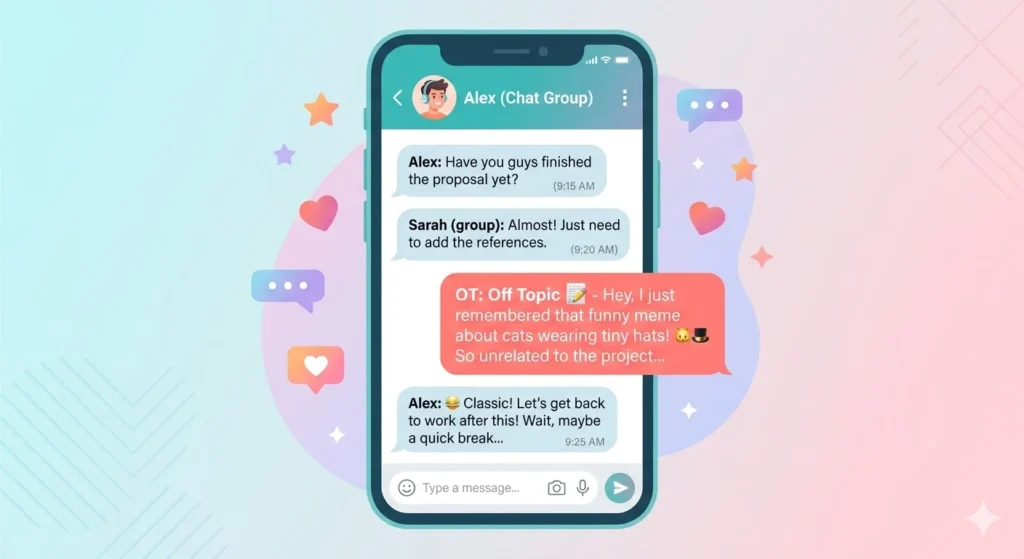

OT in texting stands for “Off Topic.” It is used when someone wants to indicate that their message or comment is not directly related to the main conversation or discussion thread.
Texting and online conversations have developed their own language, full of abbreviations, acronyms, and shorthand. One of the most common terms you might see in forums, group chats, or social media threads is OT. While it looks simple, understanding what OT means in texting is essential for navigating conversations smoothly and avoiding misunderstandings.
In this guide, you will learn the meaning of OT, its origin, real-world usage, tone implications, examples, and how it compares to similar texting abbreviations. By the end, you will be confident recognizing and using OT in digital conversations.
What Does OT Mean in Texting?
In texting and online discussions, OT stands for Off Topic.
When someone marks a message as OT, they are signaling that the content of their message is not related to the main subject of the conversation. This is a way to keep threads organized while still sharing additional thoughts.
For example:
“OT: I just saw a cute dog outside my window 🐶”
Here, the message is not part of the main discussion, but the sender still wants to share it.
Origin and Popularity of OT
Where OT Came From
The term OT originated in online forums and early internet chat rooms, where conversations often went off track. Users needed a way to indicate that their message was a tangent, not part of the main discussion.
Over time, OT spread to:
- Text messaging
- Group chats
- Social media platforms
- Email threads
It remains a popular shorthand for anyone who wants to signal a topic change politely.
Why OT Became Popular
OT became common because it:
- Is short and easy to type
- Helps conversations stay organized
- Alerts readers to a shift in discussion
- Works across formal and informal communication
How OT Is Used in Texting
The abbreviation OT can appear in many contexts. Below are the most common examples.
1. Forums and Online Communities
In forums like Reddit, Discord, or specialized communities, users often prefix a message with OT to signal a tangent.
Example:
OT: Does anyone have tips for growing indoor plants?
Even though the discussion may be about cooking, this signals the change in topic.
2. Group Chats
In group chats with friends or colleagues, OT can be used to introduce a side topic without confusing the main discussion.
Example:
OT: Happy birthday to Sam! 🎉
The message is not part of the ongoing conversation, but it’s still relevant socially.
3. Text Messages
People also use OT in private texts, especially when the conversation drifts.
Example:
OT, did you see the new trailer for that movie?
Here, the sender clearly indicates a topic shift.
4. Email Threads
Even in professional contexts, OT can be used to flag non-essential information.
Example:
OT: Just a heads-up, the office plants have been watered.
This shows that the content is minor and unrelated to the main email topic.
Tone of OT in Digital Communication
The tone of OT depends on context.
Friendly or Casual Tone 😊
- OT: I found this meme, thought you’d like it!
- OT: Just saw a rainbow 🌈
Neutral / Informational Tone
- OT: Reminder that tomorrow is a holiday.
- OT: FYI, the meeting has been rescheduled.
Lightly Negative / Offhand Tone
- OT: I know this isn’t related, but I’m frustrated about the update.
Using OT helps communicate respect for the main conversation while still sharing thoughts.
OT vs Similar Texting Abbreviations
Understanding OT is easier when compared to related abbreviations.
| Abbreviation | Meaning | Use Case | Tone |
|---|---|---|---|
| OT | Off Topic | Tangent messages, side discussions | Neutral to friendly |
| IMO | In My Opinion | Sharing personal perspective | Neutral |
| FYI | For Your Information | Informative messages | Neutral, professional |
| NSFW | Not Safe For Work | Alerts about sensitive content | Cautionary |
| BTW | By The Way | Adds extra info to main topic | Casual |
Key takeaway: OT specifically signals topic divergence, unlike IMO or BTW, which stay connected to the main conversation.
Examples of OT in Context
Friendly Example
OT: I can’t believe how cute this puppy is 🐾
Neutral Example
OT: The deadline has been extended to Friday.
Slightly Humorous Example
OT: Speaking of food, who wants pizza tonight? 🍕
These examples show how OT is flexible and can match the tone of the conversation.
Common Mistakes With OT
Even though OT is simple, some mistakes can occur.
Using OT Unnecessarily
Some people mark every minor digression as OT. Overuse can make conversations feel choppy.
Forgetting to Use OT in Tangents
Failing to mark a clear tangent may confuse readers or derail the main discussion.
Confusing OT With Other Abbreviations
OT should not be used for opinion statements (IMO) or additional info (BTW). It is strictly for off-topic content.
Alternate Meanings of OT
While OT in texting almost always means Off Topic, it can have other meanings depending on context:
- Occupational Therapy in medical conversations
- Over Time in sports or work contexts
- Old Testament in religious discussions
Always consider the context to avoid misunderstanding.
Polite and Professional Alternatives to OT
If you prefer not to use abbreviations, you can say:
- “This is a bit off topic, but…”
- “On a different note…”
- “Switching gears for a moment…”
- “As a side note…”
These phrases communicate the same idea in a full sentence and work well in professional or formal contexts.
When to Use OT Effectively
OT works best when:
- You want to introduce a tangent without derailing the main conversation
- You are sharing a side thought in a forum or chat
- You need to separate unrelated points in group messages or email threads
Tips for smooth usage:
- Place OT at the beginning of the message
- Keep the tangent short and relevant
- Avoid overusing OT in a single conversation
Frequently Asked Questions
1. What does OT mean in texting?
OT means Off Topic, indicating that the message does not relate directly to the main conversation.
2. Is OT casual or formal?
It is generally casual, but can be used professionally in emails to mark side notes.
3. Can OT be used in group chats?
Yes, it helps signal a tangent without confusing participants.
4. What is the difference between OT and BTW?
OT marks unrelated content, while BTW adds information connected to the main topic.
5. Is OT always written in uppercase?
Usually yes, but lowercase “ot” is sometimes used in informal texting.
6. Can OT have negative tones?
Yes, if the tangent expresses frustration or criticism, but it is usually neutral.
7. Are there other meanings of OT?
Yes, including Occupational Therapy, Over Time, and Old Testament depending on context.
8. How do I use OT politely?
Use it at the beginning of the message or say “On a different note” for a full-sentence alternative.
Conclusion
So, what does OT mean in texting? It stands for Off Topic and signals that a message is separate from the main discussion.
Key points to remember:
- OT marks tangents and side discussions
- It originated in forums and early online chats
- Tone can be casual, neutral, or lightly humorous
- Alternatives exist for professional contexts
- Proper use keeps conversations organized and clear
in group chats, social media threads, or emails, using OT correctly helps maintain clarity while sharing side thoughts.
Discover More Post
What Does Volume Mean in Science? Definition, Formula …
What Does PCT Mean in Football? Simple … – DefineHubs.com –
What Does Excluded Mean in PowerSchool – DefineHubs.com –