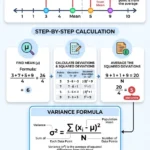


Variance in statistics measures how spread out a set of numbers is from their mean. It quantifies the degree of dispersion in data, indicating whether values cluster near the average or are widely scattered.
When you analyze data, you often need more than the average to understand patterns. This is where variance becomes essential. Although it might seem technical, variance is one of the core concepts that allows statisticians, researchers, and analysts to interpret data effectively.
In this guide, you’ll learn its definition, how it’s calculated, why it matters, and see practical examples. You’ll also discover related measures, common mistakes, and answers to frequently asked questions so you can confidently use it in real-world scenarios.
Understanding Variance in Simple Terms
Variance measures the spread of data points around the mean.
A small variance shows that values are close together, while a large variance indicates wider differences among numbers. For example, consider two groups of exam scores:
- Group A: 78, 80, 79, 77, 81
- Group B: 60, 95, 70, 88, 55
Even if both groups have similar averages, the second group shows more variability.
By quantifying how much values deviate from the mean, analysts can assess consistency, predictability, and reliability in data.
Origin and Importance
The concept was formalized by Ronald A. Fisher in the early 20th century. Fisher introduced this measure to evaluate variability beyond simple averages, particularly in research and genetics.
Variance is essential because it:
- Shows how consistent or inconsistent data is
- Supports risk evaluation in finance
- Forms the basis for standard deviation, regression, and other statistical tests
- Helps researchers assess experiment reliability
Without it, summaries like averages would provide an incomplete picture.
How to Calculate Variance
The calculation depends on whether you are analyzing an entire population or just a sample.
Population Variance Formula
σ2=N∑(xi−μ)2
Where:
- σ2 = population variance
- N = number of data points
- xi = individual data points
- μ = population mean
Sample Variance Formula
s2=n−1∑(xi−xˉ)2
Here:
- s2 = sample variance
- n = number of points in the sample
- xi = each value
- xˉ = sample mean
Notice that for samples, we divide by n−1 to correct for bias, known as Bessel’s correction.
Step-by-Step Example
Imagine a dataset: 4, 7, 6, 9, 10
- Calculate the mean:
xˉ=54+7+6+9+10=7.2
- Compute squared differences:
(4−7.2)2=10.24,(7−7.2)2=0.04,(6−7.2)2=1.44,(9−7.2)2=3.24,(10−7.2)2=7.84
- Sum the squared differences:
10.24+0.04+1.44+3.24+7.84=22.8
- Divide by n−1=4 for the sample:
s2=422.8=5.7
Thus, the sample variance equals 5.7.
Interpreting the Result
Variance is expressed in squared units, which can feel abstract. That’s why the standard deviation—the square root of variance—is often easier to interpret.
- Low variance: Data points are close to the mean.
- High variance: Values are widely spread, indicating variability.
Variance vs Standard Deviation
While related, they serve different purposes:
| Measure | Meaning | Interpretation |
|---|---|---|
| Variance | Average squared deviation from the mean | Shows spread in squared units |
| Standard Deviation | Square root of variance | Expresses spread in original units |
Variance is used in formulas and theoretical work, while standard deviation is intuitive for interpreting data in context.
Applications
Variance is not limited to academics; it has practical uses across industries:
- Finance: Evaluates risk and volatility in investments
- Research: Measures consistency in experiments and surveys
- Quality Control: Monitors production variability
- Education: Assesses differences in student performance
Understanding variability helps make informed decisions and predictions.
Practical Examples
- A teacher compares test results across classes. A higher variance indicates uneven scores.
- Analysts measure stock returns. Large variance signals volatility.
- A factory tracks product weights. Low variance ensures consistent quality.
Common Mistakes
- Confusing sample and population variance
- Forgetting to square differences before averaging
- Interpreting variance in original units instead of squared units
- Assuming variance alone shows direction of change
Related Concepts
- Covariance: Measures how two variables change together
- Coefficient of Variation: Standard deviation divided by the mean
- Mean Absolute Deviation: Average absolute differences from the mean
These measures complement variance for deeper analysis.
Frequently Asked Questions
1. What does variance measure?
It measures how spread out values are around the mean.
2. Can variance be negative?
No, because it is based on squared differences.
3. Why square the differences?
Squaring prevents positive and negative deviations from canceling each other.
4. What is the difference between sample and population variance?
Population variance divides by the total number of points; sample variance divides by one less than the sample size.
5. Is variance the same as standard deviation?
Not exactly. Standard deviation is the square root of variance and easier to interpret in original units.
6. Can variance be zero?
Yes, if all data points are identical.
7. How do I interpret high variance?
It indicates data points are widely spread and less predictable.
8. Why is variance important in statistics?
It helps assess consistency, reliability, and risk across datasets.
Conclusion
Variance is a key statistical measure that shows how much values differ from the mean. Understanding it helps you:
- Evaluate consistency in data
- Compare datasets effectively
- Make informed decisions in research, finance, and quality control
Combined with standard deviation and other measures, variance provides a full picture of variability.
Discover More Post
What Does Excluded Mean in PowerSchool – DefineHubs.com –
What Does TS Mean in Snapchat? Full … – DefineHubs.com –
What Does Volume Mean in Science? Definition, Formula …