
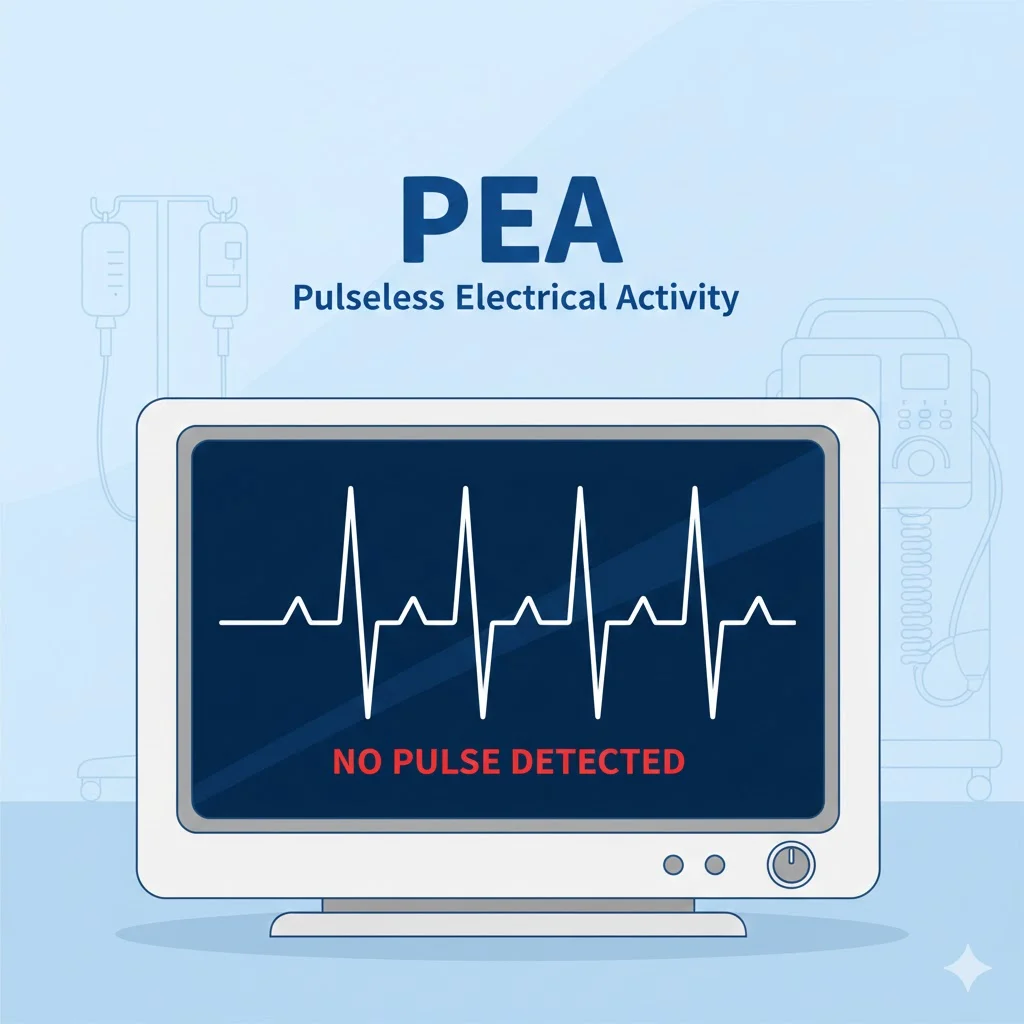

PEA in medical terms stands for Pulseless Electrical Activity. It is a life threatening condition where the heart shows electrical activity on a monitor but fails to produce a detectable pulse or effective blood circulation.
Medical abbreviations can be confusing, especially when they appear during emergencies or in hospital reports. One such term that often causes concern is PEA. It may look simple, but in medical settings, it represents a serious and urgent condition that requires immediate action.
In this comprehensive guide, you will learn what PEA means in medical terms, why it happens, how it is diagnosed, how it is treated, and how it differs from other cardiac arrest rhythms. Whether you are a student, healthcare professional, or someone trying to understand a medical report, this article will help you clearly understand PEA.
What Does PEA Mean in Medical Terms?
In medicine, PEA means Pulseless Electrical Activity.
This condition occurs when:
- The heart’s electrical system is still working
- The heart muscle does not contract effectively
- There is no palpable pulse
- Blood is not circulating through the body
As a result, the patient is in cardiac arrest, even though electrical activity may still appear normal or organized on an ECG monitor.
Understanding Pulseless Electrical Activity
To understand PEA, it helps to know how the heart normally works.
The heart relies on:
- Electrical signals to tell it when to beat
- Mechanical contractions to pump blood
In PEA, the electrical signals are present, but the mechanical pumping fails. Consequently, oxygenated blood does not reach vital organs, including the brain.
This makes PEA a medical emergency that requires immediate cardiopulmonary resuscitation and advanced life support.
Why PEA Is Considered Cardiac Arrest
Even though electrical activity is visible, PEA is classified as a form of cardiac arrest because:
- There is no effective circulation
- The patient is unresponsive
- Breathing is absent or abnormal
- A pulse cannot be detected
For this reason, PEA is treated the same way as other cardiac arrest rhythms in emergency medicine.
Common Causes of PEA
PEA is usually caused by an underlying problem that prevents the heart from pumping effectively. Clinicians often use a structured approach to identify these causes.
The Hs and Ts of PEA
Medical professionals commonly memorize the Hs and Ts, which represent the most frequent reversible causes of PEA.
Hs
| Cause | Explanation |
|---|---|
| Hypovolemia | Severe blood or fluid loss |
| Hypoxia | Lack of oxygen |
| Hydrogen ion | Acidosis |
| Hypo or hyperkalemia | Abnormal potassium levels |
| Hypothermia | Critically low body temperature |
Ts
| Cause | Explanation |
|---|---|
| Tension pneumothorax | Air trapped in the chest compressing the heart |
| Tamponade | Fluid buildup around the heart |
| Toxins | Drug overdose or poisoning |
| Thrombosis coronary | Heart attack |
| Thrombosis pulmonary | Pulmonary embolism |
Identifying and treating these causes quickly can significantly improve survival chances.
How PEA Is Diagnosed
PEA is diagnosed during an emergency assessment.
Typically, diagnosis involves:
- ECG showing organized electrical activity
- No palpable pulse
- Unresponsiveness
- Signs of cardiac arrest
Ultrasound is sometimes used in emergency departments to confirm that the heart is not pumping effectively.
PEA vs Other Cardiac Arrest Rhythms
Understanding how PEA differs from other cardiac arrest rhythms is essential.
Comparison Table
| Rhythm | Electrical Activity | Pulse | Shockable |
|---|---|---|---|
| PEA | Present | Absent | No |
| Asystole | Absent | Absent | No |
| Ventricular fibrillation | Disorganized | Absent | Yes |
| Ventricular tachycardia | Rapid abnormal | Absent | Yes |
Unlike ventricular fibrillation, PEA is not treated with defibrillation.
Is PEA a Shockable Rhythm?
No, PEA is not a shockable rhythm.
Defibrillation works by resetting chaotic electrical activity. Since PEA already has organized electrical signals, defibrillation does not correct the underlying problem.
Instead, treatment focuses on:
- High quality CPR
- Epinephrine administration
- Identifying and correcting the underlying cause
Treatment and Management of PEA
Treatment of PEA follows advanced cardiac life support guidelines.
Immediate Actions
The first steps include:
- Confirming absence of pulse
- Starting CPR immediately
- Providing oxygen and airway support
- Establishing intravenous access
Early and effective CPR is critical for survival.
Medications Used in PEA
Epinephrine is the primary medication used in PEA.
Its purpose is to:
- Improve coronary and cerebral blood flow
- Increase the chance of return of spontaneous circulation
Other medications may be used depending on the identified cause.
Addressing the Underlying Cause
Because PEA is usually secondary to another problem, treating the cause is essential.
Examples:
- Giving fluids for hypovolemia
- Oxygen for hypoxia
- Needle decompression for tension pneumothorax
- Thrombolytics for massive pulmonary embolism
Without correcting the cause, resuscitation efforts are unlikely to succeed.
Prognosis and Survival Rates
Unfortunately, PEA has a lower survival rate compared to shockable rhythms.
However, outcomes improve when:
- CPR is started immediately
- The cause is reversible
- The arrest is witnessed
- Advanced care is provided quickly
Early recognition remains one of the most important factors.
PEA in Medical Documentation
In medical charts, PEA is often recorded during emergency events.
Examples:
- Patient went into PEA arrest
- PEA noted on monitor
- CPR initiated for PEA
Understanding this terminology can help patients and families better interpret medical records.
Alternate Meanings of PEA in Medicine
Although Pulseless Electrical Activity is the most common meaning, PEA can occasionally stand for other terms in non emergency contexts.
Examples include:
- Phenylethylamine in biochemistry
- Physical examination assessment in documentation
Context is essential. In emergency medicine, PEA almost always means Pulseless Electrical Activity.
Common Misconceptions About PEA
Many people misunderstand PEA due to the presence of electrical activity.
Clarifying points:
- PEA does not mean the heart is working
- Electrical activity alone does not equal circulation
- PEA is always a medical emergency
Recognizing these facts helps avoid dangerous delays in treatment.
Frequently Asked Questions
1. What does PEA stand for in medical terms?
PEA stands for Pulseless Electrical Activity.
2. Is PEA considered cardiac arrest?
Yes. PEA is a form of cardiac arrest because there is no pulse or effective circulation.
3. Can PEA be shocked?
No. PEA is not a shockable rhythm.
4. What causes PEA?
PEA is usually caused by conditions such as hypoxia, hypovolemia, cardiac tamponade, or pulmonary embolism.
5. How is PEA treated?
Treatment includes CPR, epinephrine, oxygen, and correcting the underlying cause.
6. Can someone survive PEA?
Survival is possible, especially if the cause is reversible and treatment begins quickly.
7. How is PEA different from asystole?
PEA has electrical activity without a pulse, while asystole has no electrical activity at all.
8. Is PEA always fatal?
No, but it is extremely serious and requires immediate medical intervention.
Conclusion
So, what does PEA mean in medical terms? It refers to Pulseless Electrical Activity, a critical condition where the heart’s electrical system is active but fails to produce a pulse or circulate blood.
Key points to remember:
- PEA is a form of cardiac arrest
- Electrical activity does not mean effective heart function
- It is not treated with defibrillation
- CPR and identifying the cause are essential
- Rapid response improves survival chances
Understanding PEA can make a significant difference when interpreting medical information or learning emergency care concepts.
Discover More Post
What Does a Red Card Mean in Soccer? Rules, Punishments …
What Does PIM Mean in Hockey? Simple Explanation for New …