
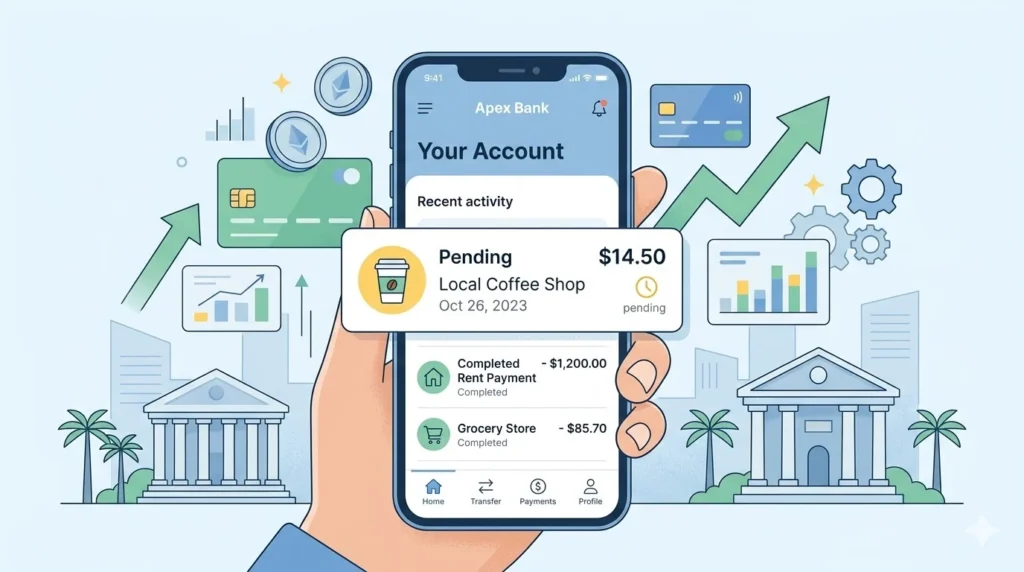

Pending in banking refers to a transaction that has been initiated but not yet fully processed or finalized. The money may be temporarily held or deducted, but the transaction is still awaiting completion by the bank or payment network.
If you check your bank account and see a transaction labeled “pending,” it can feel confusing or even stressful. Has the money already been taken? Can you still use those funds? Is something wrong?
The good news is that a pending transaction is completely normal. In fact, it is part of how modern banking systems process payments securely and efficiently. In this guide, you will learn exactly what pending means in banking, why it happens, how long it lasts, and what you should do when you see it.
What Does Pending Mean in Banking?
In simple terms, pending means “in progress”.
When a transaction is marked as pending, it means:
- The payment has been authorized
- The bank is processing it
- The final transfer of money has not yet been completed
At this stage, the amount may already be deducted from your available balance, but it is not fully posted to your account history yet.
Why Do Transactions Show as Pending?
Banks and payment systems use the pending stage as a verification and processing step.
This happens for several reasons.
1. Authorization Check
First, the bank checks whether you have enough funds. Once approved, the amount is temporarily reserved.
2. Merchant Processing Time
Next, the business or merchant must confirm the transaction on their end. This step can take time depending on their system.
3. Payment Network Delays
Additionally, transactions often pass through payment networks before reaching the final bank. This adds another layer of processing.
4. Fraud Protection
Finally, pending status allows banks to monitor unusual activity and prevent fraud before completing the transaction.
How Pending Transactions Work
To better understand the process, here is a simple breakdown.
- You make a payment or purchase
- The bank authorizes the transaction
- The amount is marked as pending
- The merchant finalizes the charge
- The bank posts the transaction as completed
During the pending stage, the money is set aside but not fully transferred yet.
How Long Do Pending Transactions Take?
The duration of a pending transaction depends on several factors.
Typical Timeframes
| Transaction Type | Pending Time |
|---|---|
| Debit card purchases | 1 to 3 business days |
| Credit card payments | 1 to 5 business days |
| Online transfers | 1 to 3 business days |
| International payments | 3 to 7 business days |
In most cases, transactions clear within a few days. However, weekends, holidays, and processing delays can extend this time.
Examples of Pending Transactions
Seeing real examples can make things clearer.
Example 1: Card Payment
You buy groceries for 50 dollars. The transaction shows as pending immediately. After one or two days, it becomes a completed charge.
Example 2: Online Shopping
You order an item online. The payment appears as pending until the seller confirms and ships the product.
Example 3: Hotel or Fuel Hold
A hotel or fuel station may place a temporary hold that appears as pending. The final amount may change once the transaction is completed.
Emotional Context of “Pending”
Although “pending” is a technical term, it can feel different depending on the situation.
Neutral Tone
- The transaction is simply being processed
- No action is required
Slight Concern
- The amount is unavailable for spending
- The final charge has not yet appeared
Frustration
- The transaction takes longer than expected
- A refund is still pending
Understanding that pending is a normal step can reduce unnecessary worry.
Pending vs Posted Transactions
A common question is how pending differs from completed or posted transactions.
Comparison Table
| Pending | Posted |
|---|---|
| Still processing | Fully completed |
| May change | Final amount |
| Not permanent | Permanent record |
| Funds may be on hold | Funds officially transferred |
In short, a pending transaction is temporary, while a posted transaction is final.
Can You Spend Money That Is Pending?
This depends on your available balance.
In most cases:
- The pending amount is already deducted from your available funds
- You cannot spend that portion again
Even if the transaction is not finalized, the bank treats the funds as reserved.
Can Pending Transactions Change or Disappear?
Yes, and this sometimes surprises people.
Possible Changes
- The amount may adjust slightly
- The transaction may be canceled
- A duplicate pending charge may disappear
For example, restaurants or fuel stations may initially hold a higher amount, then finalize the exact total later.
Common Situations Where You See Pending
You are more likely to notice pending transactions in certain situations.
These include:
- Online shopping
- Hotel bookings
- Fuel stations
- Subscription services
- International payments
In all these cases, processing time plays a role.
What to Do If a Transaction Stays Pending Too Long
While most transactions clear quickly, delays can happen.
Here is what you can do.
Step 1: Wait a Few Days
Many transactions resolve within 2 to 3 business days.
Step 2: Check with the Merchant
Sometimes the delay is on the seller’s side.
Step 3: Contact Your Bank
If the transaction remains pending for too long, your bank can investigate.
Common Mistakes and Misunderstandings
Many people misunderstand what pending really means.
Mistake 1: Thinking the Money Is Gone
Pending does not always mean the payment is final.
Mistake 2: Assuming an Error
Most pending transactions are completely normal.
Mistake 3: Double Spending
Trying to spend money that is already pending can lead to insufficient balance.
Alternate Meanings of Pending
Outside banking, the word “pending” has a broader meaning.
It generally means:
- Waiting to be decided
- Not yet completed
- In progress
However, in banking, it specifically refers to transactions that are still processing.
Polite and Professional Alternatives to “Pending”
In formal or customer service communication, you may see alternatives such as:
- In process
- Awaiting confirmation
- Under review
- Not yet completed
- Processing
These phrases all convey a similar meaning in a more formal tone.
Frequently Asked Questions
1. What does pending mean in a bank account?
It means the transaction has started but is not yet fully completed.
2. Does pending mean the money is already taken?
The amount is usually reserved, but the transaction is not finalized yet.
3. How long do pending transactions last?
Most last between 1 and 3 business days, but some can take longer.
4. Can a pending transaction be canceled?
Yes, especially if the merchant does not complete it.
5. Why is my transaction pending for so long?
Delays can happen due to weekends, holidays, or merchant processing times.
6. Can I use money that is pending?
No, because it is typically deducted from your available balance.
7. What happens if a pending transaction disappears?
It usually means the transaction was canceled or not completed.
8. Is a pending transaction a problem?
No, it is a normal part of banking and payment processing.
Conclusion
So, what does pending mean in banking? It simply means a transaction is in progress and not yet finalized.
To recap:
- Pending transactions are temporary
- The money is usually reserved but not fully transferred
- Most transactions clear within a few days
- Delays are normal in certain situations
- Understanding pending helps you manage your balance better
By knowing how pending transactions work, you can avoid confusion, track your finances more accurately, and feel more confident when checking your account.
Discover More Post
TS Meaning in Text: What Does TS Stand For in Messages? in …
MK Meaning in Text What Does MK Mean in Messages? in 2026
on Meaning in Text What Does Ion Mean in Slang? in 2026