
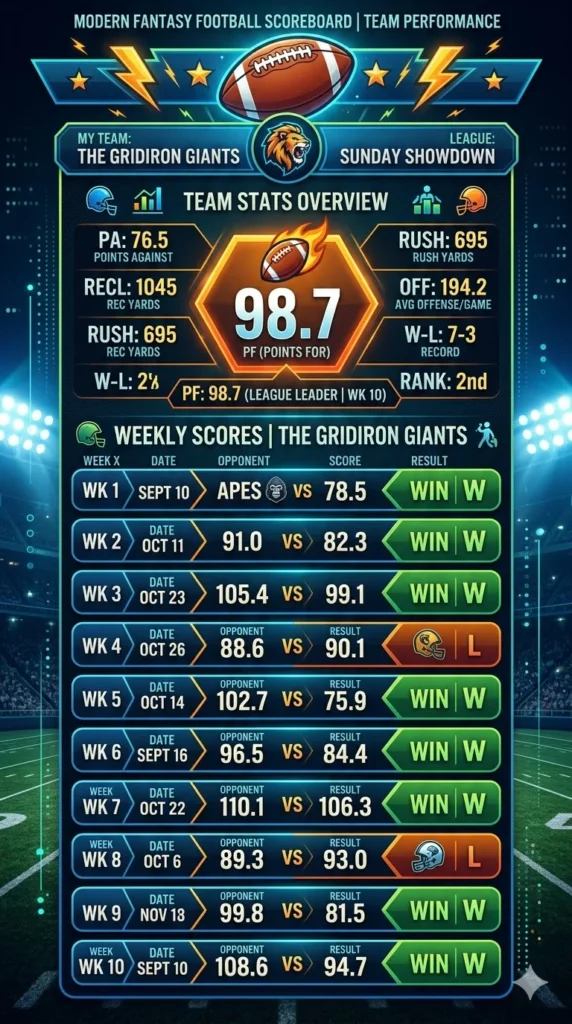

PF in fantasy football stands for “Points For.” It represents the total number of points your team has scored throughout the season. PF is a key statistic used to evaluate performance, compare teams, and track scoring trends in fantasy football leagues.
If you’ve ever checked your fantasy football standings and seen abbreviations like PF, PA, or W-L, you might have paused and wondered what they actually mean. Understanding these terms is essential if you want to manage your team strategically and track how well you’re performing each week.
In this article, you will learn exactly what PF means in fantasy football, why it matters, how it’s calculated, and how it differs from related stats. We will also provide examples, tips, and a clear comparison table so you can read your league standings like a pro.
What Does PF Mean in Fantasy Football?
In fantasy football, PF means “Points For.”
Points For measures the total points your team has accumulated over the course of the season. These points come from the performances of your players in real-life games. In most fantasy leagues, PF is automatically calculated each week based on scoring rules, such as:
- Touchdowns
- Passing yards
- Rushing yards
- Receptions (in PPR leagues)
- Field goals and extra points for kickers
PF is a direct reflection of how productive your team has been and is often used as a tiebreaker when multiple teams have the same win-loss record.
Why PF Matters in Fantasy Football
PF is more than just a number on your scoreboard. It provides insight into several important aspects of your team and league:
- Team Scoring Strength: Higher PF usually indicates your team consistently scores points.
- League Comparisons: PF helps you see which teams are scoring the most in your league.
- Tiebreakers: Many leagues use PF to break ties when teams have the same record.
- Trend Analysis: PF over time shows whether your team is improving, declining, or maintaining consistency.
Even if your win-loss record isn’t perfect, having a high PF can show that your team is competitive and scoring efficiently.
How PF Is Calculated
PF is calculated by summing all points scored by each player on your roster according to your league’s scoring system. For example:
- A quarterback scores 25 points through passing touchdowns and yards.
- A running back adds 15 points from rushing touchdowns and yards.
- A wide receiver adds 10 points from receptions and receiving yards.
Total PF for the week = 25 + 15 + 10 = 50 points
Over the season, these weekly totals are added together to form your team’s cumulative PF.
PF vs PA: Understanding the Difference
It’s common for beginners to confuse PF with PA.
- PF (Points For): The total points your team has scored.
- PA (Points Against): The total points your team’s opponents have scored against you.
Comparison Table
| Abbreviation | Meaning | What It Shows |
|---|---|---|
| PF | Points For | Total points your team has scored |
| PA | Points Against | Total points your opponents have scored against you |
| W | Wins | Number of matches won |
| L | Losses | Number of matches lost |
Understanding both PF and PA can give you a better sense of your team’s strengths and weaknesses, as well as potential playoff positioning.
Examples of PF in Real Fantasy Football
Here are some examples of how PF is used in league standings and discussions:
Example 1: Standings View
Team A: W 6 – L 3 – PF 1,050 – PA 980
Team B: W 6 – L 3 – PF 1,100 – PA 1,020
Even though Team A and Team B have the same record, Team B has a higher PF, which may make them the higher seed in playoffs if your league uses PF as a tiebreaker.
Example 2: Discussion in Fantasy Forums
“I lost this week, but my PF is still the highest in the league at 1,050 points.”
Here, PF highlights that the team is scoring well even if the win-loss record isn’t perfect.
Example 3: Week-by-Week Tracking
“My PF went from 120 last week to 150 this week thanks to my quarterback and wide receiver combo.”
Tracking weekly PF trends helps managers make roster adjustments for future matchups.
Why PF Can Be More Informative Than Wins Alone
While wins and losses matter, PF provides a deeper insight into a team’s performance. For example:
- A team with 3 wins and 6 losses might have a high PF, meaning they lost close games but scored a lot.
- A team with 6 wins and 3 losses might have a lower PF, indicating they won by narrow margins and are less dominant overall.
Thus, PF is a valuable tool for predicting playoff potential and evaluating team strength.
Polite or Professional Alternatives to PF
In more analytical discussions or articles, PF can also be referred to as:
- Total Points Scored
- Cumulative Points
- Offensive Points Total
These terms are more descriptive but mean the same thing as PF in fantasy football contexts.
Tips for Using PF Strategically
- Track weekly PF trends to anticipate high-scoring matchups.
- Compare PF and PA to assess your team’s efficiency.
- Don’t rely solely on wins; PF can reveal hidden strengths.
- Use PF as a tiebreaker guide when setting your playoff strategy.
By keeping an eye on PF, you gain more insight into your team’s performance and league dynamics.
Frequently Asked Questions
1. What does PF mean in fantasy football?
PF stands for “Points For,” which is the total number of points your team has scored during the season.
2. Is PF the same as my total score?
Yes, PF is the cumulative total points scored by your team across all weeks.
3. How is PF calculated?
PF is calculated by adding up all points scored by your roster according to your league’s scoring rules.
4. What is the difference between PF and PA?
PF is points your team scores, while PA is points your opponents score against you.
5. Does a high PF guarantee playoff success?
Not necessarily. Wins matter more for playoff qualification, but PF can indicate a strong, consistent team.
6. Can PF help in tiebreakers?
Yes. Many leagues use PF as a tiebreaker when teams have identical records.
7. Should I focus on PF or W-L record?
Both are important. PF helps you understand scoring trends, while W-L determines standings and playoff eligibility.
8. Can PF fluctuate weekly?
Absolutely. PF changes every week depending on player performances and matchups.
Conclusion
So, what does PF mean in fantasy football? It represents Points For, the total points your team has scored over the season. Understanding PF is essential for evaluating performance, comparing teams, tracking trends, and planning playoff strategies.
Key takeaways:
- PF reflects your team’s scoring efficiency
- It is different from PA, which measures points against
- PF helps with tiebreakers and trend analysis
- Weekly tracking can inform roster decisions and matchups
By monitoring PF, you gain a strategic edge and a clearer picture of your team’s strengths and weaknesses.
Discover More Post
FW Meaning in Text What Does FW Mean in Messages?for 2026
ASL Meaning in Text What Does ASL Stand For? in 2026
What Does DW Mean in Text? Clear Meaning, Usage, and …