
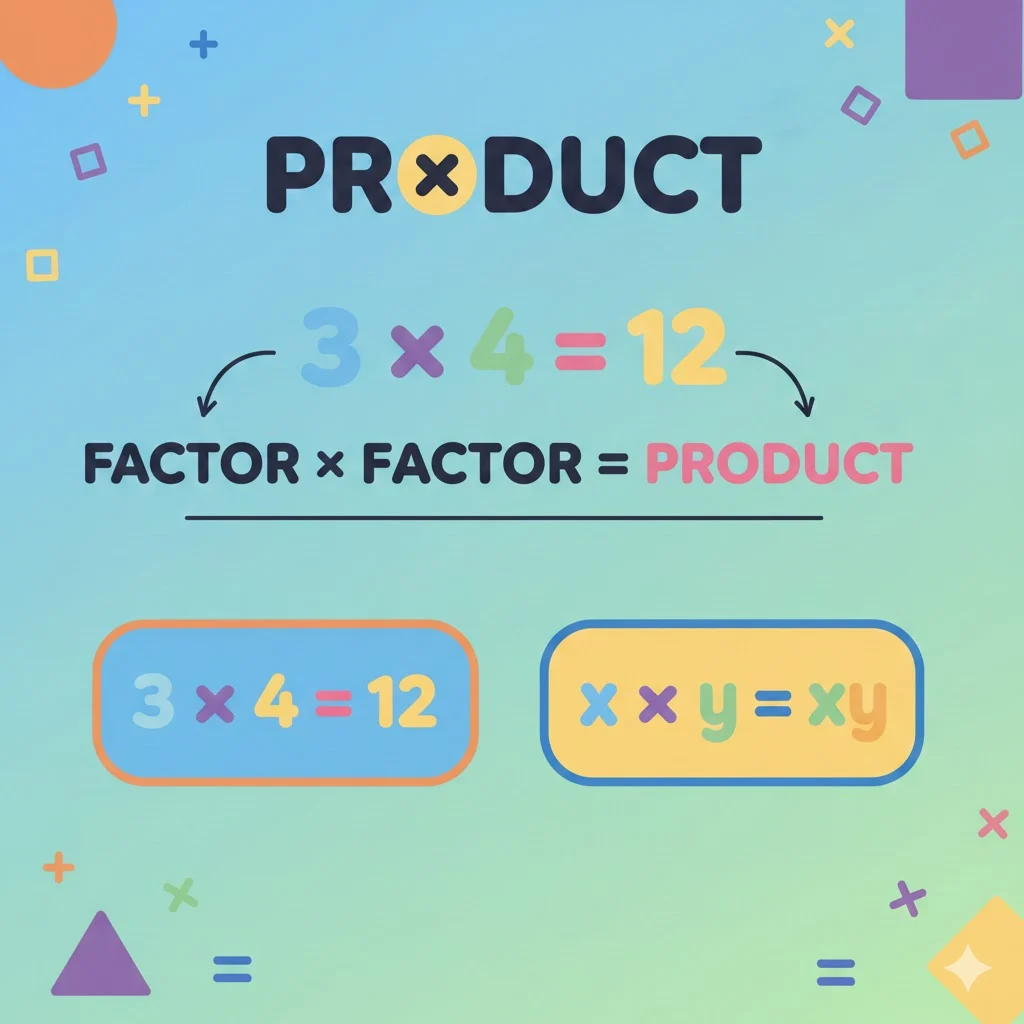

In math, a product is the result of multiplying two or more numbers or expressions together. For example, the product of 3 and 4 is 12 because 3 × 4 = 12.
Mathematics has its own language, and understanding terms like product is essential for mastering basic operations and building advanced skills. Whether you are learning arithmetic, algebra, or preparing for standardized tests, knowing what a product is and how to use it correctly can make a huge difference in your confidence and accuracy.
In this article, we will explain exactly what product means in math terms, explore examples, compare it with related concepts, discuss common mistakes, and provide tips to help you use the term naturally in calculations and explanations.
What Does Product Mean in Math Terms?
In mathematics, a product is the result of multiplying numbers, variables, or expressions. It is a fundamental concept used in arithmetic, algebra, geometry, and beyond.
Key Points About Product:
- A product comes from the multiplication of two or more factors.
- The factors can be numbers, variables, or algebraic expressions.
- Products can be positive, negative, or zero, depending on the factors.
For instance, if you multiply 5 by 2, the product is 10 because 5 × 2 = 10. Similarly, if you multiply variables such as x and y, the product is xy.
Origin and Use of the Term Product
The word product comes from the Latin word productum, which means “something brought forth” or “result.” In mathematics, it specifically refers to what is produced when numbers are multiplied.
The term has been in use for centuries and appears in arithmetic textbooks, algebra courses, and advanced mathematics. It is essential for understanding concepts such as:
- Multiplication
- Area (length × width)
- Volume (length × width × height)
- Algebraic expressions
Using the word product helps mathematicians and students describe multiplication results clearly.
How to Identify a Product
Identifying a product in math problems is straightforward. Look for numbers or expressions being multiplied together.
Examples:
- 6 × 7 = 42 → The product is 42
- 3a × 4b = 12ab → The product is 12ab
- (x + 2)(x – 3) = x² – x – 6 → The product is x² – x – 6
Notice that the product can be simple, like a number, or more complex, like an algebraic expression.
Product vs Sum vs Difference vs Quotient
Sometimes learners confuse product with other operations. Here’s a comparison:
| Term | Operation | Example | Result |
|---|---|---|---|
| Product | Multiplication | 3 × 4 | 12 |
| Sum | Addition | 3 + 4 | 7 |
| Difference | Subtraction | 7 – 4 | 3 |
| Quotient | Division | 12 ÷ 3 | 4 |
Key takeaway: A product always comes from multiplication, while sum, difference, and quotient come from addition, subtraction, and division, respectively.
Examples of Products in Different Contexts
Simple Arithmetic
- 8 × 5 = 40 → Product is 40
- 0 × 9 = 0 → Product is 0
- –3 × 7 = –21 → Product is –21
Algebra
- x × y = xy → Product is xy
- 2a × 3b = 6ab → Product is 6ab
- (x + 1)(x – 2) = x² – x – 2 → Product is x² – x – 2
Geometry
- Area of rectangle = length × width → Product of length and width
- Volume of box = length × width × height → Product of three dimensions
These examples show how products appear across different math topics.
Properties of a Product
Understanding properties of multiplication helps make sense of products:
- Commutative Property – Changing the order does not change the product.
Example: 4 × 5 = 5 × 4 = 20 - Associative Property – Grouping factors differently does not change the product.
Example: (2 × 3) × 4 = 2 × (3 × 4) = 24 - Distributive Property – Multiplying a number by a sum is the same as multiplying each addend separately.
Example: 3 × (4 + 5) = 3 × 4 + 3 × 5 = 27 - Identity Property – Multiplying by 1 leaves the number unchanged.
Example: 7 × 1 = 7 - Zero Property – Multiplying by 0 always gives 0.
Example: 0 × 15 = 0
Common Mistakes with Products
Even experienced learners sometimes make errors when identifying products:
- Confusing addition with multiplication
Example: 3 + 4 = 7 is a sum, not a product - Ignoring negative signs
Example: –2 × 5 = –10, not 10 - Forgetting parentheses in algebraic products
Example: (x + 2)(x – 3) ≠ x + 2x – 3 → Correct product is x² – x – 6
Being mindful of these mistakes improves accuracy in calculations.
Polite or Professional Alternatives to Saying “Product”
In formal math or academic contexts, you can also refer to a product as:
- Result of multiplication
- Multiplicative result
- Outcome of factors
For example, instead of saying “The product is 12,” you could say, “The result of multiplying these numbers is 12.”
Frequently Asked Questions
1. What does product mean in math terms?
A product is the result of multiplying two or more numbers or expressions.
2. Is product the same as sum?
No. A sum comes from addition, while a product comes from multiplication.
3. Can a product be negative?
Yes. Multiplying a positive number by a negative number gives a negative product.
4. Is the product always a number?
Not always. The product can be a number, variable, or algebraic expression.
5. How do you find the product of two numbers?
Multiply the numbers together using × or parentheses.
6. What is the product of 0 and any number?
The product is always 0.
7. Are there properties of products?
Yes. Properties include commutative, associative, distributive, identity, and zero properties.
8. What is the difference between product and quotient?
A product comes from multiplication, while a quotient comes from division.
Conclusion
In math, a product is simply the result of multiplying numbers, variables, or expressions. Understanding products is fundamental for arithmetic, algebra, and geometry. Remember these key points:
- A product comes from multiplication
- It can be simple or complex
- Properties like commutative and distributive help simplify calculations
- Avoid common mistakes like confusing it with sums or ignoring negatives
Mastering the concept of product builds a strong foundation for more advanced math topics and everyday problem solving.
discover more post
MB Meaning in Text What Does MB Stand For in Messages …
ASL Meaning in Text What Does ASL Stand For? in 2026
MBN Meaning in Text What Does MBN Stand For? in 2026