
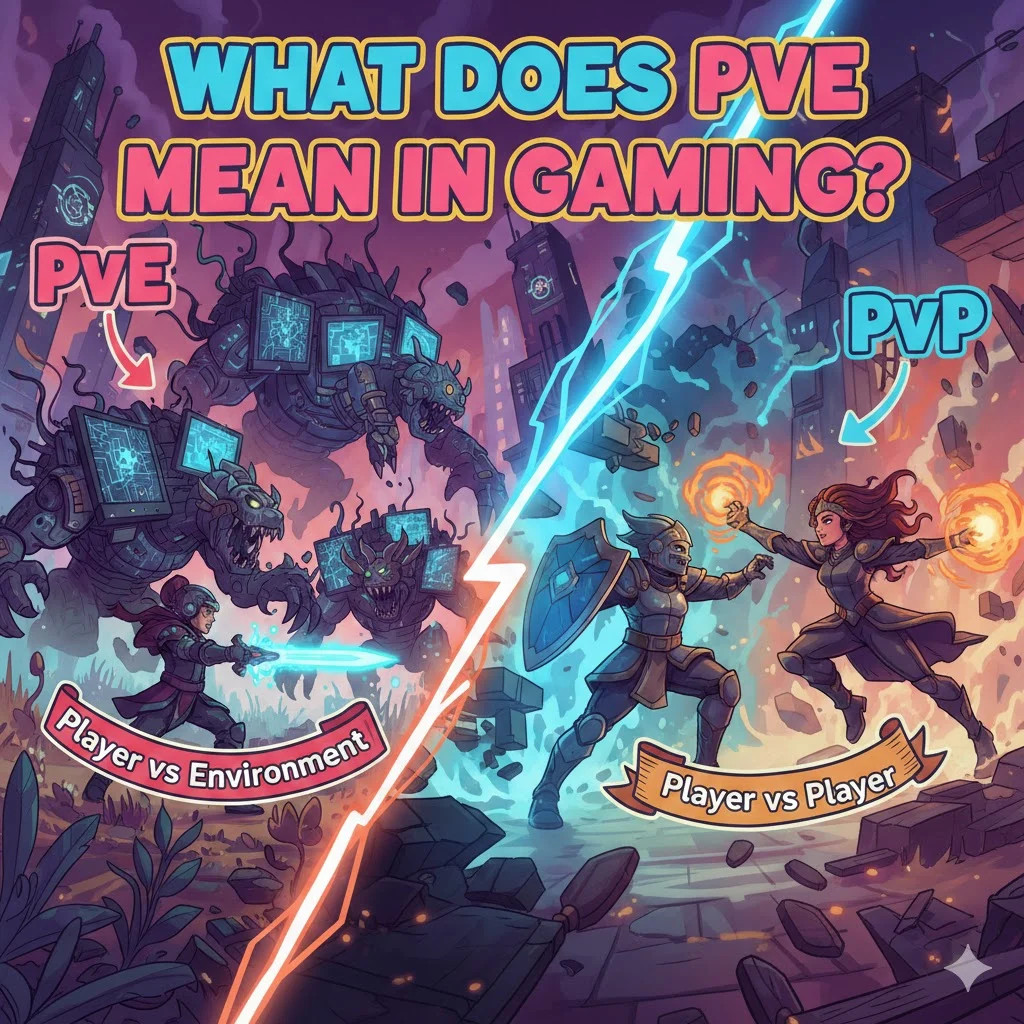

PvE in gaming stands for “Player versus Environment.” It refers to gameplay where players compete against computer controlled enemies, story driven challenges, or game generated obstacles instead of fighting other real players.
If you have spent any time in online games, multiplayer titles, or gaming forums, you have likely seen the term PvE. At first, it might look like just another gaming abbreviation. However, once you understand it, you realize that PvE describes one of the most important gameplay styles in modern video games.
Because many games separate PvE and PvP modes, knowing the difference can completely change how you choose what to play. In this guide, you will learn exactly what PvE means in gaming, how it works, where it came from, how it compares to PvP, and why millions of players prefer it.
What Does PvE Mean in Gaming?
In gaming, PvE means Player versus Environment.
Specifically, it describes game modes where:
- Players fight computer controlled enemies
- Challenges are created by the game itself
- The main objective is completing missions, quests, or story content
- Competition is against AI rather than other humans
As a result, PvE focuses more on teamwork, strategy, progression, and storytelling rather than direct player competition.
Breaking Down the Term PvE
To fully understand PvE, it helps to look at each part of the abbreviation.
Player refers to you or your team.
Versus means competing against something.
Environment includes everything controlled by the game such as monsters, bosses, missions, and world events.
In other words, PvE means the player is battling the game world itself.
The Origin and Rise of PvE in Gaming
The concept of PvE has existed since the earliest single player games. Classic titles like The Legend of Zelda and Final Fantasy were entirely PvE experiences because players only fought computer controlled enemies.
Later, with the rise of online multiplayer games such as World of Warcraft, the distinction between PvE and PvP became more important. Developers began labeling servers and game modes clearly so players could choose their preferred style.
Since then, PvE has become a core category in:
- MMORPGs
- Shooters
- Survival games
- Role playing games
- Co op action titles
Today, many games offer both PvE and PvP modes, allowing players to switch depending on mood and preference.
Types of PvE Gameplay
PvE is not just one style of play. Instead, it appears in several formats.
1. Story Campaigns
First, many games feature narrative driven PvE campaigns.
In these modes, players complete missions, defeat bosses, and progress through a storyline. For example, games like Elden Ring focus heavily on PvE exploration and boss battles.
2. Co op PvE
Additionally, cooperative PvE allows players to team up against AI enemies.
For instance, in Destiny 2, players join forces for strikes and raids against powerful bosses. Similarly, Monster Hunter: World revolves around hunting large creatures with friends.
In these games, teamwork and coordination are more important than competing against each other.
3. Dungeon and Raid Content
Furthermore, many MMORPGs include structured PvE challenges.
Dungeons often involve small groups completing objectives. Raids usually require larger teams and advanced strategy.
A well known example is raid content in Final Fantasy XIV, where players cooperate to defeat complex boss mechanics.
4. Survival and Open World PvE
Finally, some open world games emphasize environmental challenges.
In Minecraft, players fight mobs and survive against environmental dangers. Likewise, ARK: Survival Evolved includes PvE servers where players face dinosaurs and natural threats instead of other players.
PvE vs PvP: What Is the Difference?
One of the most common questions gamers ask is how PvE compares to PvP.
Comparison Table
| PvE | PvP |
|---|---|
| Player vs Environment | Player vs Player |
| AI controlled enemies | Real human opponents |
| Often story driven | Competitive and skill based |
| Focus on teamwork and progression | Focus on competition and ranking |
| Lower pressure environment | High pressure and unpredictable |
Because of these differences, some players prefer PvE for its relaxed pace. Meanwhile, others choose PvP for adrenaline and competition.
Why Many Gamers Prefer PvE
Although competitive gaming is popular, PvE offers unique advantages.
First, PvE is usually less stressful because you are not facing unpredictable human opponents.
Second, it allows for story immersion and world building.
Third, cooperative PvE builds teamwork without rivalry.
Finally, progression often feels more rewarding and consistent.
For example, players who enjoy narrative depth often gravitate toward PvE heavy titles like The Witcher 3: Wild Hunt.
Real World Examples of PvE in Action
To better understand PvE in context, here are examples of how players use the term.
Friendly Tone 🎮
“I mostly play PvE because I love story quests.”
Neutral Tone
“This server is PvE only.”
Competitive but Non PvP
“Our guild focuses on endgame PvE content.”
In each case, PvE clearly signals gameplay against the game world rather than other players.
Common PvE Game Modes
PvE can appear under different names depending on the game.
These may include:
- Campaign mode
- Story mode
- Co op missions
- Raid mode
- Horde mode
- Survival mode
Although the labels vary, the core idea remains the same. The player battles the environment.
Alternate Meanings of PvE
Outside gaming, PvE rarely has other meanings. In technical discussions, it almost always refers to Player versus Environment.
Therefore, context usually makes the meaning obvious.
When to Choose PvE Over PvP
Choosing between PvE and PvP depends on your goals.
You might prefer PvE if:
- You enjoy storytelling
- You like cooperative teamwork
- You prefer steady progression
- You want lower pressure gameplay
On the other hand, PvP may suit you better if:
- You thrive on competition
- You enjoy ranking systems
- You like unpredictable challenges
Many players actually enjoy both modes depending on mood.
Frequently Asked Questions
1. What does PvE stand for in gaming?
PvE stands for Player versus Environment.
2. Is PvE single player only?
No. PvE can be single player or multiplayer cooperative.
3. Is PvE easier than PvP?
Not necessarily. While PvE can feel less stressful, high level raids and bosses can be extremely challenging.
4. Can PvE be competitive?
Yes. Some PvE modes include leaderboards, speed runs, and ranked challenges.
5. What games are mostly PvE?
Many RPGs, survival games, and story driven games focus heavily on PvE content.
6. What is a PvE server?
A PvE server prevents player versus player combat, focusing only on AI enemies and environmental challenges.
7. Is PvE good for beginners?
Yes. PvE often provides a more forgiving learning environment.
8. Can a game have both PvE and PvP?
Yes. Many modern games include both options.
Conclusion
So, what does PvE mean in gaming? In simple terms, it means Player versus Environment, where players battle computer controlled enemies instead of other people.
To recap:
- PvE focuses on AI driven challenges
- It includes campaigns, raids, co op missions, and survival modes
- It differs from PvP, which involves player competition
- It appeals to gamers who enjoy story, teamwork, and progression
Ultimately, PvE remains one of the most popular and accessible gameplay styles in the gaming world. Whether you enjoy epic boss fights, cooperative missions, or immersive storytelling, PvE offers something for nearly every type of player.
discover more post
What Does Exalted Mean in the Bible? Biblical Meaning …
What Does OTP Mean in Text Slang? Full … – DefineHubs.com –
What Does Total Games Mean in Tennis? Definition …


