
Space in art refers to the area around, between, above, below, or within objects in an artwork. It is one of the fundamental elements of art used to create depth, perspective, and a sense of three dimensionality on a flat surface or in a physical form.
Have you ever looked at a painting and felt like you could step right into it? Or noticed how some artworks feel open and airy while others feel crowded or intense? That feeling often comes down to one powerful element artists carefully control: space.
Understanding what space means in art helps you see artwork in a completely new way. It is not just about empty areas. Instead, space shapes how we experience depth, distance, balance, and even emotion in visual art.
In this guide, you will learn the meaning of space in art, its different types, how artists use it, and why it plays such a crucial role in everything from paintings to sculptures.
What Does Space Mean in Art?
In art, space is the area that surrounds or exists within objects in a composition.
It includes:
- The distance between elements
- The area around objects
- The illusion of depth on a flat surface
- The physical area an artwork occupies
In simple terms, space answers the question: Where are things placed and how far apart are they?
Because of this, space helps artists guide the viewer’s eye and create visual structure.
Why Space Is Important in Art
Space is essential because it influences how an artwork feels and how viewers interpret it.
For example, a painting with a lot of open space can feel calm and peaceful. On the other hand, a crowded composition may feel chaotic or intense.
In addition, space helps artists:
- Create depth and realism
- Organize elements clearly
- Direct attention to focal points
- Balance the composition
- Evoke mood and emotion
Without space, artwork would look flat, cluttered, or confusing.
Types of Space in Art
Artists use several types of space to build their compositions. Each type serves a different purpose.
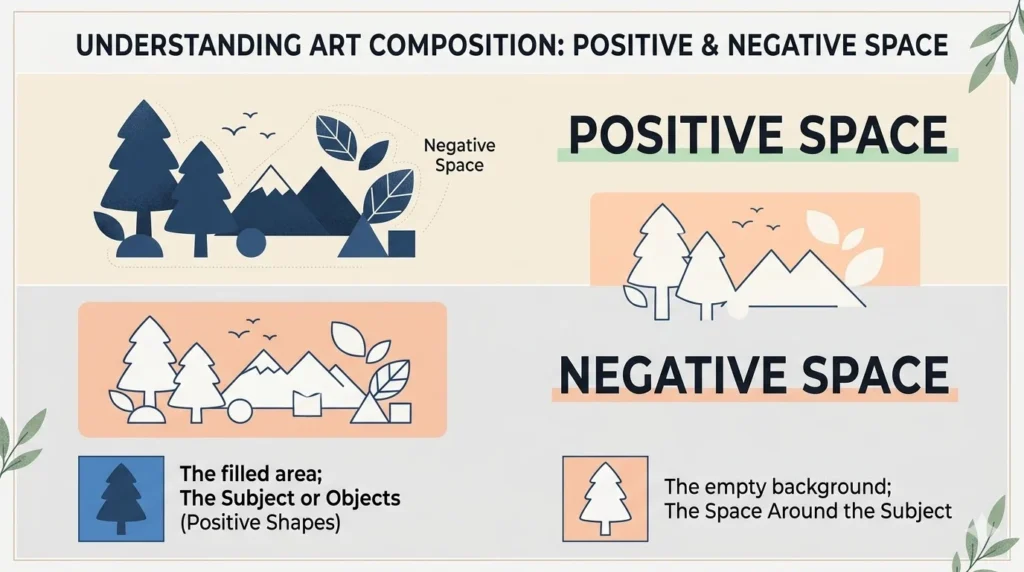
1. Positive Space
Positive space refers to the main subjects or objects in an artwork.
Examples:
- A person in a portrait
- A tree in a landscape
- A bowl of fruit in a still life
This is the area that immediately draws attention.
2. Negative Space
Negative space is the empty or open space around and between objects.
Although it may seem unimportant, negative space plays a critical role in defining shapes and creating balance.
For instance, the space around a figure can help outline its form clearly.
3. Deep Space
Deep space creates the illusion that the scene extends far into the distance.
Artists achieve this using techniques like:
- Perspective
- Overlapping objects
- Size variation
As a result, the artwork appears more realistic and immersive.
4. Shallow Space
In contrast, shallow space keeps everything close to the front.
Objects appear flat and near the surface, with little sense of depth.
This style is common in:
- Modern art
- Abstract paintings
- Traditional patterns
5. Two Dimensional Space
Two dimensional space refers to flat surfaces such as drawings, paintings, and prints.
Even though the surface is flat, artists can still create the illusion of depth.
6. Three Dimensional Space
Three dimensional space exists in physical artworks like sculptures and installations.
Unlike paintings, these works occupy real space and can be viewed from multiple angles.
Types of Space in Art Table
| Type of Space | Description | Example |
|---|---|---|
| Positive Space | Main subject area | A person in a portrait |
| Negative Space | Empty surrounding area | Background around objects |
| Deep Space | Illusion of distance | Landscape with horizon |
| Shallow Space | Minimal depth | Flat abstract painting |
| Two Dimensional | Flat surface | Drawing or painting |
| Three Dimensional | Real physical space | Sculpture |
How Artists Create Space
Artists use various techniques to create the illusion or structure of space.
Perspective
Perspective makes objects appear smaller as they move farther away. This creates depth and realism.
Overlapping
When one object covers part of another, it appears closer to the viewer.
Size Variation
Larger objects seem closer, while smaller ones appear farther away.
Placement
Objects placed higher on the canvas often appear more distant.
Color and Value
Lighter and cooler colors tend to recede, while darker and warmer colors appear closer.
Examples of Space in Art
Understanding space becomes easier when you look at real scenarios.
Example 1: Landscape Painting
A landscape may show mountains in the background and trees in the foreground.
The mountains appear smaller and lighter, creating deep space.
Example 2: Portrait
In a portrait, the person is the positive space, while the background is negative space.
A simple background can make the subject stand out more clearly.
Example 3: Abstract Art
Abstract artists often play with negative space to create interesting shapes and visual effects.
Sometimes, the empty space becomes just as important as the objects themselves.
Emotional Impact of Space
Space does more than organize elements. It also affects mood and emotion.
For example:
- Open space can feel calm and peaceful
- Tight space can feel tense or crowded
- Balanced space can feel harmonious
- Uneven space can feel dynamic or unstable
Because of this, artists carefully control space to influence how viewers feel.
Space Compared to Other Elements of Art
Space is one of the core elements of art, along with line, shape, color, texture, form, and value.
Here is how space compares to a few related elements.
| Element | Focus | Relationship to Space |
|---|---|---|
| Line | Direction and movement | Defines boundaries in space |
| Shape | Flat areas | Occupies space |
| Form | Three dimensional objects | Exists within space |
| Color | Visual tone | Creates depth in space |
Together, these elements work to create a complete visual experience.
Common Mistakes When Understanding Space
Many beginners misunderstand how space works in art.
Ignoring Negative Space
Focusing only on objects can lead to cluttered compositions. Paying attention to empty areas improves balance.
Overcrowding the Composition
Adding too many elements reduces clarity and visual impact.
Lack of Depth
Without techniques like perspective or overlapping, artwork may look flat.
Alternate Meanings of Space
While this article focuses on art, the word space has other meanings.
For example:
- Physical area or distance
- Outer space in science
- Personal space in social contexts
However, in art, space specifically refers to the visual or physical area within a composition.
Practical Tips for Using Space in Art
If you are creating your own artwork, consider these tips.
- Leave room around your subject to avoid clutter
- Use negative space intentionally
- Experiment with depth and perspective
- Balance empty and filled areas
- Guide the viewer’s eye through placement
With practice, you will start to see how powerful space can be.
Frequently Asked Questions
1. What does space mean in art?
Space in art refers to the area around, between, or within objects in a composition.
2. What is positive and negative space?
Positive space is the subject, while negative space is the empty area around it.
3. Why is space important in art?
It helps create depth, balance, and visual clarity.
4. What is deep space in art?
Deep space creates the illusion of distance and depth.
5. What is shallow space?
Shallow space keeps objects close to the surface with little depth.
6. How do artists create space?
They use techniques like perspective, overlapping, and color.
7. Is space only in paintings?
No. Space exists in both two dimensional and three dimensional art.
8. Can space affect emotion in art?
Yes. Space can make an artwork feel calm, crowded, or dynamic.
Conclusion
So, what does space mean in art? It is the area around and within objects that helps create structure, depth, and meaning in an artwork.
To recap:
- Space defines where elements exist in a composition
- It includes both positive and negative areas
- It can create depth or keep things flat
- It plays a key role in mood and balance
- It is essential in all forms of art
Once you start noticing space, you will see art differently. Paintings, drawings, and sculptures will feel more intentional, balanced, and expressive.
Discover More Post
What Does E Mean in Grades? GPA Impact and Passing …
What Does Simba Mean in Swahili? Meaning, Origin …
What Does Esq Mean in Law? Legal Meaning and Proper …