
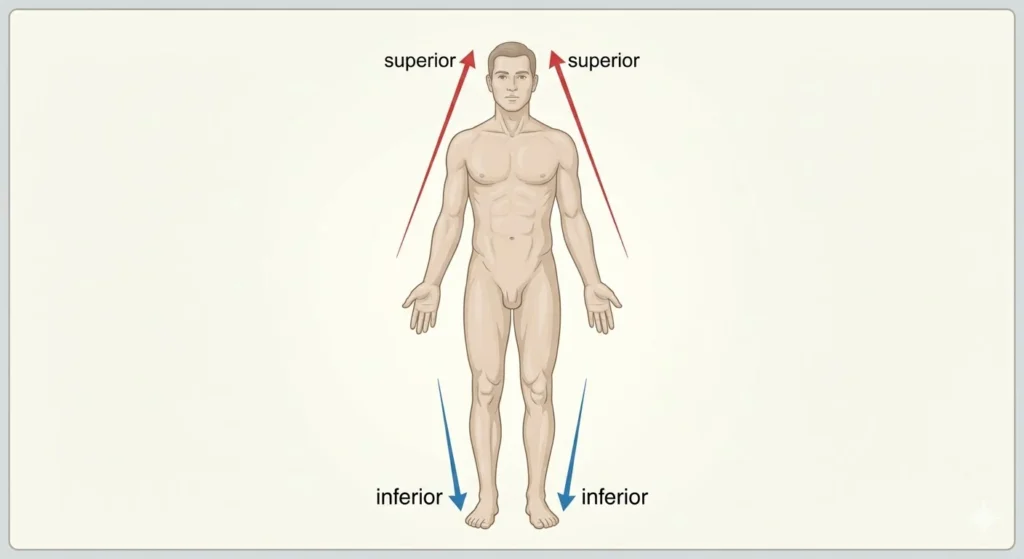

Superior in anatomy means “above” or “toward the head.” It is a directional term used to describe the position of one body part in relation to another.
If you have ever studied biology, medicine, or even basic human anatomy, you have probably come across the term superior. At first, it might sound like it means “better” or “higher in quality.” However, in anatomy, the meaning is completely different.
In medical and scientific contexts, superior is a precise directional term. Therefore, it helps describe the location of structures in the body with clarity. As a result, understanding this term is essential for reading anatomy textbooks, following medical explanations, and communicating effectively in healthcare settings.
In this guide, you will learn exactly what superior means in anatomy, how it is used, how it compares to related terms, and how to recognize it in real examples.
What Does Superior Mean in Anatomy?
In anatomy, superior means “above,” “higher,” or “closer to the head.”
More specifically, it describes the position of one structure relative to another. In other words, if something is closer to the head, it is considered superior.
For example:
- The head is superior to the chest
- The chest is superior to the abdomen
In each case, the structure positioned nearer to the head is described as superior.
Why Directional Terms Like Superior Matter
In anatomy, clear communication is essential. Without standardized terms like superior, descriptions of the body could easily become confusing.
For instance, words like “above” or “below” can depend on how a person is positioned. However, anatomical terms are based on a fixed reference point. Because of this, they remain consistent regardless of posture.
As a result, healthcare professionals across the world can understand each other without confusion. In addition, students can learn complex structures more easily using this shared system.
The Anatomical Position
Before using terms like superior, it is important to understand the anatomical position.
This standard reference posture includes:
- Standing upright
- Facing forward
- Arms at the sides
- Palms facing forward
Because all directional terms are based on this position, their meanings stay consistent. Even if a person is lying down, the definition does not change. Therefore, superior always means toward the head, regardless of body orientation.
How Superior Is Used in Anatomy
The term superior appears in many anatomical descriptions. In general, it is used to compare structures, describe organs, and name specific parts of the body.
1. Comparing Body Parts
First of all, superior is commonly used to compare two body parts.
For example:
- The nose is superior to the mouth
- The eyes are superior to the cheeks
- The shoulders are superior to the hips
In each of these examples, the first structure is positioned closer to the head. Therefore, it is described as superior.
2. Describing Internal Organs
In addition, superior is frequently used when discussing internal anatomy.
For instance:
- The lungs are superior to the diaphragm
- The heart is superior to the liver
- The brain is superior to the spinal cord
These comparisons make it easier to understand how organs are arranged inside the body. Moreover, they are commonly used in both education and clinical practice.
3. Naming Anatomical Structures
Furthermore, the word superior often appears in official anatomical names.
Examples include:
- Superior vena cava
- Superior temporal gyrus
In these cases, the term indicates position rather than function. For example, the superior vena cava carries blood from the upper part of the body to the heart. Therefore, its name reflects its location.
Examples of Superior in Context
To better understand how superior is used, consider the following examples across different contexts.
Simple Comparisons
- The head is superior to the neck
- The chest is superior to the abdomen
Medical Context
- The superior portion of the lung is affected
- Pain is located in the superior region of the shoulder
Educational Context
- Students learn that the skull is superior to the spine
In all of these cases, the meaning remains consistent. That is to say, superior always refers to a position closer to the head.
Superior vs Inferior: Key Differences
To fully understand superior, it is helpful to compare it with its opposite term.
Comparison Table
| Term | Meaning | Direction |
|---|---|---|
| Superior | Above or toward the head | Upward |
| Inferior | Below or toward the feet | Downward |
Example Comparison
- The heart is superior to the stomach
- The stomach is inferior to the heart
Thus, these two terms work together to describe relative positions clearly.
Superior vs Other Directional Terms
In addition to superior and inferior, anatomy uses several other directional terms.
Common Related Terms
| Term | Meaning |
|---|---|
| Superior | Toward the head |
| Inferior | Toward the feet |
| Anterior | Toward the front |
| Posterior | Toward the back |
| Medial | Toward the midline |
| Lateral | Away from the midline |
Example
- The nose is superior and anterior to the mouth
- The ears are lateral to the nose
By combining these terms, descriptions become even more precise. As a result, complex anatomical relationships are easier to understand.
Common Mistakes When Using Superior
Although the term is straightforward, some common mistakes still occur.
Confusing Superior with “Better”
In everyday English, superior often means “better” or “higher in quality.” However, in anatomy, this meaning does not apply. Instead, it strictly refers to position.
Ignoring the Anatomical Position
Another frequent mistake is forgetting the anatomical reference point. Even if someone is lying down, the terminology does not change. Therefore, superior still means toward the head.
Alternate Meanings of Superior
Outside of anatomy, superior can have different meanings.
For example, it may refer to:
- Higher rank or status
- Better quality
- Greater skill or ability
However, in medical and scientific contexts, the meaning is very specific. In this case, it always refers to location within the body.
Polite and Professional Usage
In professional and academic writing, superior is already considered precise and appropriate.
Common examples include:
- The superior region of the abdomen
- The superior aspect of the organ
- The superior border of the structure
These phrases are widely used in textbooks, research papers, and clinical documentation. Therefore, mastering them is especially useful for students and professionals.
Frequently Asked Questions
1. What does superior mean in anatomy?
It means “above” or “toward the head” when comparing body parts.
2. What is the opposite of superior in anatomy?
The opposite is inferior, which means “below” or “toward the feet.”
3. Does superior mean better in anatomy?
No. Instead, it only describes position, not quality.
4. Can superior be used for organs?
Yes. In fact, it is commonly used to describe the position of organs.
5. Is superior always toward the head?
Yes. By definition, it always refers to direction toward the head.
6. What is an example of superior in a sentence?
For example, the lungs are superior to the diaphragm.
7. Why are anatomical terms like superior important?
Because they provide clarity and consistency in medical communication.
8. Is superior used in everyday conversation?
Not usually in its anatomical sense. However, it is very common in medical and educational contexts.
Conclusion
So, what does superior mean in anatomy? In simple terms, it means “above” or “toward the head,” and it helps describe the position of one structure in relation to another.
To summarize:
- Superior refers to direction, not quality
- It always indicates a position closer to the head
- It is based on the anatomical position
- It is often paired with inferior for clarity
- It is widely used in both education and healthcare
Ultimately, understanding superior is a foundational step in learning anatomy. Once you grasp it, you will find it much easier to interpret and describe the human body accurately.
Discover More Post
What Does Gordo Mean in Spanish? Meaning, Usage, and …
What Does DPS Mean in Games? Definition, Roles, and …
What Does BR Mean in Text? Simple Meaning and Examples …