
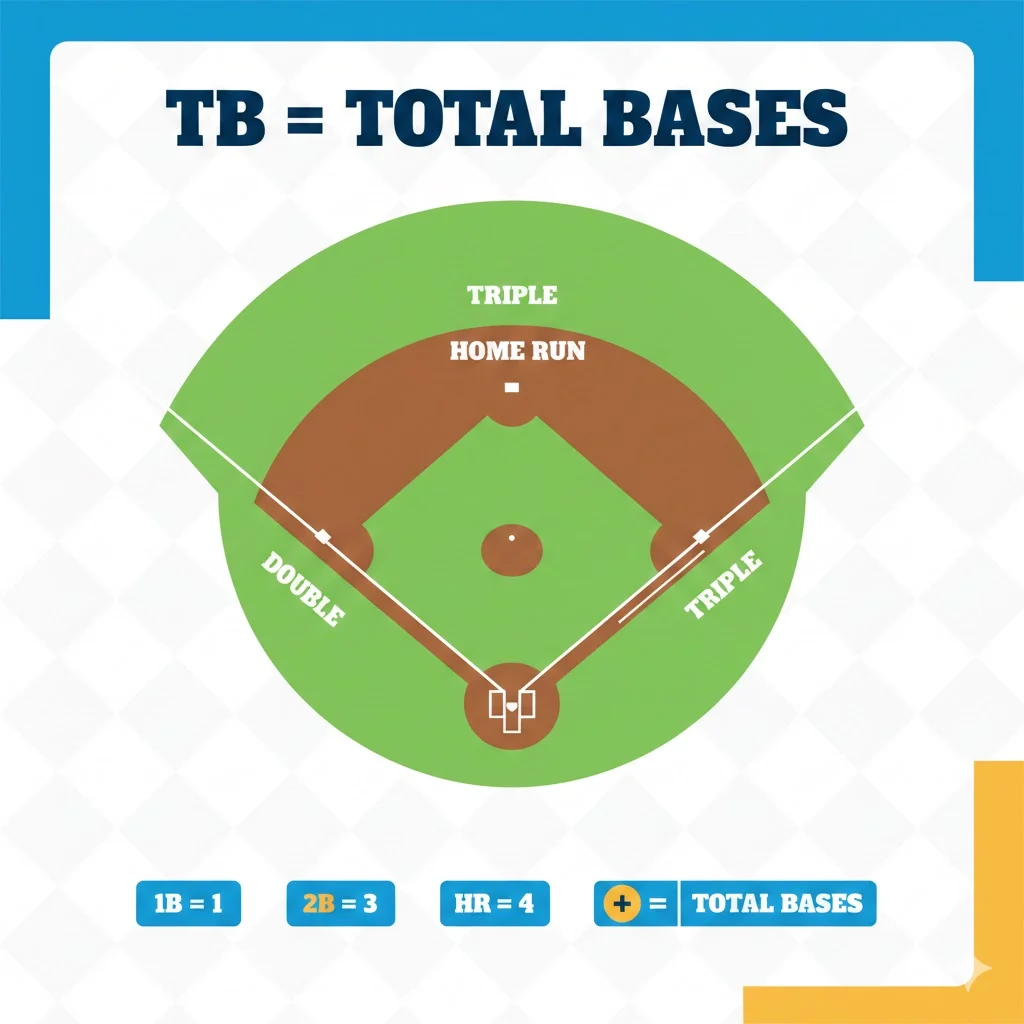

TB in baseball stands for “Total Bases.” It is a statistic that measures the total number of bases a hitter earns from hits. A single counts as one base, a double as two, a triple as three, and a home run as four.
Baseball is full of abbreviations that can look confusing at first glance. If you have ever checked a box score and seen “TB” next to a player’s name, you might have wondered what it actually means. Fortunately, the answer is straightforward once you break it down.
In this complete guide, you will learn exactly what TB means in baseball, how it is calculated, why it matters, how it differs from similar stats, and how it shows up in real games. By the end, you will understand how Total Bases helps measure offensive performance in a meaningful way.
What Does TB Mean in Baseball?
In baseball, TB stands for Total Bases.
Total Bases is a hitting statistic that measures the number of bases a player gains from hits during a game, series, or season.
Importantly, Total Bases only counts bases earned from hits. Walks, hit by pitch, stolen bases, and errors do not count toward TB.
How Total Bases Are Calculated
The calculation is simple but powerful.
Each type of hit is worth a different number of bases:
- Single equals 1 base
- Double equals 2 bases
- Triple equals 3 bases
- Home run equals 4 bases
Total Bases Formula
Total Bases equals
Singles plus 2 times Doubles plus 3 times Triples plus 4 times Home Runs
Because of this weighted system, players who hit for power tend to accumulate more Total Bases.
Example of TB Calculation
Let us look at a simple example.
If a player has:
- 2 singles
- 1 double
- 1 home run
The Total Bases would be:
2 singles equals 2 bases
1 double equals 2 bases
1 home run equals 4 bases
Total equals 8 TB
Even though the player only had 4 hits, they earned 8 total bases because extra base hits carry more value.
Why Total Bases Matter in Baseball
Total Bases gives a clearer picture of offensive production than just counting hits.
For example, two players could each have three hits in a game. However, if one hits three singles and the other hits two doubles and a home run, their impact is very different.
Therefore, TB rewards power and extra base hitting.
What TB Tells You
- How much damage a hitter does
- How productive a player is at the plate
- How often a player advances himself with strong hits
- Contribution to scoring potential
Because of this, Total Bases is often used when evaluating strong offensive performances.
TB in Professional Baseball Context
You will regularly see TB in box scores from leagues such as:
- Major League Baseball
- National League
- American League
In official MLB box scores, TB is listed alongside stats like hits, runs, RBIs, and home runs.
For example, a box score might show:
Player Name
4 AB
3 H
7 TB
That means the player had 3 hits and accumulated 7 total bases in that game.
TB vs Other Baseball Statistics
To better understand TB, it helps to compare it to other common stats.
TB vs Hits
| Hits | Total Bases |
|---|---|
| Counts number of hits | Weighs hits based on value |
| Single and home run both count as 1 hit | Home run counts as 4 bases |
| Measures frequency | Measures impact |
As a result, TB gives more context than hits alone.
TB vs Slugging Percentage
Slugging Percentage uses Total Bases in its formula.
Slugging Percentage equals
Total Bases divided by At Bats
Therefore, TB is the foundation of slugging percentage.
TB vs On Base Percentage
On Base Percentage includes:
- Hits
- Walks
- Hit by pitch
However, Total Bases only includes hits and values them differently.
Real Game Example
Imagine a player in a professional game:
- 1 single
- 1 double
- 1 triple
- 1 home run
That equals:
1 plus 2 plus 3 plus 4
Total of 10 TB
That is considered an outstanding offensive performance.
In fact, games where players reach double digit Total Bases are rare and usually highlight worthy.
Common Situations Where TB Is Mentioned
You may see TB referenced in:
- Sports broadcasts
- Fantasy baseball scoring
- Sports betting markets
- Player performance discussions
- Statistical leaderboards
In fantasy baseball leagues, some formats award points based on Total Bases. Similarly, sports betting often includes player props such as over or under a certain number of Total Bases.
Does TB Include Walks or Stolen Bases?
No.
This is a common misconception.
Total Bases only counts bases gained from hits.
The following do not count:
- Walks
- Hit by pitch
- Reaching on error
- Stolen bases
Even if a player steals second and third, those bases are not added to TB.
Alternate Meanings of TB in Baseball
In baseball contexts, TB almost always means Total Bases.
However, outside baseball, TB can mean:
- Tuberculosis in medical contexts
- Tampa Bay when referring to teams such as the Tampa Bay Rays
Context is important. In a box score or stat sheet, TB almost certainly refers to Total Bases.
Polite and Professional Ways to Reference TB
If you are writing about baseball in a professional setting, you might say:
- The player recorded eight total bases in the game
- He led the team in total bases
- She finished the season with 250 total bases
Using the full phrase Total Bases is often clearer in formal writing, especially for readers who may not know the abbreviation.
Common Mistakes About TB
Assuming It Equals Hits
Not all hits are equal in Total Bases. A single and a home run both count as one hit, but they count differently in TB.
Forgetting the Weighted Value
Extra base hits significantly increase TB. Therefore, power hitters often dominate this category.
Counting Walks by Accident
Walks help a player reach base, but they do not increase Total Bases.
Frequently Asked Questions
1. What does TB stand for in baseball?
TB stands for Total Bases.
2. How are Total Bases calculated?
Total Bases are calculated by adding one for each single, two for each double, three for each triple, and four for each home run.
3. Does TB include walks?
No. Walks are not included in Total Bases.
4. Does TB include stolen bases?
No. Stolen bases do not count toward Total Bases.
5. Why is TB important?
Total Bases measures offensive impact and power hitting ability.
6. Is TB used in Major League Baseball?
Yes. It is a standard statistic in Major League Baseball box scores.
7. What is a good number of TB in one game?
Four or more Total Bases in a game is generally considered strong. Double digit TB is exceptional.
8. How does TB affect slugging percentage?
Slugging percentage is calculated by dividing Total Bases by at bats, so TB directly influences that statistic.
Conclusion
So, what does TB mean in baseball?
TB stands for Total Bases, a statistic that measures how many bases a player earns from hits. Unlike simple hit totals, Total Bases assigns different values to singles, doubles, triples, and home runs. Because of this, it highlights power and offensive production more effectively.
To summarize:
- TB equals Total Bases
- It only counts bases from hits
- Extra base hits increase TB significantly
- It is a key part of slugging percentage
- It is commonly used in professional baseball statistics
Understanding TB gives you deeper insight into player performance and offensive strength. Once you know how it works, reading a box score becomes much more meaningful.
Discover More Post
What Does Excluded Mean in PowerSchool – DefineHubs.com –
What Does Andante Mean in Music? Simple Explanation with …