
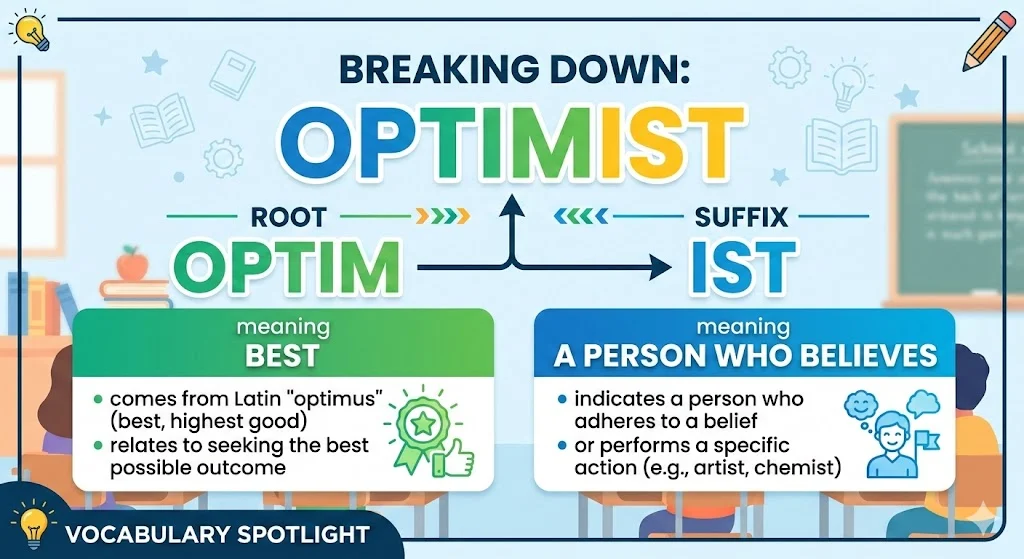

The suffix ist in the word optimist means a person who practices, believes in, or is characterized by something. In optimist, the suffix ist turns the root word optim into a noun meaning a person who believes that good things will happen.
Have you ever wondered why so many English words end in ist? Words like artist, scientist, activist, and optimist all share this common ending. Although it is small, the suffix ist carries powerful meaning.
If you are asking, what does the suffix ist mean in optimist, you are really exploring how English builds words and how suffixes shape meaning. In this guide, you will learn exactly what ist means, how it functions in optimist, where it comes from, and how it compares to other similar suffixes.
By the end, you will understand not only this one word, but also dozens of other words that use the same pattern.
What Does the Suffix Ist Mean in Optimist?
In the word optimist, the suffix ist means:
A person who believes in, practices, or is associated with something.
Therefore:
Optimist = optim + ist
Meaning = a person who believes the best will happen
The root part optim comes from a Latin word meaning “best.” When combined with ist, it forms a noun describing someone who expects positive outcomes.
Breaking Down the Word Optimist
To understand the meaning clearly, it helps to break the word into parts.
Word Structure Table
| Word Part | Meaning |
|---|---|
| Optim | Best or favorable |
| Ist | A person who believes or practices |
| Optimist | A person who expects good outcomes |
As a result, the suffix transforms an abstract idea into a person.
Without the suffix, “optim” would not function as a complete noun in English. However, adding ist gives it identity and personality.
What Is a Suffix?
A suffix is a group of letters added to the end of a word to change its meaning or grammatical function.
For example:
Teach becomes teacher
Art becomes artist
Piano becomes pianist
Similarly, when ist is added to a root word, it usually creates a noun that refers to a person.
Meaning of Ist in English
The suffix ist commonly means:
- A person who practices something
- A person who believes in something
- A specialist in a field
- A supporter of a movement or idea
Because of this flexibility, it appears in many different contexts.
Examples of Words That Use Ist
To better understand the pattern, here are some common examples.
Profession or Skill
| Word | Meaning |
|---|---|
| Artist | A person who creates art |
| Pianist | A person who plays piano |
| Scientist | A person who studies science |
| Dentist | A person who practices dentistry |
In these cases, ist refers to someone who practices a profession or skill.
Belief or Ideology
| Word | Meaning |
|---|---|
| Optimist | A person who expects positive outcomes |
| Pessimist | A person who expects negative outcomes |
| Realist | A person who sees things as they are |
| Idealist | A person guided by ideals |
Here, ist refers to someone who holds a belief or viewpoint.
Origin of the Suffix Ist
The suffix ist comes from Greek and Latin origins.
It entered English through Latin words ending in ista, which were influenced by Greek istes. Over time, English adopted the ending to create nouns describing people connected to ideas, practices, or professions.
Because English borrows heavily from Latin and Greek, the suffix ist appears frequently in academic, scientific, and descriptive vocabulary.
How Ist Changes the Meaning of Optim
Before the suffix is added, “optim” relates to the idea of the best.
Once ist is added, the meaning shifts from a concept to a person.
For example:
Optimism refers to the belief in positive outcomes.
Optimist refers to the person who holds that belief.
Notice how the suffix determines whether we are talking about an idea or an individual.
Optimist Compared to Similar Words
Understanding optimist becomes easier when you compare it with related words.
Comparison Table
| Word | Suffix | Meaning |
|---|---|---|
| Optimism | ism | The belief in positive outcomes |
| Optimist | ist | A person who believes in positive outcomes |
| Optimistic | ic | Having a positive outlook |
As you can see, different suffixes create different word types.
Tone and Usage of Optimist
The word optimist usually has a positive tone. However, context matters.
Positive Tone 😊
She is an optimist who always sees opportunity in challenges.
Here, the word suggests hopefulness and resilience.
Neutral Tone
He considers himself an optimist when it comes to business.
In this case, the word simply describes a mindset.
Slightly Critical Tone
Stop being such an optimist. We need to think realistically.
Although not negative by definition, tone can change perception.
Other Common Words Ending in Ist
Because the suffix is so productive in English, it appears in many fields.
Academic Fields
Biologist
Psychologist
Economist
Political and Social Terms
Activist
Socialist
Capitalist
Personal Traits
Altruist
Egotist
Perfectionist
In all these examples, ist identifies a person connected to the base word.
Is Ist Always Positive?
Not necessarily.
While some ist words have positive meanings, others can be neutral or even negative depending on context.
For example:
Altruist often carries positive meaning.
Egotist may carry negative meaning.
Therefore, the suffix itself is neutral. The root word determines emotional tone.
Common Confusion with Similar Suffixes
English contains other suffixes that look similar.
Ist vs Ism
Ist refers to a person.
Ism refers to a belief, system, or doctrine.
Example:
Optimism is the belief.
Optimist is the believer.
Ist vs Er
Er also refers to a person who performs an action.
Teacher
Driver
Runner
However, er usually attaches to verbs, while ist often attaches to nouns or concepts.
Practical Tip for Understanding Ist Words
If you see a word ending in ist, ask yourself:
Is this referring to a person connected to this idea or activity?
In most cases, the answer will be yes.
This strategy helps decode unfamiliar vocabulary quickly.
Frequently Asked Questions
1. What does the suffix ist mean in optimist?
It means a person who believes in or practices something. In optimist, it means a person who believes good things will happen.
2. Is ist always used for professions?
No. It can describe professions, beliefs, attitudes, or personal traits.
3. What is the root word of optimist?
The root comes from Latin meaning “best.”
4. What is the difference between optimism and optimist?
Optimism is the belief. Optimist is the person who holds that belief.
5. Does ist always mean a person?
In most English words, yes. It almost always refers to a person.
6. Is optimist a positive word?
Generally yes. It suggests hope and positivity.
7. What is the opposite of optimist?
Pessimist.
8. Can ist be negative?
The suffix itself is neutral, but the root word can create a negative meaning.
Conclusion
So, what does the suffix ist mean in optimist?
It means a person who believes in or practices something. In the case of optimist, it refers to someone who believes that good things will happen.
To summarize:
Ist turns ideas into people
In optimist, it creates a noun describing a hopeful person
The suffix comes from Greek and Latin roots
It appears in many English professions and belief based words
It is neutral in tone, while the root word shapes meaning
Once you understand how ist works, you can recognize and interpret dozens of English words more easily. In fact, learning suffixes like this is one of the fastest ways to expand vocabulary and improve reading comprehension.
Discover More Post
What Does Proximal Mean in Anatomy? Clear Definition and …
What Does Opa Mean in Greek? Meaning, Origin, and Usage …