
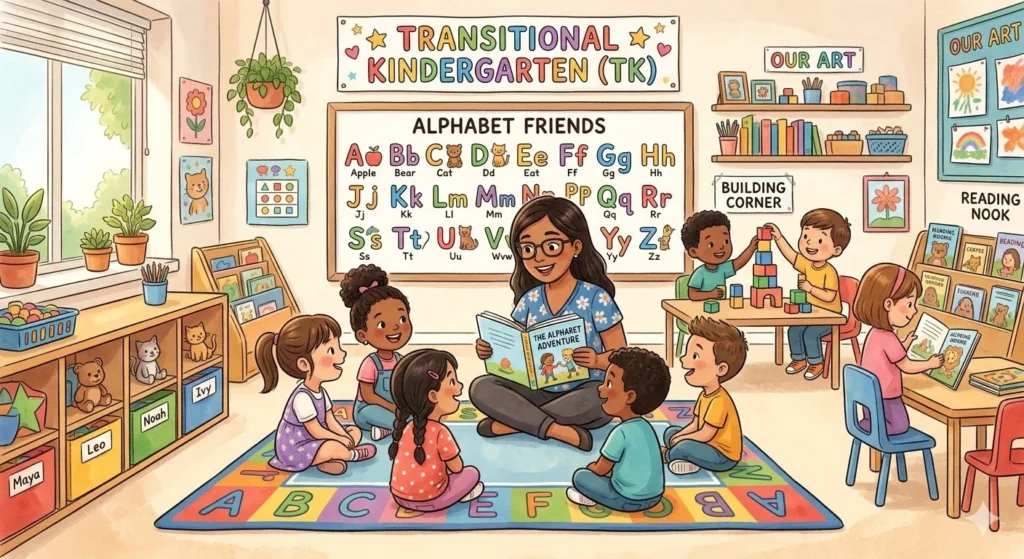

TK in school stands for Transitional Kindergarten. It is a bridge program between preschool and kindergarten designed for children who are not yet ready for traditional kindergarten, typically around 4 to 5 years old.
If you have heard the term TK in a school context and wondered what it means, you are not alone. Many parents, especially those new to the education system, come across this term during enrollment or school discussions.
At first, it might seem like just another abbreviation. However, TK plays an important role in early childhood education, helping young learners build the skills they need before entering kindergarten.
In this guide, you will learn exactly what TK means in school, how it works, who it is for, and how it compares to preschool and kindergarten. By the end, you will clearly understand whether TK might be the right step for a child’s learning journey.
What Does TK Mean in School?
In education, TK stands for Transitional Kindergarten.
It is a pre kindergarten program that prepares children academically, socially, and emotionally for kindergarten.
Unlike preschool, which can vary widely in structure, TK is usually part of the public school system and follows a more structured curriculum.
As a result, it serves as a transition year between preschool and kindergarten.
What Is Transitional Kindergarten?
Transitional Kindergarten is designed to give children extra time to develop key skills before entering a formal kindergarten classroom.
In many cases, TK is ideal for children who:
- Are younger than the kindergarten age cutoff
- Need more time to develop social skills
- Benefit from a slower introduction to structured learning
- Are not quite ready for full academic expectations
Because of this, TK helps children build confidence while learning in a supportive environment.
Age Requirements for TK
Age eligibility for TK can vary depending on the country or school system. However, there are general guidelines.
Typical Age Range
| Program | Age Range |
|---|---|
| Preschool | 3 to 4 years |
| TK | 4 to 5 years |
| Kindergarten | 5 to 6 years |
In many school systems, TK is specifically designed for children who turn 5 shortly after the kindergarten cutoff date.
Therefore, it gives them an extra year to mature before starting formal schooling.
What Do Children Learn in TK?
The TK curriculum focuses on foundational development rather than strict academics.
At the same time, it introduces early learning concepts in a gentle and engaging way.
Key Learning Areas
- Early literacy skills such as letter recognition
- Basic math concepts like counting and patterns
- Social skills such as sharing and cooperation
- Emotional development and self regulation
- Motor skills including writing and movement
In addition, teachers often use play based learning to make lessons enjoyable and effective.
How TK Differs from Preschool
Although TK and preschool may seem similar, there are important differences.
Comparison Table
| Feature | TK | Preschool |
|---|---|---|
| Structure | More structured | More flexible |
| Curriculum | School based curriculum | Play based focus |
| Setting | Public or private school | Mostly private centers |
| Teacher Requirements | Certified teachers | Varies |
| Goal | Prepare for kindergarten | Early development |
In general, TK is more academically oriented than preschool, while still maintaining a playful learning environment.
How TK Differs from Kindergarten
While TK prepares children for kindergarten, the two are not the same.
Key Differences
- TK is slower paced, while kindergarten introduces more structured academics
- TK focuses on readiness, while kindergarten focuses on performance
- TK emphasizes development, while kindergarten emphasizes learning outcomes
Because of this, TK acts as a stepping stone rather than a replacement.
Real Classroom Examples of TK
Understanding how TK works becomes easier with real examples.
Example 1 Friendly Tone 😊
A teacher might say:
“Today we are learning letters through songs and games.”
This keeps learning fun and engaging.
Example 2 Neutral Tone
A parent might say:
“My child is in TK this year to get ready for kindergarten.”
This reflects a practical and common reason for enrollment.
Example 3 Concerned Tone
Another parent might say:
“I felt my child needed more time before starting kindergarten, so we chose TK.”
This shows how TK can support different developmental needs.
Benefits of TK for Children
Transitional Kindergarten offers several advantages.
Key Benefits
- Builds confidence before formal schooling
- Supports social and emotional growth
- Encourages independence
- Provides structured learning in a gentle way
- Helps children adjust to classroom routines
As a result, many children enter kindergarten feeling more prepared and comfortable.
Common Misconceptions About TK
Despite its benefits, TK is sometimes misunderstood.
Misconception 1
TK is the same as preschool
Reality
It is more structured and part of the school system
Misconception 2
TK delays learning
Reality
It strengthens foundational skills for long term success
Misconception 3
Only struggling children need TK
Reality
Many children benefit from the extra year, regardless of ability
Alternate Meanings of TK
While TK usually means Transitional Kindergarten in schools, it can have other meanings in different contexts.
For example:
- To come in gaming or chat
- Team kill in online games
- Touch keyboard in technology
However, in an educational setting, TK almost always refers to Transitional Kindergarten.
Polite or Professional Alternatives to Saying TK
If you prefer more formal language, you can use these alternatives:
- Transitional Kindergarten program
- Pre kindergarten class
- Early learning foundation year
- Kindergarten readiness program
These phrases are especially useful in formal discussions or written communication.
When Should a Child Attend TK?
Deciding whether TK is the right choice depends on several factors.
Parents may consider TK if a child:
- Is close to the kindergarten age cutoff
- Needs more time socially or emotionally
- Has not attended preschool
- Would benefit from a structured environment before kindergarten
In many cases, teachers and school counselors can help guide this decision.
Frequently Asked Questions
1. What does TK stand for in school?
TK stands for Transitional Kindergarten, a program that prepares children for kindergarten.
2. Is TK the same as preschool?
No. TK is more structured and usually part of the school system.
3. What age is TK for?
Most children in TK are between 4 and 5 years old.
4. Is TK required?
No. It is optional in most school systems.
5. Does TK replace kindergarten?
No. It comes before kindergarten and prepares children for it.
6. Is TK free?
In many public schools, TK is free, but this depends on location.
7. What skills do kids learn in TK?
Children learn early literacy, math basics, social skills, and emotional development.
8. How do I know if my child needs TK?
If your child is not fully ready for kindergarten, TK can be a helpful option.
Conclusion
So, what does TK mean in school? It stands for Transitional Kindergarten, a valuable program that helps children move smoothly from preschool into kindergarten.
To recap:
- TK is designed for children around 4 to 5 years old
- It focuses on readiness, not pressure
- It builds social, emotional, and academic skills
- It serves as a bridge between early learning and formal education
Ultimately, TK gives children the time and support they need to start their educational journey with confidence.
Discover More Post
EYP Meaning in Text What It Stands For and How to Use It for …
What Does WSG Mean in Text? Definition, Usage, and …
SYBAU Meaning in Text Definition, Usage, and Examples for …