
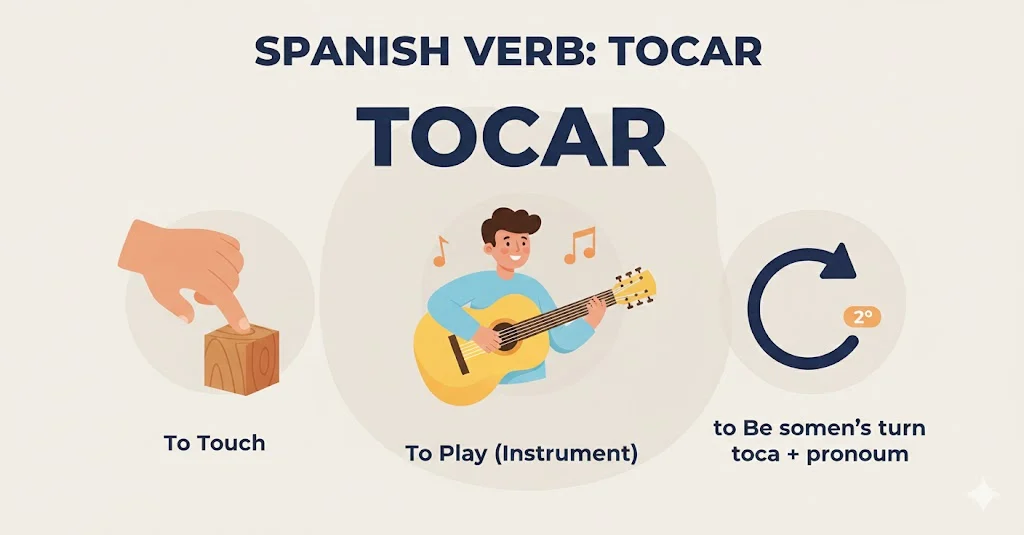

Tocar is a Spanish verb that most commonly means “to touch,” “to play” an instrument, or “to be someone’s turn,” depending on context. It is a versatile verb used in daily conversation, music, routines, and even expressions of obligation or responsibility.
Spanish verbs often carry more meaning than their direct English translations, and tocar is a perfect example. At first, learners usually associate it with touching something. However, as you hear it used by native speakers, you quickly realize that tocar shows up in many situations that have nothing to do with physical contact.
Because tocar has several everyday meanings, understanding how it works will greatly improve your comprehension and fluency. In this guide, you will learn what tocar means in Spanish, where it comes from, how it is used in real life, and how to avoid common mistakes.
What Does Tocar Mean in Spanish?
In Spanish, tocar can mean several things depending on the situation.
The most common meanings are:
- To touch
- To play a musical instrument
- To be someone’s turn
- To affect or concern someone
- To be required or necessary to do something
As a result, tocar is a context driven verb. The surrounding words usually make the meaning clear.
Origin and Background of Tocar
The verb tocar comes from the Latin word toccare, which means “to strike” or “to hit lightly.” Over time, its meaning expanded to include touching, playing instruments, and figurative uses related to responsibility or chance.
Because of this evolution, tocar became one of the most flexible verbs in modern Spanish. Today, it is widely used across Spain, Latin America, and Spanish speaking communities worldwide.
Basic Conjugation of Tocar
Before looking at examples, it helps to see how tocar is conjugated in the present tense.
| Subject | Present Tense |
|---|---|
| Yo | toco |
| Tú | tocas |
| Él Ella Usted | toca |
| Nosotros | tocamos |
| Ellos Ustedes | tocan |
Knowing these forms will help you recognize tocar in conversation and use it correctly.
Common Uses of Tocar
1. Tocar as “To Touch”
First and foremost, tocar often means to touch physically.
Examples:
- No toques eso
Do not touch that - Tocó la puerta
He knocked on the door - Me tocó el brazo
He touched my arm
In this sense, tocar can be gentle or neutral. However, context and tone matter, especially in personal situations.
2. Tocar as “To Play” a Musical Instrument
Another very common meaning of tocar is to play an instrument.
Examples:
- Toco la guitarra
I play the guitar - Ella toca el piano
She plays the piano - Tocamos en una banda
We play in a band
In Spanish, tocar is used for instruments, while jugar is used for sports.
3. Tocar as “It Is Someone’s Turn”
One of the most practical uses of tocar is to talk about turns.
Examples:
- Me toca a mí
It is my turn - Te toca limpiar hoy
It is your turn to clean today - Le tocó pagar
He ended up paying
This usage is extremely common in daily routines, games, and shared responsibilities.
4. Tocar to Express Obligation or Responsibility
Closely related to turns, tocar can also express obligation in an informal way.
Examples:
- Me toca trabajar mañana
I have to work tomorrow - Nos toca estudiar
We have to study
This form feels natural and conversational, often implying that the task was assigned or unavoidable.
5. Tocar as “To Affect or Concern”
In some contexts, tocar means to affect someone emotionally or personally.
Examples:
- Esa historia me tocó
That story affected me - El tema nos toca a todos
The issue affects all of us
Here, tocar is figurative rather than physical.
Examples of Tocar in Real Conversations
Friendly Tone 😊
- ¿Puedo tocar tu guitarra?
Can I touch your guitar? - Me toca a mí ahora
It is my turn now
Neutral Tone
- Toca trabajar hoy
It is time to work today - El médico tocó el tema
The doctor brought up the topic
Negative or Serious Tone 😐
- No me toques
Do not touch me - Ese problema me toca de cerca
That problem affects me closely
In every case, the meaning of tocar depends on context rather than the word alone.
Tocar vs Similar Spanish Verbs
Understanding tocar becomes easier when you compare it to related verbs.
Comparison Table
| Verb | Meaning | Usage |
|---|---|---|
| Tocar | To touch or play | Physical contact instruments turns |
| Jugar | To play | Sports and games |
| Rozar | To brush lightly | Accidental contact |
| Afectar | To affect | Emotional or situational impact |
For example:
- Tocar la guitarra
To play the guitar - Jugar al fútbol
To play soccer
Mixing these verbs up is a common beginner mistake.
Common Expressions with Tocar
Spanish uses tocar in many fixed expressions.
Some of the most common include:
- Me toca
It is my turn - Tocar fondo
To hit rock bottom - Tocar madera
To knock on wood - Tocar el corazón
To touch the heart emotionally
Learning these expressions helps you sound more natural and fluent.
Common Mistakes with Tocar
Confusing Tocar with Jugar
Incorrect:
- Toco fútbol
Correct:
- Juego fútbol
Remember, tocar is for instruments, not sports.
Overusing Tocar for Obligation
While tocar can express obligation, it is informal. In formal settings, other verbs may sound better.
Example:
- Me corresponde trabajar
It is my responsibility to work
Alternate Meanings of Tocar
In informal or idiomatic speech, tocar can take on exaggerated meanings.
Example:
- Me tocó la lotería
I won the lottery
Here, tocar implies chance or luck rather than physical contact.
Polite and Professional Uses of Tocar
In professional contexts, tocar is often used carefully and indirectly.
Examples:
- Me toca presentar el informe
I am scheduled to present the report - El tema toca varios puntos importantes
The topic covers several important points
These uses sound natural without being too casual.
Frequently Asked Questions
1. What does tocar literally mean in Spanish?
Literally, tocar means “to touch,” but it has several extended meanings.
2. Can tocar mean to play music?
Yes. It is the standard verb for playing musical instruments.
3. Does tocar mean obligation?
Yes. It can express responsibility or something you have to do.
4. Is tocar formal or informal?
It is neutral and works in most situations, though some uses feel casual.
5. How do I know which meaning tocar has?
Context usually makes the meaning clear.
6. Can tocar be emotional?
Yes. It can mean to emotionally affect someone.
7. Is tocar used for sports?
No. Sports use jugar, not tocar.
8. Is tocar common in daily Spanish?
Yes. It is one of the most frequently used verbs.
Conclusion
So, what does tocar mean in Spanish? It is a highly flexible verb that can mean to touch, to play an instrument, to take a turn, or to be affected, depending on context.
Key points to remember:
- Tocar has multiple everyday meanings
- Context determines interpretation
- It is used for instruments but not sports
- It often appears in routines and expressions
- It is essential for natural Spanish communication
Once you master tocar, you will better understand conversations and express yourself more naturally in Spanish.