
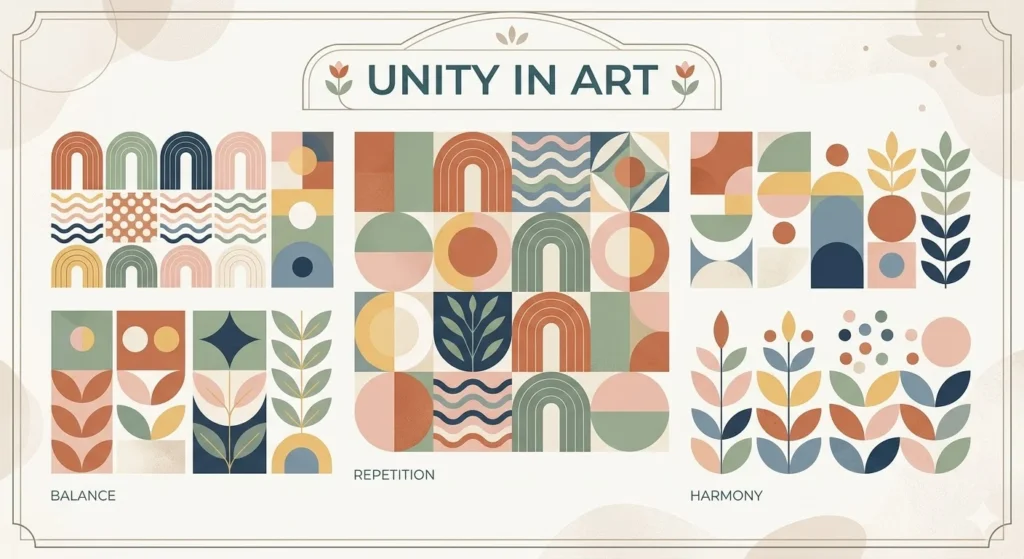

Unity in art refers to the way all elements of an artwork work together to create a sense of harmony, completeness, and cohesion. It ensures that every part of the composition feels connected and contributes to a unified whole.
Art is not just about individual elements like color, shape, or texture. Instead, it is about how all those elements come together to create a meaningful and visually pleasing experience. That is where unity in art plays a crucial role.
When an artwork has unity, it feels balanced, organized, and complete. Without it, even technically skilled pieces can appear scattered or confusing. Therefore, understanding unity is essential for artists, students, and anyone interested in visual design.
In this guide, you will learn what unity means in art, why it matters, how artists achieve it, and how it compares to similar principles.
What Does Unity Mean in Art?
In simple terms, unity in art means that all parts of an artwork belong together.
Each element supports the overall composition rather than competing for attention. As a result, the viewer experiences the artwork as a single, harmonious piece instead of disconnected parts.
Unity creates:
- Visual harmony
- A sense of completeness
- Stronger emotional impact
- Clear communication of the artist’s message
Why Unity Is Important in Art
Unity is one of the core principles of art. Without it, an artwork can feel chaotic or unfinished.
On the other hand, when unity is present, the viewer can easily understand and appreciate the piece. Moreover, it helps guide the viewer’s eye across the composition in a natural way.
Key benefits of unity include:
- Improved visual clarity
- Stronger storytelling
- Better composition balance
- Increased aesthetic appeal
Because of these advantages, artists often plan their work carefully to ensure unity is achieved.
How Artists Create Unity in Art
Artists use several techniques to bring unity into their work. While each method is different, they all aim to connect elements visually.
1. Repetition
Repetition involves using the same or similar elements throughout an artwork.
For example, repeating shapes, colors, or patterns helps tie different parts together.
Examples:
- Repeating circular shapes across a painting
- Using the same color palette throughout
- Repeating lines or textures
As a result, the artwork feels consistent and connected.
2. Proximity
Proximity refers to placing related elements close to each other.
When objects are grouped together, the viewer naturally sees them as part of the same idea.
For instance:
- Grouping figures in a scene
- Placing similar objects near each other
This technique strengthens visual relationships.
3. Alignment
Alignment creates order by arranging elements along a line or structure.
Instead of placing objects randomly, artists align them to create a sense of organization.
This leads to:
- Cleaner composition
- Better flow
- Stronger unity
4. Similarity
Similarity means using elements that look alike.
These similarities may include:
- Color
- Shape
- Size
- Texture
Because similar elements naturally relate to each other, they contribute to unity.
5. Continuation
Continuation guides the viewer’s eye across the artwork.
Artists often use lines, curves, or repeated forms to create a visual path.
As the eye follows this path, the composition feels connected and smooth.
6. Color Harmony
Color plays a major role in unity.
Using a consistent color scheme helps unify the artwork.
Examples include:
- Monochromatic color schemes
- Analogous colors
- Limited palettes
Consequently, the piece feels visually cohesive.
Examples of Unity in Art
To better understand unity, consider how it appears in different artistic contexts.
Painting Example
A landscape painting may use similar shades of green and blue throughout. As a result, all elements feel connected, from the trees to the sky.
Graphic Design Example
A poster might use the same font, color scheme, and layout style. Therefore, everything looks consistent and professional.
Photography Example
A photograph may focus on a single theme or color tone. This creates a unified mood and visual experience.
Types of Unity in Art
Unity can appear in different forms depending on the style and intention of the artwork.
Visual Unity
This is achieved through elements like color, shape, and composition.
Conceptual Unity
Here, the idea or message connects all parts of the artwork.
For example, a series of images may share a common theme such as nature or identity.
Compositional Unity
This refers to how elements are arranged to create balance and structure.
Unity vs Variety in Art
While unity is important, too much of it can make an artwork feel boring. That is why artists also use variety.
Comparison Table
| Unity | Variety |
|---|---|
| Creates harmony | Adds interest |
| Connects elements | Introduces differences |
| Makes art cohesive | Prevents monotony |
| Focuses the composition | Adds contrast |
The key is balance.provides structure, while variety keeps the artwork engaging.
Unity vs Harmony in Art
Unity and harmony are closely related, but they are not exactly the same.
- Unity focuses on the overall sense of togetherness
- Harmony focuses on how well elements visually complement each other
In many cases, harmony helps create unity.
Common Mistakes When Creating Unity
Even experienced artists can struggle with unity.
Overusing Repetition
Too much repetition can make the artwork dull.
Lack of Variety
If everything looks the same, the piece may lose interest.
Poor Composition
Random placement of elements can break unity.
Inconsistent Style
Mixing unrelated styles without intention can confuse the viewer.
Polite and Professional Ways to Describe Unity in Art
If you are analyzing or discussing art, you can use more refined language.
Examples:
- “The composition demonstrates strong unity.”
- “There is a cohesive visual structure throughout the piece.”
- “All elements work together harmoniously.”
- “The artwork achieves a sense of completeness.”
These phrases are especially useful in academic or professional settings.
Frequently Asked Questions
1. What does unity mean in art in simple terms?
Unity means all parts of an artwork work together to form a complete and cohesive whole.
2. Why is unity important in art?
It helps create harmony, clarity, and a strong visual impact.
3. How do artists create unity?
They use techniques like repetition, alignment, similarity, and color harmony.
4. Can an artwork have too much unity?
Yes. Too much unity can make a piece feel repetitive or boring.
5. What is the difference between unity and variety?
Unity creates cohesion, while variety adds interest and contrast.
6. Is unity the same as balance?
No. Balance refers to visual weight, while unity refers to overall cohesion.
7. Does unity apply to all types of art?
Yes. Unity is important in painting, design, photography, and more.
8. How can beginners improve unity in their art?
They can start by using limited colors, repeating shapes, and organizing elements clearly.
Conclusion
So, what does unity mean in art? It is the principle that ensures all parts of an artwork come together to form a cohesive and harmonious whole.
To recap:
- Unity connects all elements in a composition
- It creates balance, clarity, and visual appeal
- Artists achieve it through repetition, alignment, and color harmony
- It works best when balanced with variety
By understanding and applying unity, artists can create work that feels complete, engaging, and visually satisfying.
Discover More Post
What Does 9 Mean in Numerology? Meaning, Personality …
What Does Enterprise Mean in Business? Definition and …
What Does This Mean in Texting? Guide … – DefineHubs.com –