
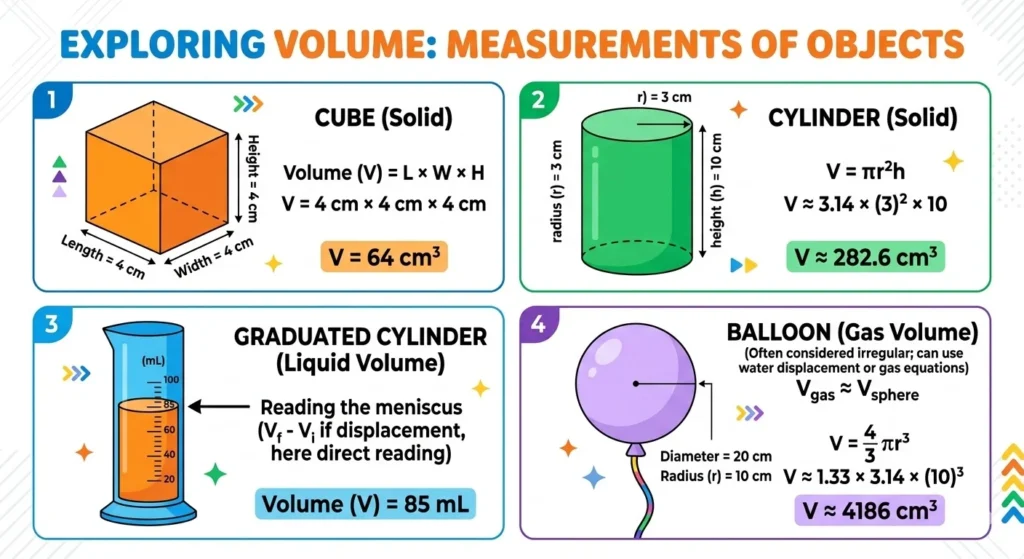

Volume in science refers to the amount of space that a substance or object occupies. It is a physical quantity measured in cubic units such as cubic meters, liters, or milliliters and is commonly used in physics, chemistry, and everyday scientific measurements.
When studying science, one of the most common concepts you will encounter is volume. From measuring liquids in a laboratory to calculating the size of a container or understanding how gases expand, volume plays a fundamental role in many scientific fields.
Although the idea may seem simple at first, volume is an important measurement that helps scientists describe matter and understand how substances behave. In this guide, you will learn what volume means in science, how it is measured, the formulas used to calculate it, and how it appears in real scientific situations.
What Does Volume Mean in Science?
In science, volume is the amount of three dimensional space occupied by an object, substance, or material.
Every physical object has volume because it takes up space. Whether it is a drop of water, a solid cube, or a large balloon filled with gas, each has a measurable volume.
Scientists use volume to understand:
- The size of objects
- The amount of liquid in containers
- The behavior of gases
- The density of substances
Because of this, volume is a key concept in physics, chemistry, biology, and environmental science.
Why Volume Is Important in Science
Volume helps scientists describe and compare matter. Without it, measuring the physical properties of materials would be difficult.
For example, scientists use volume to:
- Measure liquids in experiments
- Calculate density
- Understand gas expansion and compression
- Determine the capacity of containers
In addition, many scientific formulas require volume as a key variable.
A simple example is the density formula, which uses both mass and volume.
Density equals mass divided by volume.
Units Used to Measure Volume
Volume can be measured using different units depending on the scientific context. However, the International System of Units uses the cubic meter as the standard unit.
Common Units of Volume
| Unit | Symbol | Common Use |
|---|---|---|
| Cubic meter | m³ | Standard scientific unit |
| Liter | L | Liquids and laboratory measurements |
| Milliliter | mL | Small liquid measurements |
| Cubic centimeter | cm³ | Small solid objects |
| Cubic millimeter | mm³ | Very small volumes |
A helpful fact is that 1 milliliter equals 1 cubic centimeter.
Because of this relationship, scientists often switch between these units in laboratory work.
How Volume Is Calculated
The way volume is calculated depends on the shape of the object being measured.
Volume of a Cube or Rectangular Prism
Formula:
Volume equals length times width times height
Example:
A box that is
5 cm long
4 cm wide
3 cm high
Volume = 5 × 4 × 3
Volume = 60 cubic centimeters
Volume of a Cylinder
Formula:
Volume equals π × radius² × height
Example:
A cylinder with
radius = 2 cm
height = 10 cm
Volume = π × 2² × 10
Volume ≈ 125.66 cubic centimeters
Volume of a Sphere
Formula:
Volume equals four thirds × π × radius³
Example:
If the radius is 3 cm, the volume is approximately 113 cubic centimeters.
Measuring Volume in Scientific Experiments
In laboratories, volume is often measured using specialized equipment.
Common Tools Used to Measure Volume
| Instrument | Purpose |
|---|---|
| Graduated cylinder | Accurate measurement of liquids |
| Beaker | General liquid measurement |
| Pipette | Precise transfer of small liquid amounts |
| Burette | Controlled liquid delivery in experiments |
| Volumetric flask | Preparing exact solution volumes |
Each tool is designed for a different level of precision.
For instance, a graduated cylinder provides more accurate measurements than a beaker.
Volume of Solids, Liquids, and Gases
Volume applies to all three states of matter, but it behaves differently in each case.
Solids
Solids have a fixed volume and fixed shape.
Example:
A metal cube always occupies the same amount of space unless physically altered.
Liquids
Liquids have a fixed volume but no fixed shape.
Instead, they take the shape of their container.
For example, one liter of water remains the same volume whether it is in a bottle or a bowl.
Gases
Gases are different because they expand to fill the container they occupy.
This means their volume can change depending on pressure and temperature.
Because of this behavior, gas volume is studied carefully in physics and chemistry.
Examples of Volume in Everyday Science
Volume is not just a classroom concept. It appears in everyday life more often than many people realize.
Examples include:
Cooking measurements such as cups or milliliters
Medicine doses measured in milliliters
Fuel stored in gas tanks
Air filling balloons
Water filling a swimming pool
In each situation, volume helps measure the amount of space occupied by a substance.
Real World Example Table
| Situation | What Is Measured | Example Volume |
|---|---|---|
| Laboratory experiment | Chemical solution | 50 mL |
| Cooking recipe | Liquid ingredient | 250 mL |
| Swimming pool | Water capacity | 30,000 liters |
| Balloon filled with air | Gas volume | Several liters |
| Aquarium tank | Water space | 100 liters |
These examples show how widely volume is used across different activities and fields.
Volume and Density
Another key scientific concept closely related to volume is density.
measures how much mass exists within a certain volume.
Density Formula
Density = Mass ÷ Volume
For example:
If a substance has a mass of 200 grams and a volume of 100 cubic centimeters, its density is 2 grams per cubic centimeter.
Because density depends on volume, accurate volume measurements are essential for scientific experiments.
Common Mistakes When Learning About Volume
Students sometimes misunderstand volume because it involves three dimensional measurement.
Here are some common mistakes.
Confusing Area and Volume
Area measures two dimensional space, while volume measures three dimensional space.
For example:
Area might measure the surface of a table.
Volume measures the space inside a box.
Forgetting Cubic Units
Volume must always be expressed in cubic units.
Incorrect example:
50 cm
Correct example:
50 cm³
Mixing Units
Scientific calculations require consistent units. If one measurement is in centimeters and another is in meters, conversions must be done before calculating volume.
Alternate Meanings of Volume
Although volume usually refers to space in science, the word can have other meanings in different contexts.
For example:
In sound, volume refers to loudness.
publishing, volume can mean a book in a series.
In mathematics and science, however, volume always refers to the space an object occupies.
Polite or Professional Ways to Describe Volume
In academic or professional writing, scientists often describe volume using precise language.
Examples include:
The container holds a volume of two liters.
The experiment required a solution volume of 100 milliliters.
The gas expanded to a larger volume under lower pressure.
Using accurate units and clear descriptions helps maintain scientific clarity.
Frequently Asked Questions
1. What does volume mean in science?
Volume is the amount of space that an object or substance occupies.
2. What are common units of volume?
Common units include cubic meters, liters, milliliters, and cubic centimeters.
3. How do scientists measure volume?
Scientists measure volume using tools such as graduated cylinders, pipettes, and volumetric flasks.
4. Does every object have volume?
Yes. Any object that occupies space has volume.
5. What is the difference between mass and volume?
Mass measures the amount of matter in an object, while volume measures the space it occupies.
6. Why is volume important in experiments?
Volume helps scientists measure liquids, calculate density, and understand physical properties of substances.
7. Can gases have volume?
Yes. Gases have volume and expand to fill the container they are in.
8. Is volume always measured in liters?
No. Liters are common for liquids, but volume can also be measured in cubic meters or cubic centimeters.
Conclusion
So, what does volume mean in science? Simply put, it refers to the amount of space occupied by an object or substance. This concept is essential for measuring liquids, calculating density, and understanding how solids, liquids, and gases behave.
Key points to remember include:
Volume measures three dimensional space
It is expressed in cubic units or liters
Scientists measure it using specialized tools
It plays an important role in many scientific formulas
By understanding volume and how it works, students and learners gain a stronger foundation in scientific measurement and experimentation.
Discover Most Post
What Does Infer Mean in Reading? Clear Definition and …
What Does E Mean in Grades? GPA Impact and Passing …
What Does Deductible Mean in Insurance? Clear Explanation …