
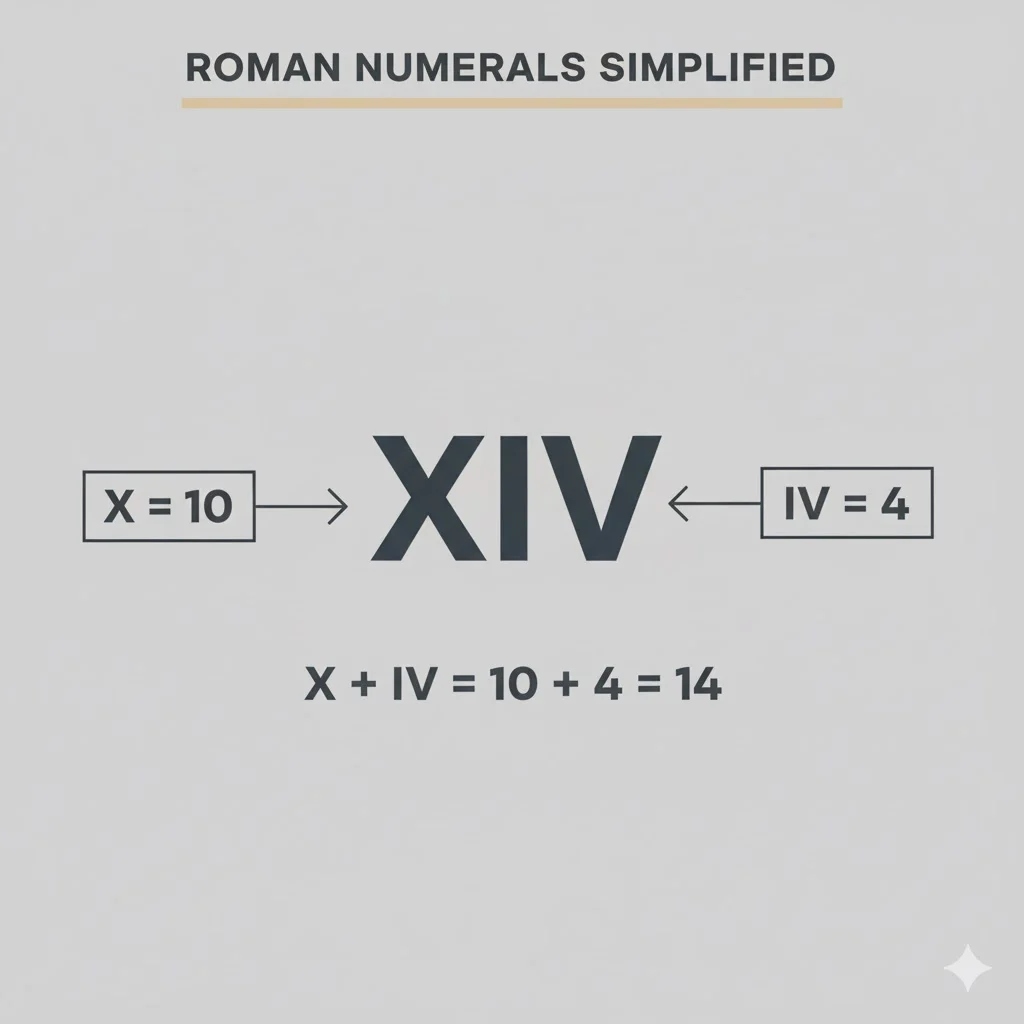

XIV is a Roman numeral that means 14. It is formed by combining X which equals 10 and IV which equals 4, resulting in the number fourteen.
Roman numerals may look mysterious at first, but once you understand how they work, they become surprisingly logical. One numeral that often catches people’s attention is XIV. You might see it on clocks, book chapters, movie titles, or even tattoos and wonder what it actually means.
In this article, you will learn exactly what XIV means in Roman numerals, how it is built, why it is written the way it is, and how it is used in real life. By the end, you will be able to read and understand XIV with confidence.
What Does XIV Mean in Roman Numerals?
In Roman numerals, XIV represents the number 14.
This value comes from combining two parts:
- X equals 10
- IV equals 4
When you add them together, the result is 14.
Unlike some Roman numerals that simply stack symbols, XIV follows a special subtraction rule, which makes it especially important to understand.
Understanding the Roman Numeral System
Before breaking down XIV further, it helps to understand the basics of Roman numerals.
Roman numerals originated in ancient Rome and were used for counting, trade, and record keeping. Instead of digits like 1, 2, and 3, the Romans used letters.
Here are the most common Roman numeral symbols.
| Roman Numeral | Value |
|---|---|
| I | 1 |
| V | 5 |
| X | 10 |
| L | 50 |
| C | 100 |
| D | 500 |
| M | 1000 |
Using these symbols, Romans built numbers by adding or subtracting values based on their order.
How XIV Is Constructed Step by Step
To fully understand XIV, it helps to look at each part individually.
Step 1: The Meaning of X
The letter X represents 10. It is one of the most frequently used Roman numerals and forms the foundation of many numbers.
Step 2: The Meaning of IV
The combination IV represents 4. Instead of writing four as IIII, Roman numerals use subtraction here.
Since I comes before V, it means:
- 5 minus 1 equals 4
Step 3: Putting It Together
When X and IV are combined:
- X equals 10
- IV equals 4
Together, they equal 14, which is written as XIV.
Why XIV Is Written This Way
One common question is why 14 is written as XIV instead of XIIII.
The answer lies in the subtractive rule of Roman numerals.
When a smaller numeral appears before a larger one, it is subtracted. This rule helps avoid repetition and keeps numbers shorter and clearer.
In XIV:
- I comes before V
- That signals subtraction
- So IV equals 4, not 6
As a result, XIV follows proper Roman numeral rules and is considered the correct and standard form.
XIV Compared to Similar Roman Numerals
To avoid confusion, it helps to compare XIV with nearby Roman numerals.
Comparison Table
| Roman Numeral | Value | Explanation |
|---|---|---|
| XIII | 13 | 10 plus 3 |
| XIV | 14 | 10 plus 4 |
| XV | 15 | 10 plus 5 |
| XVI | 16 | 10 plus 6 |
This comparison shows how XIV fits neatly between XIII and XV, following consistent Roman numeral logic.
Common Places Where You See XIV
Roman numerals are still widely used today, especially in formal or decorative contexts.
You may encounter XIV in the following places.
Clocks and Watches
On analog clocks, Roman numerals often mark the hours. While XIV is not an hour on a clock face, the same numbering logic applies to timekeeping designs.
Book Chapters and Outlines
Many books use Roman numerals for introductions, chapters, or sections. Chapter XIV simply means Chapter 14.
Movie Titles and Sequels
Some movie franchises use Roman numerals instead of regular numbers. If you see Part XIV, it refers to the fourteenth installment.
Events and Ceremonies
Roman numerals are often used for events like Super Bowls, anniversaries, and formal ceremonies because they look elegant and timeless.
Tattoos and Art
People sometimes choose Roman numerals like XIV for tattoos because they represent meaningful dates or numbers in a classic style.
How to Read XIV Out Loud
When reading Roman numerals aloud, XIV is read as:
- “Fourteen”
You do not say the letters individually. Instead, you convert the numeral to its number and say that number.
Common Mistakes When Reading XIV
Even though XIV is straightforward, some mistakes are common.
Confusing IV with VI
IV equals 4
VI equals 6
The order of the letters matters. In XIV, the IV comes after X, not the other way around.
Thinking XIV Equals 16
Some people mistakenly add the values incorrectly. However:
- X equals 10
- IV equals 4
So the correct total is 14, not 16.
Alternate Meanings of XIV
Outside of Roman numerals, XIV does not have widely accepted alternate meanings.
In rare cases, it may be used symbolically or stylistically, such as a brand name or artistic reference. However, its primary and recognized meaning remains the number fourteen.
Polite and Professional Usage of XIV
XIV is commonly used in formal writing and professional contexts where Roman numerals are preferred.
Examples include:
- Chapter XIV of the report
- Section XIV of the agreement
- Event XIV of the annual conference
In these cases, using Roman numerals adds structure and formality.
Frequently Asked Questions
1. What does XIV mean in Roman numerals?
XIV means 14.
2. How do you calculate XIV?
You calculate it by adding X which equals 10 and IV which equals 4.
3. Why is 14 written as XIV and not XIIII?
Because Roman numerals use subtraction rules to avoid repetition.
4. Is XIV always equal to 14?
Yes. In Roman numerals, XIV always represents 14.
5. What is the difference between XIV and XV?
XIV equals 14, while XV equals 15.
6. Can XIV be used in modern writing?
Yes. It is often used in formal documents, titles, and design elements.
7. How do you write 14 correctly in Roman numerals?
The correct form is XIV.
Conclusion
So, what does XIV mean in Roman numerals? It means 14, formed by combining X for 10 and IV for 4.
To recap:
- XIV follows Roman numeral subtraction rules
- It represents the number fourteen
- It appears in books, titles, events, and art
- It remains widely understood and used today
Once you understand XIV, reading Roman numerals becomes much easier. With practice, symbols that once seemed confusing start to feel familiar and logical
Discover More Post
What Does Delta H Mean in Chemistry? Simple Explanation …
What Does Holy Mean in the Bible? Biblical Meaning …