
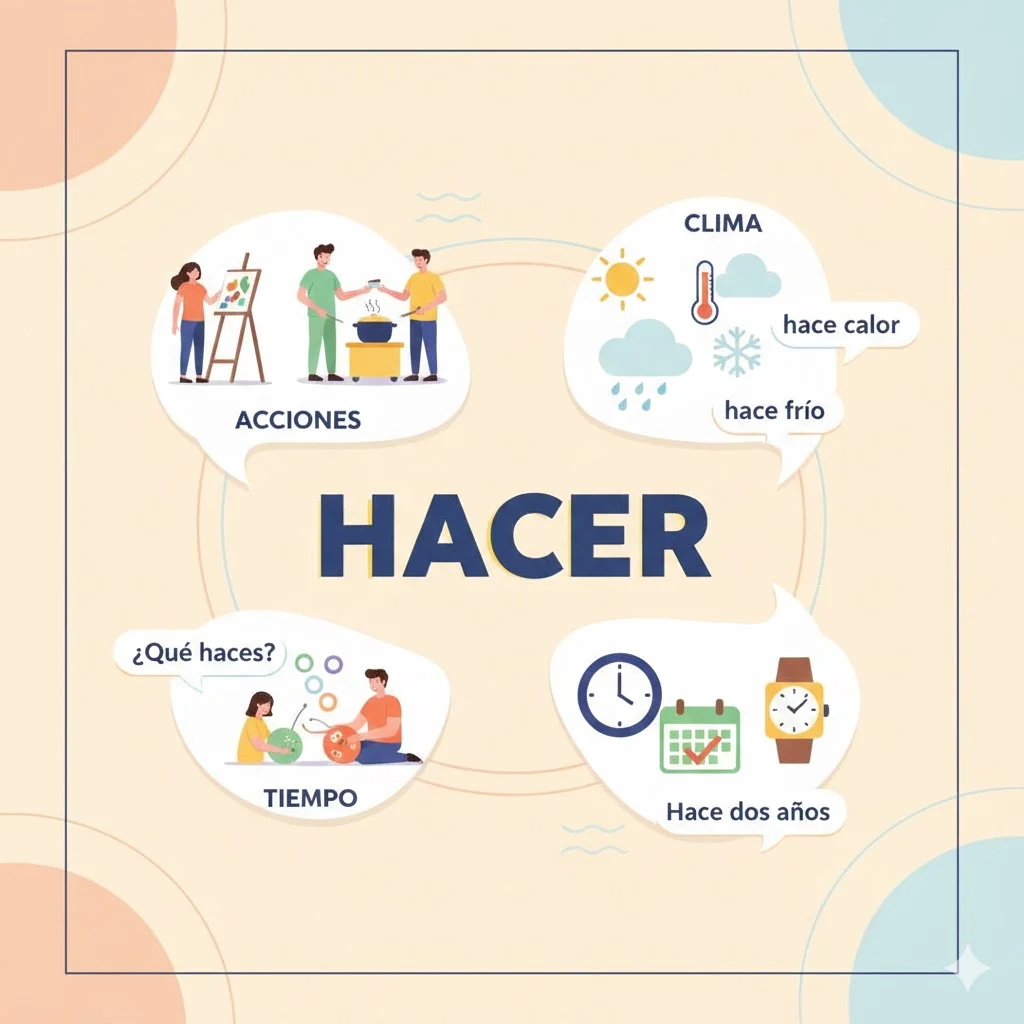

Hacer is a Spanish verb that means “to do” or “to make.” It is one of the most commonly used verbs in Spanish and appears in everyday conversations to talk about actions, activities, creation, time, and even weather expressions.
If you are learning Spanish, you will quickly notice that hacer shows up everywhere. From asking what someone is doing to talking about the weather or describing how long ago something happened, this verb plays a central role in daily communication.
Although hacer often translates as “to do” or “to make,” its real value comes from how flexible it is. Understanding how hacer works will help you sound more natural and confident in Spanish, whether you are speaking casually or writing professionally.
What Does Hacer Mean in Spanish?
In Spanish, hacer primarily means “to do” or “to make.”
However, its meaning depends heavily on context. While English separates “do” and “make” into two verbs, Spanish uses hacer for both ideas.
As a result, hacer can refer to:
- Performing an action
- Creating or producing something
- Completing tasks
- Talking about time and weather
Because of this wide range, hacer is considered an essential Spanish verb.
The Verb Hacer and Why It Is Important
To better understand hacer, it helps to know its grammatical role.
Hacer is an irregular verb, which means some of its conjugations do not follow standard patterns. Despite this, it is used so often that learners tend to memorize it quickly.
In daily life, Spanish speakers rely on hacer in questions, instructions, and descriptions.
Present Tense of Hacer
Here is how hacer is conjugated in the present tense.
| Subject | Form |
|---|---|
| Yo | hago |
| Tú | haces |
| Él Ella Usted | hace |
| Nosotros | hacemos |
| Ellos Ustedes | hacen |
Notably, the yo form hago is irregular, while the other forms are more predictable.
Common Uses of Hacer
Spanish speakers use hacer in several key situations. Each use has its own nuance and purpose.
1. To Do or Perform an Action
First of all, hacer is used to talk about actions or activities.
Examples:
- ¿Qué haces?
What are you doing? - Hago mi tarea
I do my homework - Hace ejercicio todos los días
He exercises every day
This is one of the most frequent uses of hacer.
2. To Make or Create Something
In addition, hacer means “to make” when creating or producing something.
Examples:
- Hago la cena
I make dinner - Hace un pastel
She makes a cake - Hicimos un plan
We made a plan
Here, hacer refers to bringing something into existence.
3. Talking About Weather
Another important use of hacer is in weather expressions.
Examples:
- Hace calor
It is hot - Hace frío
It is cold - Hace buen tiempo
The weather is nice
In these expressions, hacer does not refer to a person. Instead, it functions impersonally.
4. Talking About Time and Duration
Furthermore, hacer is commonly used to talk about how much time has passed.
Examples:
- Hace dos años
Two years ago - Hace mucho tiempo
A long time ago - ¿Cuánto tiempo hace?
How long has it been?
This structure is unique to Spanish and is very useful in conversation.
5. Expressing Obligations and Instructions
Finally, hacer can appear in expressions related to instructions or expectations.
Examples:
- Tienes que hacer esto
You have to do this - Hay que hacer algo
Something must be done
These expressions are common in both casual and professional settings.
Examples of Hacer in Real Conversations
To see how hacer works in context, here are examples with different tones.
Friendly Tone 😊
- ¿Qué haces hoy?
What are you doing today? - Hacemos algo esta noche
Let’s do something tonight
Neutral Tone
- Hago el informe ahora
I am doing the report now - Hace falta más tiempo
More time is needed
Negative or Frustrated Tone 😐
- No quiero hacer esto
I do not want to do this - Hace demasiado calor
It is too hot
These examples show how flexible hacer can be.
Hacer vs Other Action Verbs
Spanish has many verbs related to actions, but hacer is one of the broadest.
Comparison Table
| Verb | Meaning | Typical Use |
|---|---|---|
| Hacer | To do or make | General actions and creation |
| Crear | To create | Artistic or original creation |
| Fabricar | To manufacture | Industrial or physical production |
| Realizar | To carry out | Formal tasks or projects |
Although these verbs overlap, hacer remains the most versatile.
Common Expressions with Hacer
Spanish includes many fixed expressions that use hacer.
Some of the most common include:
- Hacer la cama
To make the bed - Hacer ejercicio
To exercise - Hacer daño
To cause harm - Hacer falta
To be necessary
Learning these expressions helps improve fluency quickly.
Common Mistakes with Hacer
Even though hacer is common, learners often make mistakes.
Confusing Hacer and Trabajar
Incorrect:
- Hago en una oficina
Correct:
- Trabajo en una oficina
Hacer does not replace specific job related verbs like trabajar.
Forgetting Irregular Forms
Another frequent issue is forgetting the irregular yo form.
Incorrect:
- Yo haco
Correct:
- Yo hago
Remembering this irregularity is essential.
Alternate Meanings of Hacer
In standard Spanish, hacer mainly means “to do” or “to make.”
However, in idiomatic expressions, it can take on figurative meanings.
Example:
- Me hace feliz
It makes me happy
Here, hacer expresses cause and effect rather than physical action.
Polite and Professional Uses of Hacer
Fortunately, hacer fits well in professional communication.
Examples:
- Haré lo posible
I will do my best - Hicimos un acuerdo
We reached an agreement - ¿Puede hacerme el favor?
Could you do me a favor?
These phrases are commonly used in workplaces and formal interactions.
Frequently Asked Questions
1. What does hacer literally mean in Spanish?
Literally, hacer means “to do” or “to make.”
2. Is hacer a regular or irregular verb?
It is an irregular verb, especially in the yo form and some past tenses.
3. Can hacer mean both do and make?
Yes. Spanish uses hacer for both meanings.
4. How is hacer used with weather?
It is used impersonally in expressions like hace calor.
5. Can hacer be used for time expressions?
Yes. It is commonly used to say how long ago something happened.
6. Is hacer formal or informal?
It works in both formal and informal contexts.
7. What is the most common form of hacer?
The present tense form hace is very common.
8. How can I learn to use hacer naturally?
Practice common phrases and pay attention to how native speakers use it.
Conclusion
So, what does hacer mean in Spanish? At its core, it means “to do” or “to make,” but its usage goes far beyond that.
To recap:
- Hacer describes actions and creation
- It is used for weather and time expressions
- It appears in many common phrases
- It works in casual and professional language
- It is one of the most important Spanish verbs to learn
Once you understand hacer, you will recognize it everywhere and use it with confidence
Discover More Post
What Does ETOH Mean in Medical Terms? Clear Explanation
What Does PEA Mean in Medical Terms? Pulseless Electrical …