
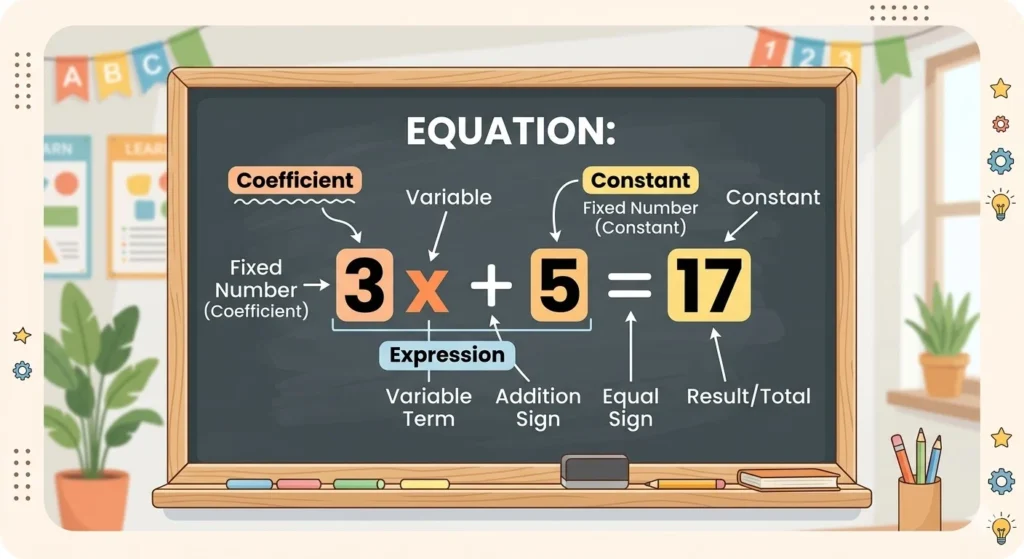

In math, a constant is a fixed value that does not change. Unlike variables, which can take different values, a constant always remains the same within a given problem or equation.
If you have ever looked at a math equation and wondered why some numbers stay the same while others change, you are already thinking about constants. The idea of a constant in math is simple, yet it plays a crucial role in everything from basic arithmetic to advanced algebra and calculus.
Understanding constants helps you read equations more clearly, solve problems faster, and build a strong foundation for higher level math. In this guide, you will learn exactly what a constant means in math, how it is used, and how it compares to variables and coefficients.
What Does Constant Mean in Math?
A constant in math is any number or value that does not change.
In contrast, variables can represent different values depending on the situation. However, a constant remains fixed throughout the problem.
For example:
- In the expression 5 + x, the number 5 is a constant
- In the equation y = 3x + 2, both 3 and 2 are constants
Because constants do not vary, they provide stability and structure in mathematical expressions.
Why Constants Are Important in Math
Constants might seem simple, but they are essential for understanding how math works.
First, they help define equations clearly. Without constants, many formulas would not make sense or produce accurate results.
In addition, constants allow mathematicians to describe real world patterns in a precise way. For instance, fixed values like tax rates, speeds, or measurements are often represented as constants.
As a result, constants appear in nearly every branch of mathematics, from basic arithmetic to advanced calculus.
Types of Constants in Math
Not all constants are used in the same way. Depending on the context, they can appear in different forms.
1. Fixed Numerical Constants
These are simple numbers that never change.
Examples:
- 2
- 10
- 100
For example:
- In x + 7, the number 7 is a constant
2. Constants in Algebraic Expressions
In algebra, constants appear alongside variables.
Examples:
- In 3x + 5, the number 5 is a constant
- In 4a − 9, the number 9 is a constant
Although variables may change, constants stay the same.
3. Mathematical Constants
Some constants are universally known and used across mathematics.
Examples include:
- π which is approximately 3.14159
- e which is approximately 2.718
These values are always the same, no matter the problem.
4. Constant Terms
A constant term is a number in an expression that has no variable attached to it.
Examples:
- In 2x + 6, the number 6 is the constant term
- In x² − 4, the number −4 is the constant term
This type of constant is very common in algebra.
Constant vs Variable
To fully understand constants, it helps to compare them with variables.
Comparison Table
| Constant | Variable |
|---|---|
| Fixed value | Can change |
| Does not depend on conditions | Depends on the situation |
| Example: 5 | Example: x |
| Remains the same | Can vary |
Example
In the equation:
y = 2x + 3
- x is a variable
- 2 and 3 are constants
While x can change, the constants stay fixed.
Constant vs Coefficient
Another term often confused with constants is coefficient.
A coefficient is a number that multiplies a variable.
Comparison Table
| Constant | Coefficient |
|---|---|
| Stands alone | Multiplies a variable |
| Example: 4 | Example: 4 in 4x |
| Does not involve variables | Always attached to a variable |
Example
In 5x + 2:
- 5 is a coefficient
- 2 is a constant
Even though both are numbers, they play different roles.
Examples of Constants in Math
To make things clearer, here are practical examples.
Basic Example
8 + x = 12
- 8 and 12 are constants
Algebra Example
y = 4x + 7
- 4 and 7 are constants
Geometry Example
The value of π is a constant used in formulas for circles.
Real Life Example
If a bus ticket costs 50 units, that price can be treated as a constant in a calculation.
Example Table of Constants in Equations
| Expression | Constant Values |
|---|---|
| x + 5 | 5 |
| 3y − 2 | 3 and 2 |
| y = 7x + 1 | 7 and 1 |
| 2a + 10 | 2 and 10 |
This table shows how constants appear in different expressions.
How Constants Are Used in Different Areas of Math
Constants are used in many areas of mathematics. Their role may vary, but their definition stays the same.
In Arithmetic
Constants are simple fixed numbers used in calculations.
In Algebra
Constants help form equations and expressions.
In Geometry
Constants like π are used in formulas.
In Calculus
Constants appear in derivatives and integrals, often representing fixed values.
Common Mistakes About Constants
Even though constants are straightforward, students often misunderstand them.
Confusing Constants with Variables
A constant does not change, while a variable does.
Incorrect thinking:
x is always a constant
Correct understanding:
x is usually a variable unless defined otherwise
Mixing Up Coefficients and Constants
For example:
In 6x + 3
- 6 is a coefficient
- 3 is a constant
Assuming All Numbers Are Constants
Numbers attached to variables act differently.
For example:
In 5x, the number 5 is not just a constant. It is a coefficient.
Alternate Meanings of Constant
Although this article focuses on math, the word constant has broader meanings.
In everyday language, it means something that stays the same over time.
Examples:
- A constant temperature
- Constant effort
However, in math, the meaning is strictly about fixed numerical values.
Polite and Professional Ways to Explain Constant
If you need to explain this concept clearly, here are some simple alternatives:
- A value that does not change
- A fixed number in an equation
- A stable quantity in a mathematical expression
These explanations are helpful for teaching or presentations.
Frequently Asked Questions
1. What is a constant in math in simple terms?
A constant is a number that always stays the same.
2. Is 5 a constant?
Yes. The number 5 is a constant because it does not change.
3. Can a constant ever change?
No. By definition, a constant does not change within a given problem.
4. What is the difference between a constant and a variable?
A constant stays the same, while a variable can take different values.
5. Is π a constant?
Yes. π is a well known mathematical constant.
6. What is a constant term?
A constant term is a number in an expression without any variable attached.
7. Can constants be negative?
Yes. Constants can be positive or negative numbers.
8. Are coefficients constants?
Coefficients are numbers, but they are specifically attached to variables, so they are not the same as standalone constants.
Conclusion
So, what does constant mean in math? It refers to a fixed value that does not change, no matter how the rest of the equation behaves.
To recap:
- Constants remain the same in any given expression
- They are different from variables, which can change
- They appear in algebra, geometry, calculus, and everyday math
- They help create structure and clarity in equations
By understanding constants, you gain a clearer view of how mathematical expressions work. This knowledge makes solving problems easier and builds a strong foundation for more advanced concepts.
Discover More Post
What Does Volume Mean in Science? Definition, Formula …
What Does PCT Mean in Football? Simple … – DefineHubs.com –
What Does Excluded Mean in PowerSchool – DefineHubs.com –